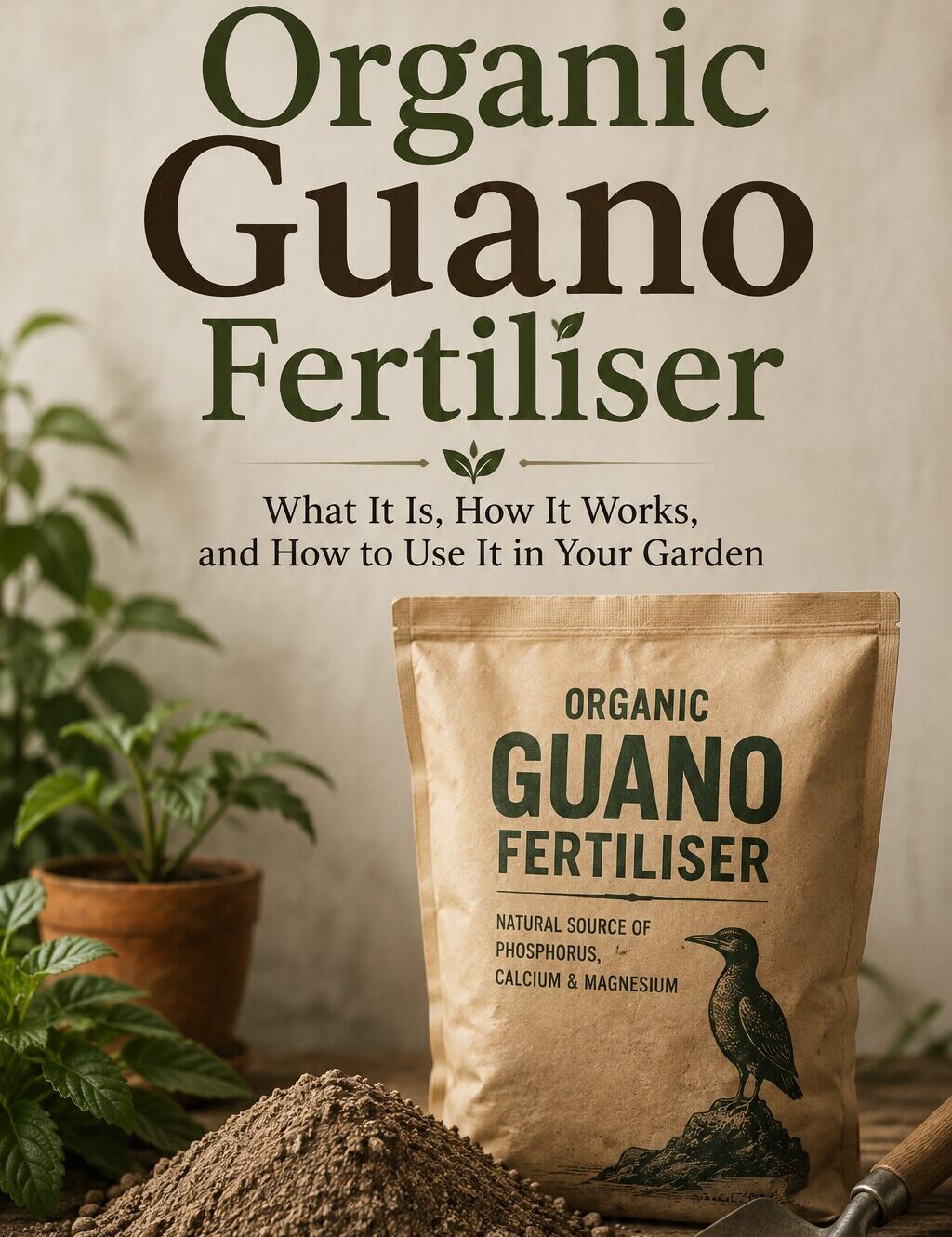

Organic Guano Fertiliser: What It Is, How It Works, and How to Use It in Your Garden
If you’ve ever wondered why gardeners swear by guano, the short answer is chemistry: seabird droppings that have aged for centuries on remote coral islands slowly turn into one of the most reliable natural sources of phosphorus and calcium available to home growers. It’s not glamorous, but it works.
This guide breaks down exactly what organic guano fertiliser is, what’s actually inside the bag, and how to use it correctly so your tomatoes set more fruit, your roses bloom harder, and your soil keeps improving season after season. We’ll cover the simple chemistry behind it (no science degree required), realistic application rates, common mistakes, and how it compares to rock phosphate, bone meal, and other popular options — so you can buy with confidence.
What Is Guano Fertiliser?
Guano is, quite literally, bird droppings — but not the fresh kind you’d find under a nesting colony. Over hundreds or even thousands of years, seabird colonies on remote coral and limestone islands build up thick layers of droppings. Rain, sun, and time react with the underlying rock, and the phosphorus in the guano bonds with calcium from the limestone to form a dense, mineral-rich material.
This is sometimes called fossilised or hard rock guano, and it behaves quite differently to fresh guano. During that long geological process, the nitrogen that fresh droppings contain largely washes away or breaks down, while the phosphorus becomes locked into calcium phosphate minerals — a slow-release form rather than a fast-acting one.
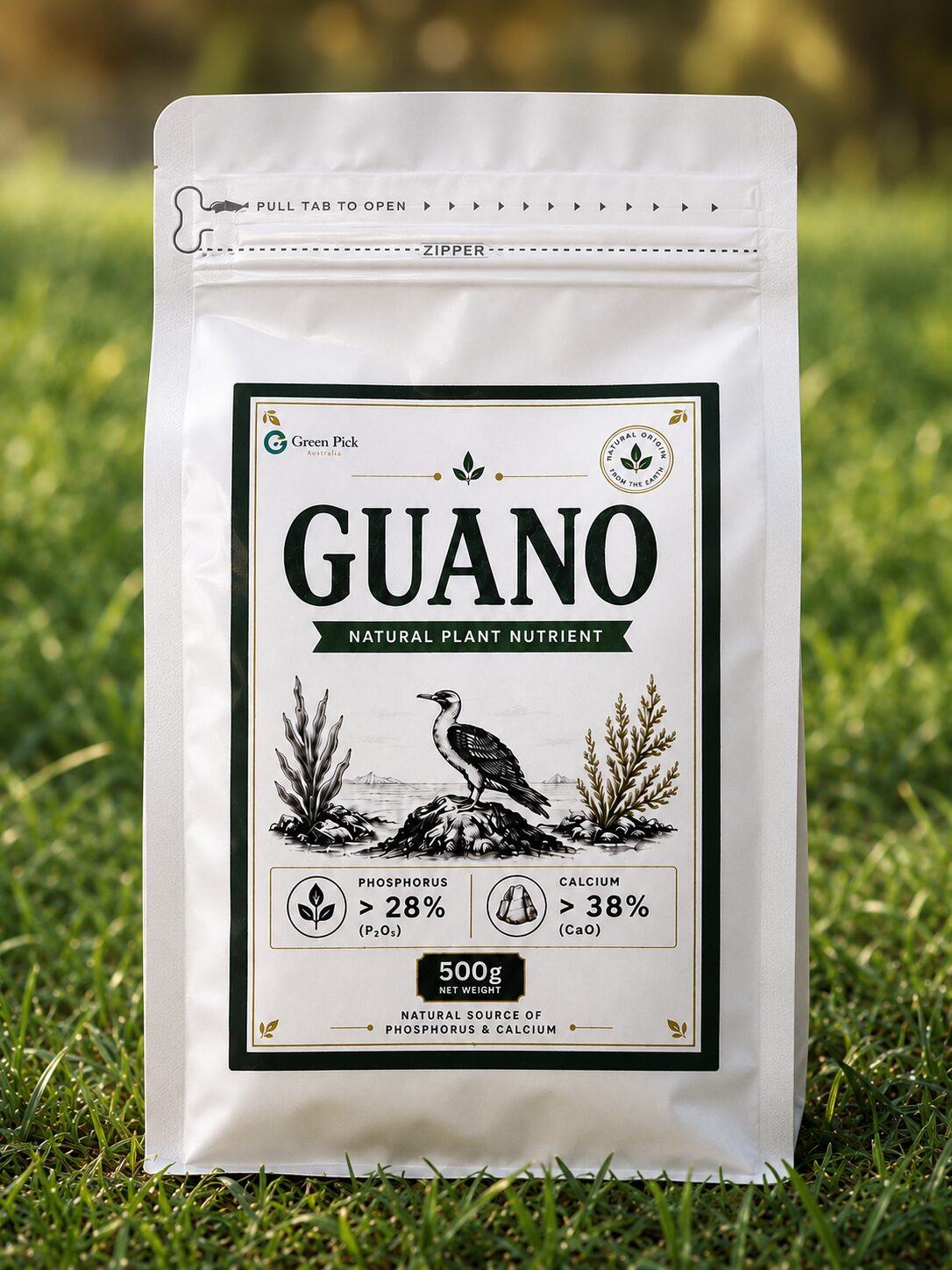
Based on the analysis you’d typically see on a bag like this — 25% Total Phosphorus (P₂O₅), 5% Available Phosphorus (P₂O₅), 30% Calcium (CaO), and 2.5% Magnesium (MgO), with no nitrogen listed — this is a textbook example of fossilised seabird guano rock. It’s a genuine, well-documented category of organic fertiliser, not a marketing spin on plain rock phosphate.
Why Gardeners Use Guano
Guano earns its place in the garden shed for a few practical reasons:
- ●It’s a natural, multi-nutrient input — phosphorus, calcium, and magnesium in one product, rather than three separate bags.
- ●It releases slowly, which means a lower risk of nutrient burn compared with fast-acting synthetic fertilisers.
- ●It builds soil over time rather than just feeding one crop cycle, which suits gardeners who think in seasons rather than weeks.
- ●It fits organic and low-input growing philosophies, since it hasn’t been chemically processed to force solubility.
It’s particularly well suited to home gardeners, veggie patch growers, and greenhouse users working in the 500 g to 5 kg range — enough to properly treat garden beds, pots, and a few fruit trees without buying (or storing) a commercial-scale sack.
Being Organic: What That Actually Means Here
To understand why guano counts as “organic” in a meaningful sense, it helps to compare it with its synthetic cousin: superphosphate. Superphosphate starts life as rock phosphate (which can include guano-derived rock) and is then treated with sulfuric or phosphoric acid to force the phosphorus into a highly soluble form. That acid treatment is what makes it “conventional” rather than organic.
Guano fertiliser, by contrast, is simply mined, dried, and ground — no acid treatment, no synthetic additives. That’s what allows it to be classified and marketed as an organic input in most growing systems.
One honest caveat: organic certification (as opposed to organic origin) varies by supplier and batch. If you’re growing under a certified organic program — for example, to Australian Certified Organic standards — check the specific certification status of the product you’re buying, rather than assuming all guano products are automatically certified.
Key Benefits — And Why They Actually Happen
1. Deeper Roots, Better Flowering and Fruiting (Phosphorus)
Phosphorus is one of the three primary plant nutrients, and it’s central to energy transfer inside the plant (via molecules like ATP) as well as root development, flowering, and seed and fruit formation. A steady phosphorus supply is one of the main reasons gardeners see stronger root systems and better fruit set on crops like tomatoes, capsicums, and pumpkins.
2. Long-Lasting Feed With Low Burn Risk
Because most of the phosphorus in guano is bound in mineral form rather than dissolved, it can’t flood the root zone the way a soluble synthetic fertiliser can. That makes it more forgiving if you apply slightly too much — though, as covered below, “organic” doesn’t mean “unlimited.”
3. Calcium for Cell Strength and Soil Structure
Calcium is a building block of plant cell walls and plays a role in preventing physiological problems like blossom end rot in tomatoes and capsicums. It’s worth being honest here: blossom end rot is usually triggered more by inconsistent watering than by an outright calcium shortage, so guano’s calcium content helps but isn’t a substitute for even watering. Calcium also helps flocculate (bind together) clay particles, gradually improving structure in heavy soils.
4. Magnesium for Greener, More Productive Growth
Magnesium sits at the centre of every chlorophyll molecule, so it’s directly involved in photosynthesis. A modest, steady magnesium supply supports healthy leaf colour and overall plant vigour.
The Simple Chemistry Behind Guano
You don’t need a chemistry degree to understand your fertiliser bag — just three ideas.
Why “P₂O₅” instead of just “phosphorus”? This dates back to early 20th-century fertiliser labelling standards. Nutrient content is expressed as the oxide form (P₂O₅ for phosphorus, CaO for calcium, MgO for magnesium) as a historical convention, even though the nutrient isn’t literally sitting in the bag as that oxide. It’s simply the industry-standard way of measuring and comparing products.
Why is there such a big gap between “Total” and “Available” phosphorus? In fossilised guano, phosphorus is chemically combined with calcium to form apatite-like minerals — essentially a very stable rock. Plants can’t take up phosphorus in that locked form. Soil acids, organic acids from root exudates, and microbial activity gradually break the mineral down and release phosphorus for plants to use. That’s why “Available P₂O₅” (the immediately usable fraction) is so much lower than “Total P₂O₅” (the full reserve) — and why this type of guano is a long-term feed, not a quick fix.
| Nutrient | Typical Content | What It Tells You |
|---|---|---|
| Total Phosphorus (P₂O₅) | 25% | The full phosphorus reserve, most of it slow-release |
| Available Phosphorus (P₂O₅) | 5% | The portion plants can use straight away |
| Calcium (CaO) | 30% | Strong soil-structure and cell-wall benefit; mild liming effect |
| Magnesium (MgO) | 2.5% | Supports chlorophyll and photosynthesis |
| Nitrogen (N) | Not present | This type of guano is not a nitrogen source — pair it with one if needed |
A practical takeaway on pH: reserve phosphorus unlocks faster in slightly acidic soils. If your soil is already alkaline or heavily calcareous, expect the release to be even slower, and be mindful that guano’s own calcium content will nudge pH upward further over repeated applications.
Best Uses and Suitable Plants
This type of guano shines wherever you want to build long-term soil fertility rather than chase a rapid green-up.
| Plant / Use | Why Guano Helps |
|---|---|
| Tomatoes, capsicums, chillies | Phosphorus for fruit set; calcium supports cell strength |
| Root vegetables (carrots, beetroot, potatoes) | Phosphorus encourages strong root development |
| Roses and flowering shrubs | Phosphorus supports bud formation and bloom quality |
| Citrus and fruit trees | Calcium and phosphorus support fruit set and long-term vigour |
| Bulbs (garlic, tulips, daffodils) | Phosphorus aids establishment and root strike |
| New garden beds and raised beds | Builds a long-term phosphorus and calcium reserve before planting |
| Lawn renovation | Supports root strike of new grass seed or turf |
For greenhouse growers using raised beds or large containers, work guano into the growing medium before planting rather than top-dressing established plants — greenhouse crops are watered frequently, so getting it into the root zone early matters more than with open garden soil.
It’s less suited, on its own, to leafy greens or lawns that need a fast nitrogen boost, and it’s not the right choice for strongly acid-loving plants like blueberries, azaleas, and camellias, since its high calcium content will push soil pH in the wrong direction for those species.
How to Apply Guano Correctly
Timing and placement matter more with a slow-release product than with a soluble one.
- ●Apply before planting where possible — autumn or winter incorporation gives reserve phosphorus time to start converting before spring growth begins.
- ●Work it into the soil, ideally the top 10–15 cm, rather than leaving it on the surface. Phosphorus doesn’t move through soil easily, so it needs to be near the root zone.
- ●Water it in after application to help settle it into the soil and begin the breakdown process.
- ●Wear gloves and, if you’re sensitive to dust, a mask when handling the fine powder — standard practice for any mineral soil amendment.
| Use | General Application Rate | Frequency |
|---|---|---|
| Vegetable garden beds (pre-plant) | 100–150 g per m², worked into the top 10–15 cm | Once per bed preparation, before each new planting season |
| Potted plants (20–30 cm pot) | 1–2 level tablespoons mixed into potting mix | Every 3–4 months during active growth |
| Fruit trees and shrubs (establishing) | 20–30 g per planting hole, mixed with backfill soil | At planting, then annually in late winter |
| Lawns (renovation or topdressing) | 50 g per m², spread evenly and watered in | Once or twice yearly, autumn or spring |
| Bulbs | 5–10 g per hole, mixed into the base | At planting |
These figures are general starting points for home garden use rather than a strict prescription — if your product’s packaging lists its own recommended rate, follow that, and when in doubt, start on the lower end.
Common Mistakes to Avoid
- ●Expecting fast results. Because most of the phosphorus is slow-release, guano is a soil-building input, not a quick green-up. Pair it with a fast-acting feed if you need immediate results.
- ●Assuming “organic” means “unlimited.” The 30% calcium content means repeated over-application can gradually push soil pH upward, which in turn can reduce the availability of iron, manganese, and zinc. Stick to recommended rates and retest your soil every couple of years if you use it regularly.
- ●Applying it to already alkaline or naturally calcareous soil and expecting a big yield jump — the phosphorus release will be even slower there, and the calcium is less needed.
- ●Sprinkling it on the surface without working it into the soil or watering it in — this dramatically slows how quickly plants can access it.
- ●Skipping nitrogen for crops that need it. This guano is not a nitrogen source, so leafy greens and heavy feeders like corn will still need a nitrogen input alongside it.
- ●Storing it somewhere damp. Keep the bag sealed and dry to stop the powder clumping.
How Guano Compares to Similar Products
There’s real variation between products that all get lumped under “guano” or “natural phosphorus fertiliser.” Here’s how the main options generally compare.
| Product | Typical Profile | Speed | Organic Origin | Best For |
|---|---|---|---|---|
| Fossilised seabird guano (this product) | 25% total / 5% available P₂O₅, 30% CaO, 2.5% MgO, no N | Slow-release P, moderate-acting Ca | Yes — aged bird droppings on coral/limestone | Long-term phosphorus and calcium building |
| Fresh seabird guano (e.g. Peruvian-type) | Around 10–12% N, several % available P, some K | Fast-acting | Yes — fresh droppings | Quick green-up, seedlings, leafy growth |
| High-phosphorus bat guano | Low N, moderate-to-high available P | Fast-acting P | Yes | Flowering and fruiting boost |
| Soft rock phosphate (mineral, non-guano) | High total P, low available P, variable Ca | Very slow | Mined mineral, not animal-derived | Long-term soil building where a non-animal source is preferred |
| Bone meal | Low N, moderate-to-high available P | Moderate | Yes — animal byproduct | Root and flower development |
| Blood and bone | Moderate N, moderate P | Moderate-to-fast | Yes — animal byproduct | General all-purpose feeding, including nitrogen needs |
The figures above are typical ranges commonly cited in horticultural references — always check the specific label on any product you buy, since values vary by brand and source. If you specifically want an organic, animal-derived product with strong calcium alongside phosphorus, fossilised guano is one of the more concentrated options available at garden scale. If your soil already has plenty of calcium, or you’d prefer a non-animal source, soft rock phosphate may suit you better; if you need nitrogen at the same time, blood and bone is worth pairing alongside guano rather than replacing it.
Frequently Asked Questions
What exactly is guano fertiliser made from?
It’s derived from seabird droppings that have accumulated and aged, often over centuries, on coral or limestone islands. Over time, the phosphorus in the droppings reacts with calcium from the underlying rock to form a mineral-rich, phosphorus- and calcium-dense material.
Is guano fertiliser really organic?
Yes, in terms of origin — it’s a naturally occurring, unprocessed animal-derived material with no synthetic acid treatment involved. If you need formal organic certification for your growing method, check the specific product’s certification status with your supplier.
What’s the difference between guano and rock phosphate?
Rock phosphate is a mined mineral deposit that isn’t necessarily animal-derived, while guano specifically comes from bird (or bat) droppings. Fossilised guano and rock phosphate can behave quite similarly in soil, but guano typically carries far more calcium because of the coral/limestone islands it forms on.
Does this guano contain nitrogen?
No. In fossilised guano, the original nitrogen from the droppings has largely broken down or washed away over the long formation process. If your plants need nitrogen, pair this product with a nitrogen source like blood and bone or a pelletised manure.
How long does it take for guano to work?
Because most of its phosphorus is in a slow-release mineral form, expect gradual improvement over weeks to months rather than an immediate response. This is a soil-building product, best applied ahead of the growing season.
How often should I apply guano to my garden?
For most garden beds, once per planting season (typically before planting) is enough. Potted plants can be topped up every three to four months during active growth, since container growing depletes nutrients faster than open ground.
Can I use guano on potted plants?
Yes. Mix a small amount into the potting mix at planting, or work it lightly into the surface of an established pot and water it in. Because pots have a limited volume of soil, stick closely to recommended rates.
Is guano safe for pets and children?
As with any garden fertiliser, it should be kept out of reach of children and pets, and hands should be washed after handling. It doesn’t contain the synthetic chemicals found in some conventional fertilisers, but that doesn’t mean it’s meant to be eaten or handled carelessly.
Does guano smell bad?
Fossilised, processed guano has typically weathered and dried for so long that it doesn’t carry the strong smell associated with fresh manure or fresh guano. Most gardeners describe it as a mild, earthy, mineral smell rather than an unpleasant odour.
Can you over-apply guano?
You can. While the slow-release nature makes it more forgiving than synthetic fertilisers, repeated over-application can raise soil pH over time due to its high calcium content, which may reduce the availability of iron, manganese, and zinc. Stick to recommended rates and monitor your soil over successive seasons.
What’s the difference between bird guano and bat guano?
Both are droppings-derived fertilisers, but they typically come from different environments and can have quite different nutrient profiles — some bat guanos are nitrogen-rich, others are phosphorus-rich, while fossilised bird guano (like this product) tends to be calcium- and phosphorus-dominant with little to no nitrogen.
Will guano change my soil pH?
Its high calcium content gives it a mild liming effect, meaning it can gradually raise pH in acidic soils. This is generally beneficial for most vegetable and ornamental plants, but it’s worth avoiding heavy or repeated use around acid-loving plants like blueberries or camellias.
Can I mix guano with compost or other fertilisers?
Yes. It works well combined with compost (for organic matter and microbial activity) and with a nitrogen source such as blood and bone if your plants need a stronger nitrogen supply than guano alone provides.
How should I store guano fertiliser?
Keep it in a sealed bag or container in a cool, dry place. As a fine powder, it can absorb moisture and clump if left open in humid conditions, which makes it harder to spread evenly.
The Bottom Line
Organic guano fertiliser isn’t the fastest-acting product on the shelf, and it’s not trying to be. What it offers instead is a genuinely natural, long-lasting source of phosphorus, calcium, and magnesium — the kind of input that rewards gardeners who plan a season or two ahead rather than chase overnight results.
If you’re building new garden beds, feeding fruiting vegetables, establishing fruit trees, or simply want a reliable organic soil amendment without synthetic processing, this is exactly the kind of product worth getting right. We stock it in home-garden-friendly sizes — from 500 g right through to 5 kg — so you can buy what you’ll actually use, rather than a bulk commercial sack that sits half-finished in the shed.
Browse our organic guano fertiliser range today and give your soil the long-term phosphorus and calcium reserve it’s been missing.