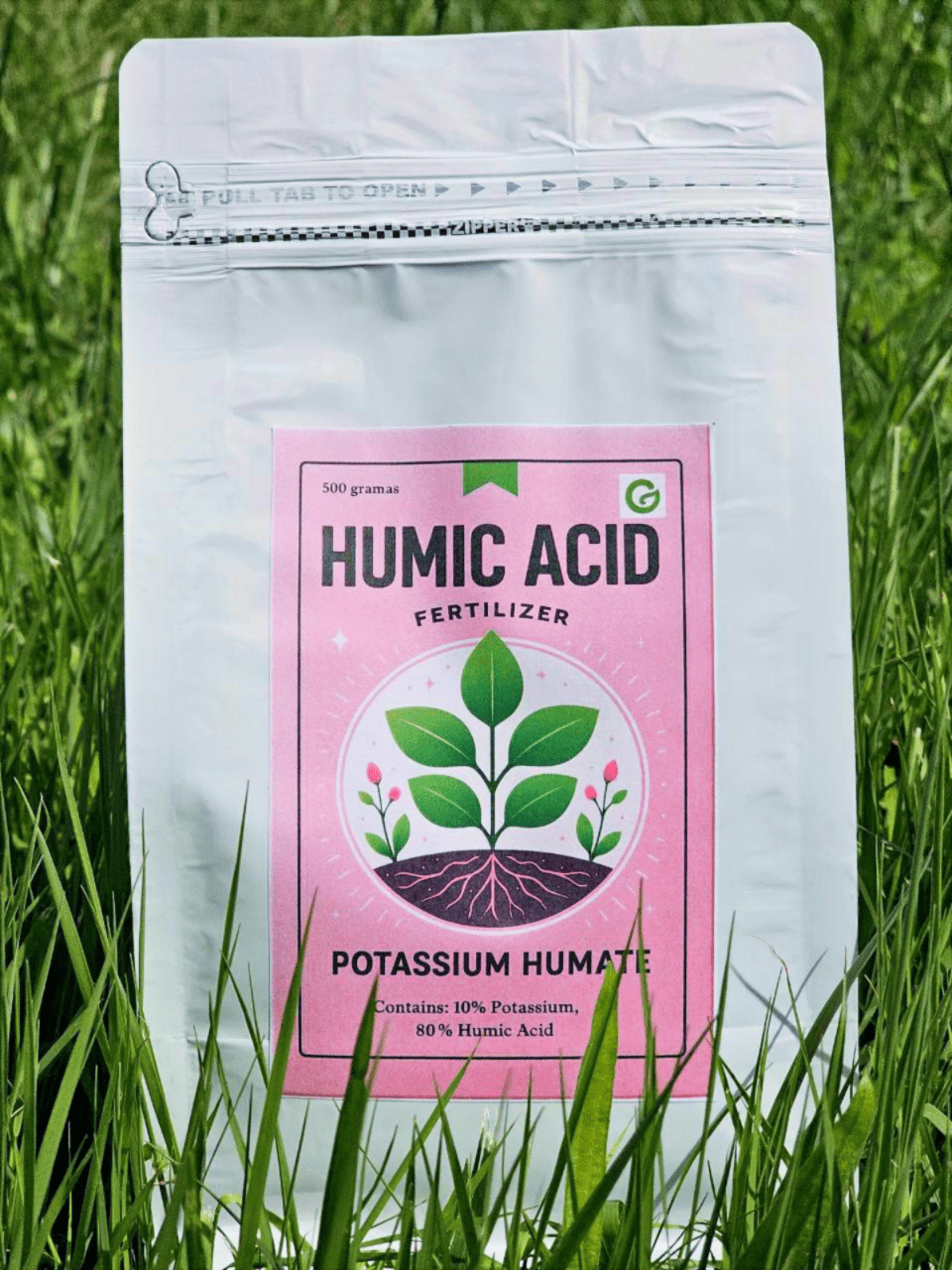

Open a bag of potassium humate and it looks like something you’d sweep out of a fireplace: black, glossy flakes or a fine dark powder. Stir a spoonful into water and it turns the colour of strong coffee.
It’s one of the most talked-about soil products around, and one of the most misunderstood. Some sellers make it sound like a cure-all. Others print purity figures that seem too good to be true, and sometimes are.
So here’s the science in plain English: what humic acid actually is, how potassium humate differs, what the research says it can and can’t do, and why the humic acid percentage on the label matters more than the size of the bag.
Before you read on: myth or fact?
Five things you’ll hear about humic products. Tap an answer to see what the evidence says.
Potassium humate and humic acid are different things.
Answer: Mostly a myth. Potassium humate is humic acid in its potassium salt form, which is what lets it dissolve in water. Read why
Potassium humate is a potassium fertilizer.
Answer: It’s a myth. The potassium is a bonus. Sulphate of potash carries about five times as much per kilo. Read why
The more humic acid you apply, the better plants grow.
Answer: It’s a myth. In the biggest review of the trials, low rates of brown-coal humic products often did best, and very high rates sometimes held plants back. Read why
A label that says 95% potassium humate means 95% humic acid.
Answer: It’s a myth. That figure includes the potassium, and the test method changes the humic acid figure too. Read why
Humic products help most when plants are stressed.
Answer: It’s a fact. Growth gains in the review were biggest under stress, such as poor or salty soil. Read why
What Is Humic Acid?
When leaves, roots and manure break down in soil, most of that material is eaten by soil life and lost as carbon dioxide. What lingers is a dark, stable fraction that soil scientists call humic substances. They’re a big part of why rich soil looks black and holds water and nutrients so well.
Chemists sort humic substances into three groups by how they behave in water:
- Humic acid dissolves in neutral and alkaline water, but drops out when the water turns strongly acidic, below about pH 2.
- Fulvic acid dissolves at any pH.
- Humin doesn’t dissolve at all.
The humic acid sold for gardens and farms mostly doesn’t come from compost or soil. It comes from leonardite, a soft brown coal that oxidised slowly in the ground over a very long time.
The Chemistry, in Plain English
Humic acid isn’t one molecule. It’s a mixture of thousands of different organic compounds, which is one reason scientists still argue about exactly what it looks like in the soil itself.
What those compounds share are acidic groups, mainly carboxyl and phenolic groups. These let humic acid latch onto nutrients such as calcium, magnesium and iron. Some of the bonds are strong enough to count as chelation, the same trick an iron chelate uses to keep iron available to roots. That grip is a big part of why humic substances provide 50 to 90% of the cation exchange capacity in soils, which is soil’s ability to hold positively charged nutrients where roots can reach them.
The same grip explains a quirk you’ll meet in the shed: humic acid and calcium don’t mix well in a tank. More on that below.
What Is Potassium Humate?
 Raw humic material barely dissolves in water. Treat it with an alkali, usually potassium hydroxide, and the humic acid becomes a potassium salt that dissolves readily. That salt is potassium humate. Most soluble humic acid powders sold for plants, our own included, are potassium humate.
So the two aren’t rivals. Potassium humate is humic acid in a form you can mix in a watering can, run through drippers or spray. Its solution is alkaline, around pH 9 to 11.
| Feature | Raw humic acid | Potassium humate |
|---|---|---|
| What it is | The humic part of organic matter, in its acid form | Humic acid reacted with potassium |
| In water | Dissolves poorly | Dissolves readily |
| Potassium | None | Around 10%, usually stated as K₂O |
| Typical use | Spread or dug into soil, often as granules | Watered on, run through drippers or sprayed |
Is Potassium Humate a Fertiliser?
Not really, despite the potassium. Most potassium humate carries around 10% potassium, usually stated as K₂O. That sounds handy, but humate goes on at small doses, so the potassium it adds is minor. Sulphate of potash carries about five times as much per kilo, and MKP about three and a half times.
It’s better thought of as a soil conditioner or biostimulant: something that helps plants use the fertiliser you give them, rather than a feed in its own right.
What the Research Says
Humic products are easy to oversell, so it’s worth knowing what the trials show. Scientists at Monash University in Victoria pooled the published experiments in a review in Advances in Agronomy. Across all sources of humic material, plants grew about 20% more shoot and root on average. The results were patchy, though: in about half the shoot studies, the gain was 5% or less.
The source mattered most. Humic products from brown coal, the raw material for most potassium humate, averaged about 12% more shoot growth. Compost-based humic material did better, and peat-based material barely registered.
Three patterns stood out:
- Stressed plants gained most. Shoot gains averaged 28% under high stress, against 18% without it.
- Low rates often did best. Brown-coal products peaked at low doses, and very high rates of some humic materials held plants back.
- Woody plants responded least. Trees and vines showed no reliable gain, and sometimes the opposite, so the authors advise against high rates on them.
The authors also suggest that, at low rates, humic products may help plants recover more of the fertiliser you apply, even when growth doesn’t change, and that salty soils look like a promising use. Just as important, the doses sold for gardens are tiny next to the humus already in soil, so potassium humate won’t rebuild soil structure on its own. Compost and mulch still do that job.
Why the Humic Acid % Matters
This is where purity earns its place. What you’re paying for is the humic acid, not the bag, so a product with more humic acid per kilo needs less product per dose. Two bags at the same price can hold very different amounts. Two things trip people up on labels:
- Humate % isn’t humic acid %. A potassium humate figure includes the potassium, so the humic acid share is lower. Ours, for example, is about 95% potassium humate and 80%+ humic acid. Check which figure a label is quoting before you compare.
- The test method changes the number. One supplier’s data sheet lists its potassium humate at 99% humic acid by a colorimetric test, and 60 to 70% by other methods. Older methods overestimate humic acid, so the international standard, ISO 19822, uses a stricter test.
When you compare products, ours included, check that both figures come from the same test.
What does a kilo of humic acid really cost?
Enter the price, pack size and humic acid % from two labels to see which gives you more humic acid for your money.
Bag B costs 33% more per kilo of humic acid than Bag A.
The starting figures are an example: two 1 kg bags at the same price. Only compare humic acid figures measured by the same test method.
Where It’s Worth Using
Going by the research, potassium humate earns its place in a few situations:
- Poor, sandy or tired soil with little organic matter, where plants are under stress.
- Salty soil or water, where humic substances may help buffer the excess salts.
- Alongside a fertiliser program, at low rates, to help plants make better use of what you apply.
- Potting mix and drip systems, where its solubility makes it easy to apply evenly.
On established fruit trees and vines, stay at the low end of the rates. For doses by plant and setup, see our humic acid guide, or plan a full program with our Smart Fertigation Planner.

A Few Things to Watch
Calcium and acid. Remember that grip on calcium? Mixed with calcium, potassium humate can curdle into clumps. Don’t combine it with calcium nitrate or other calcium fertilisers in the same tank, keep it out of mixes at pH 4 or below, and add the humate to the water before anything else. A quick jar test beats a blocked dripper.
Paving. Humates can stain tiles and pavers, so rinse off any splashes straight away.
Organic certification. It comes from natural humic deposits, but certification rules differ, so check with your certifier before using it on certified organic crops.
Pay for Humic Acid, Not the Bag
Potassium humate isn’t magic, and it isn’t a fertiliser. It’s humic acid in a form you can actually dissolve. Used at low rates alongside good feeding, it can help plants make more of what you give them, especially in poor or stressed soil. When you buy it, judge it by the humic acid you get per dollar, measured the same way.
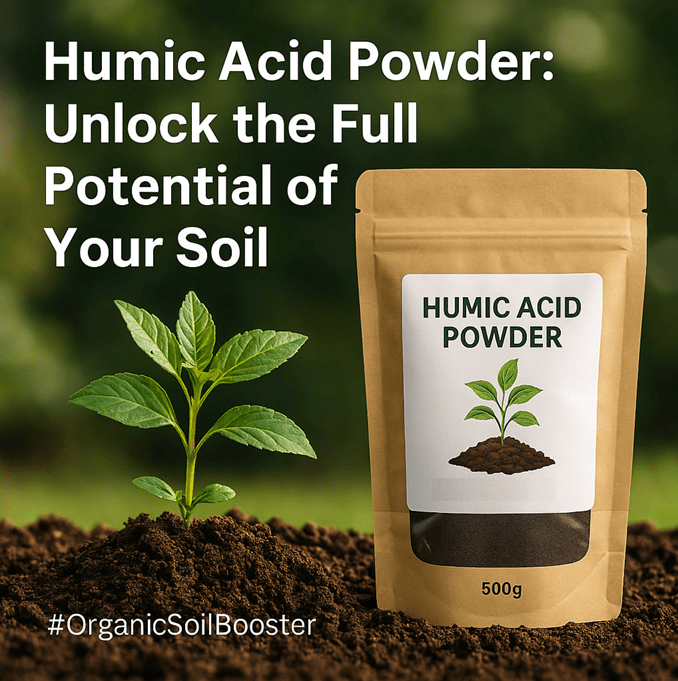
Our Humic Acid powder is potassium humate with 80%+ humic acid and about 10% potassium, in 500 g and 5 kg packs. You’ll find the rates in our humic acid guide.
Sources and further reading
- Rose M. T. and others, Monash University (2014). A meta-analysis and review of plant-growth response to humic substances: practical implications for agriculture. Advances in Agronomy 124 (PDF).
- Lamar R. T. and others (2014). A new standardized method for quantification of humic and fulvic acids in humic ores and commercial products. Journal of AOAC International 97(3) (PDF).
- Humintech (2018). ISO report: ISO 19822 for humic and fulvic acids (PDF).
- Humi[K] WSG. Technical data sheet, humic acid content by test method (PDF).
- Humintech. PowHumus WSG 85 product sheet (PDF).
- Humic Acid 10%. Product label: compatibility and mixing order (PDF).
- Wikipedia. Humic substance.