
Why Are My Citrus Leaves Turning Yellow? 7 Causes & How to Fix Them
If your lemon, orange or mandarin tree has citrus leaves turning yellow, you’re not alone — it’s one of the most common problems Australian home gardeners face. Yellowing citrus leaves usually comes down to one of seven causes, and treating the wrong one wastes a season of growth. This guide walks through all seven, how to recognise iron deficiency specifically, and when iron chelate genuinely helps fix it.
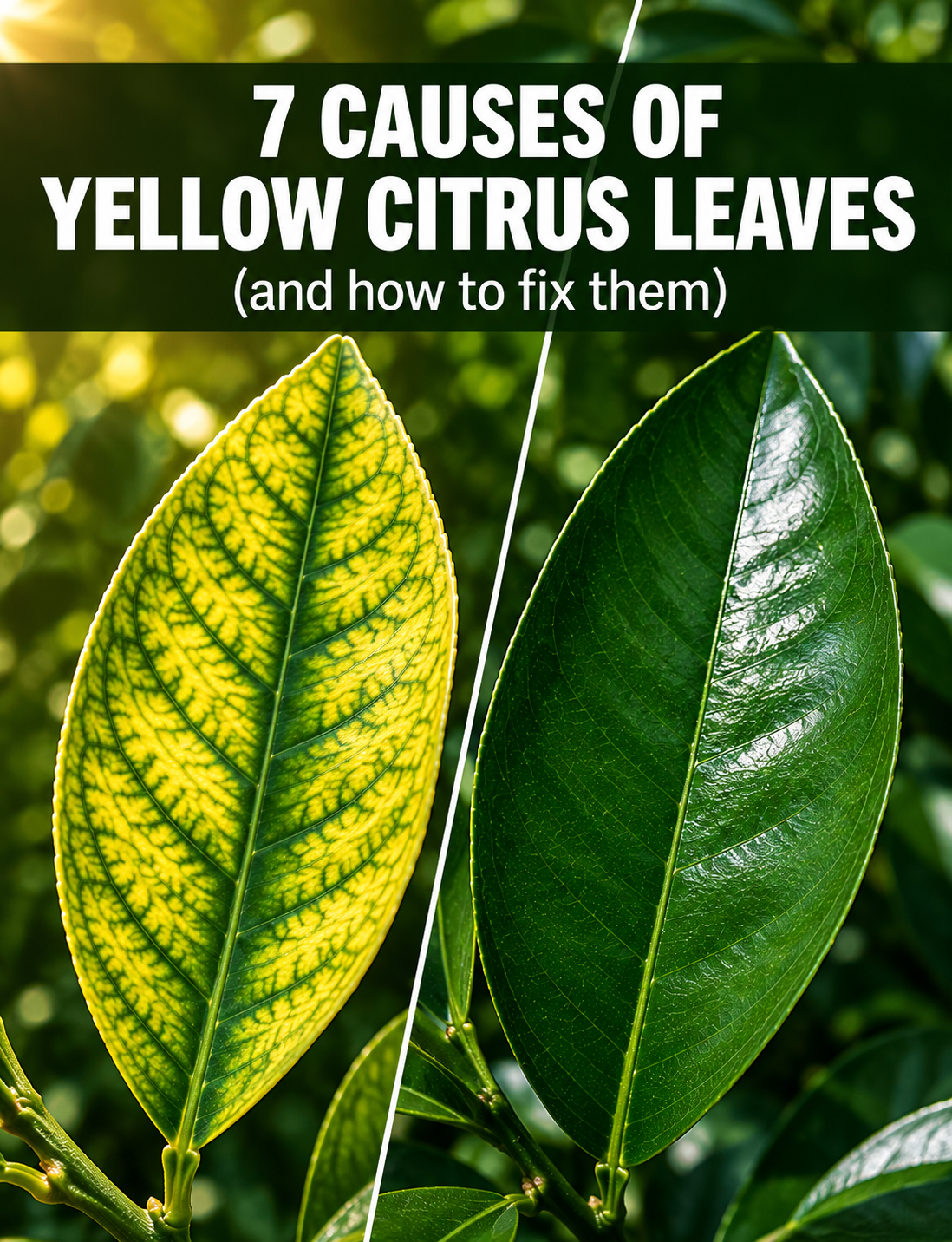
Quick answer: Yellow citrus leaves can be caused by nutrient deficiencies (iron, nitrogen, magnesium), over/underwatering, poor drainage, root damage, unsuitable soil pH, pests or disease, or old leaves dying off naturally. Iron deficiency typically shows as yellowing between the leaf veins while the veins stay green (interveinal chlorosis), most noticeable on new growth — check the pattern below before assuming iron chelate is the fix.
Jump to:
- Why are my citrus leaves turning yellow?
- How to recognise iron deficiency
- Other causes of yellow citrus leaves
- Can iron chelate fix yellow citrus leaves?
- How to apply iron chelate to citrus
- How quickly will citrus leaves turn green?
- Preventing yellow leaves
- Frequently Asked Questions
- Shop GreenPick Iron Chelate
Why are my citrus leaves turning yellow?
Citrus leaf chlorosis (the technical term for yellowing) comes down to seven common causes, and where the yellowing sits is usually your best clue:
- Iron deficiency — interveinal yellowing on new growth, veins stay green
- Nitrogen deficiency — older, lower leaves turn pale yellow all over first
- Magnesium deficiency — yellowing at leaf tips and margins, often on older leaves in autumn
- Watering issues — overwatering brings soggy soil and leaf drop; underwatering brings dull, curling or crisp leaves, especially in pots over summer
- Root damage — from deep planting or collar rot; yellowing that doesn’t respond to feeding
- Unsuitable soil pH — very alkaline or acidic soil locks up nutrients already in the ground
- Pests or disease — leafminer, scale or fungal issues can cause blotchy, uneven yellowing
One more thing worth knowing: citrus also sheds some older leaves naturally each year, so a few scattered yellow leaves low in the canopy aren’t always a sign of a problem to fix.
New growth versus old growth, and whether the veins stay green, matter more than the colour alone when narrowing things down.
How to recognise iron deficiency in citrus
Iron deficiency in citrus is sometimes called lime-induced chlorosis: it’s most common in alkaline or calcareous soils, where high pH ties up iron and makes it unavailable even when plenty is physically present. This is a genuinely Australian problem — large parts of inland NSW, South Australia and Victoria have naturally alkaline, lime-rich soils, and citrus grown there is prone to ongoing iron chlorosis.
The classic sign is interveinal chlorosis: leaf tissue turns yellow (or almost white in severe cases) while veins stay noticeably darker green, creating a net-like pattern, first on new leaves and young shoots. Lemons tend to display iron deficiency more readily than oranges or grapefruit.
Garden tip: A soil pH test kit is one of the cheapest ways to stop guessing. Above pH 7.5, iron deficiency is likely to be an ongoing issue rather than a one-off fix.
Quick checklist — does this look like iron deficiency?
- ☐ Yellowing is mainly on new leaves, not old ones
- ☐ Veins stay green while tissue between them is yellow
- ☐ Soil is alkaline or chalky, or lime has been applied nearby
- ☐ No obvious pest damage or sooty mould
If most apply, iron deficiency is a reasonable working diagnosis; if not, check the causes below first. Use this comparison as a starting point, not a definitive diagnosis:
| Symptom | Possible cause |
|---|---|
| Young leaves yellow between green veins | Iron deficiency |
| Older leaves yellow first, all over | Nitrogen deficiency |
| Yellowing at leaf tips and margins | Magnesium deficiency may be involved |
| Whole plant looks pale or washed out | Multiple possible causes |
| Yellow leaves plus waterlogged soil | Root or drainage problem |
| Yellow, curling leaves with visible tunnels | Citrus leafminer |
Other causes of yellow citrus leaves
Iron isn’t the only thing that turns citrus leaves yellow, and it’s worth ruling these out before committing to an iron program.
Nitrogen deficiency
Nitrogen deficiency usually affects older, lower leaves first, turning the whole leaf a pale, washed-out yellow rather than the two-tone pattern typical of iron deficiency. It’s common in unfed citrus, or sandy soils where nitrogen leaches away.
Magnesium deficiency
Magnesium deficiency shows as yellowing at the tips and margins of older leaves, particularly in autumn on heavily fruiting trees, since fruit draws magnesium away from the leaves. Epsom salts (magnesium sulphate), such as GreenPick’s Magnesium Sulphate, is the standard fix.
Watering and drainage problems
Both overwatering and underwatering cause yellow leaves. Waterlogged soil suffocates roots and often brings leaf drop too, while underwatered potted trees develop crisp, curling leaves in hot summers. Check pots drain freely and beds don’t pool water.
Root damage, extreme soil pH, pests and disease
Collar rot, deep planting or root disturbance can produce yellowing that won’t respond to fertiliser until fixed. Very acidic or alkaline soil can lock up several nutrients at once, and pests like leafminer or scale can also cause yellowing that looks nutrient-related.
Can iron chelate fix yellow citrus leaves?
If the pattern above points to iron deficiency, iron chelate is genuinely useful — but the type matters more than most people expect. Ordinary iron fertilisers, and even some entry-level chelates, can still become unavailable in alkaline soil, exactly the soil type where citrus most often develops iron chlorosis.
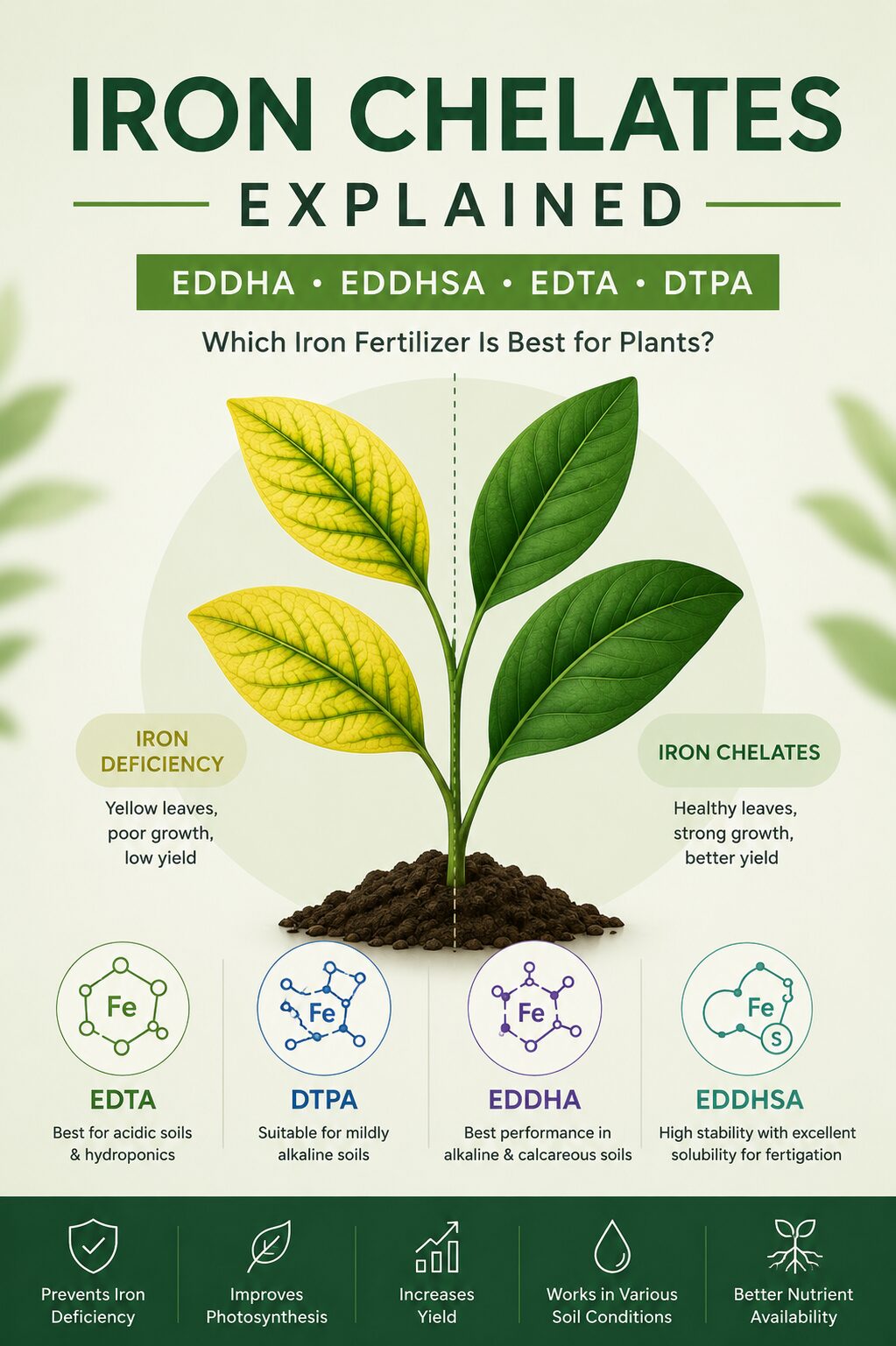
Chelation works by binding the iron ion to an organic molecule that stops it reacting with calcium and carbonates in the soil, keeping it in a form roots can take up. Different chelating agents (EDTA, DTPA, EDDHA, EDDHSA) perform differently depending on soil pH — broadly, EDDHA and EDDHSA-type chelates hold up better in alkaline soils common across inland Australia, while EDTA loses effectiveness as pH rises. See GreenPick’s breakdown of how EDDHA and EDDHSA compare for the full detail.
GreenPick’s Iron Chelate (6% EDDHSA) is formulated for this scenario: a water-soluble chelate designed to optimise iron availability in the alkaline, calcareous soils common where citrus grows across Australia. If your tree shows the new-growth interveinal yellowing described above, it’s a straightforward way to supply soluble iron to the root zone — though it corrects an iron shortfall, not every cause of yellow leaves. If watering, drainage or pests are the real problem, adding iron won’t help.
How to apply iron chelate to citrus trees
GreenPick’s own Iron Chelate usage guide sets rates by planting situation, not species — here’s how those map onto citrus. Always check the current label for exact figures.
Potted citrus
Treat potted citrus (dwarf lemons, cumquats, container mandarins) as a small garden or potted plant: dissolve roughly 15–20 grams in 10 litres of water and apply as a soil drench around the trunk base, not piled against the very centre of the root ball, then water in well. Avoid splashing on leaves. Reapply every 2–3 weeks if yellowing persists.
Young in-ground citrus trees
For a young tree still establishing, start with the same small-garden rate, watering thoroughly across the root zone rather than against the trunk, and watch the next flush of growth before repeating.
Established citrus trees
For a mature tree, GreenPick’s orchard guidance scales the rate to size: a starting point is around 50 grams dissolved in 20 litres of water, poured evenly around the root zone at the drip line (roughly under the outer canopy edge), then watered in thoroughly. Larger or multiple trees may need more — GreenPick’s full guide scales orchard dosing to trunk diameter, so check it directly for a large backyard citrus.
General application notes
- Apply to the soil at the root zone, not as a foliar spray, unless the label says otherwise, and water in thoroughly afterwards
- Apply during early morning or late evening, not the heat of the day, and wear gloves when handling the powder
How quickly will citrus leaves turn green after iron chelate?
There’s no single timeline, and it’s worth being wary of anyone promising instant results. Recovery speed depends on deficiency severity, overall tree health, soil pH and moisture, root condition, and temperature at application.
In mild cases, new growth may improve within a couple of weeks, though this varies. Leaves already badly yellowed usually won’t return to deep green — a tree’s energy goes into new growth rather than repairing old leaves, so watch new growth, not the existing yellow leaves. If you’re applying heading into a cooler winter, don’t expect much change until the tree grows again in spring.
What if the leaves don’t improve?
If there’s no improvement after a few weeks, reconsider the diagnosis rather than reapplying more product. Revisit the other causes above — nitrogen or magnesium deficiency, drainage, root problems, soil pH, pests, disease, or watering are all common reasons a tree stays yellow despite iron treatment. A local nursery or your state department of agriculture can help with soil testing.
How to prevent yellow leaves on citrus trees
A bit of routine care heads off most of the problems above before they start.
- Water consistently — deep, regular watering rather than little and often, letting the top few centimetres of soil dry between waterings
- Improve drainage — raised beds or mounding help in heavy clay soils; potted citrus needs free-draining mix and pots with real drainage holes
- Mulch — organic mulch keeps roots cooler and moisture more even, kept clear of the trunk
- Feed through the growing season — citrus are heavy feeders; a balanced fertiliser such as NPK 20-20-20 through spring and summer supports steady growth, with micronutrients like iron chelate used where a deficiency shows up
- Avoid over-fertilising — follow label rates and ease off feeding heading into winter
- Check soil pH occasionally — especially if lime has been applied to nearby garden beds or lawn
- Watch new growth — catching pale new leaves early is far easier than waiting for the whole canopy to yellow
For matching fertiliser to your specific citrus problem, GreenPick’s guide to choosing the right fertiliser is a useful next read.
Frequently Asked Questions
Why are my citrus leaves turning yellow but not falling off?
This usually points to a nutrient deficiency (iron, nitrogen or magnesium) rather than a watering or root problem, since drainage and root issues tend to bring leaf drop too. Check the vein pattern against the table above.
What does iron deficiency look like on citrus leaves?
Interveinal chlorosis: yellow tissue with noticeably green veins, mostly on new growth. In severe cases the whole leaf can turn pale or almost white.
Can I use iron chelate on potted citrus?
Yes. Use the small-garden or potted-plant rate on the label, apply as a soil drench, and water in well. Avoid overdosing, since pots have less soil to buffer excess fertiliser.
Why do my citrus leaves have yellow leaves with green veins?
This is interveinal chlorosis, most often from iron deficiency in alkaline or lime-rich soil. Magnesium deficiency looks similar but usually starts at the leaf tips and margins instead.
How often should I apply iron chelate to citrus?
It depends on deficiency severity and soil conditions — as a general guide, every 2–3 weeks while symptoms persist, tapering off once new growth comes through green. Check the label for exact frequency.
Shop GreenPick Iron Chelate
If your citrus shows genuine signs of iron deficiency — new growth with green veins and yellow tissue in between, particularly in alkaline soil — GreenPick’s Iron Chelate (6% EDDHSA) is a straightforward way to get soluble iron to the roots. It won’t fix every case of yellow leaves, but for a genuine iron shortfall it’s a practical option for Australian soils.
For exact rates and safety notes, check the full Iron Chelate usage instructions before mixing your first batch.