
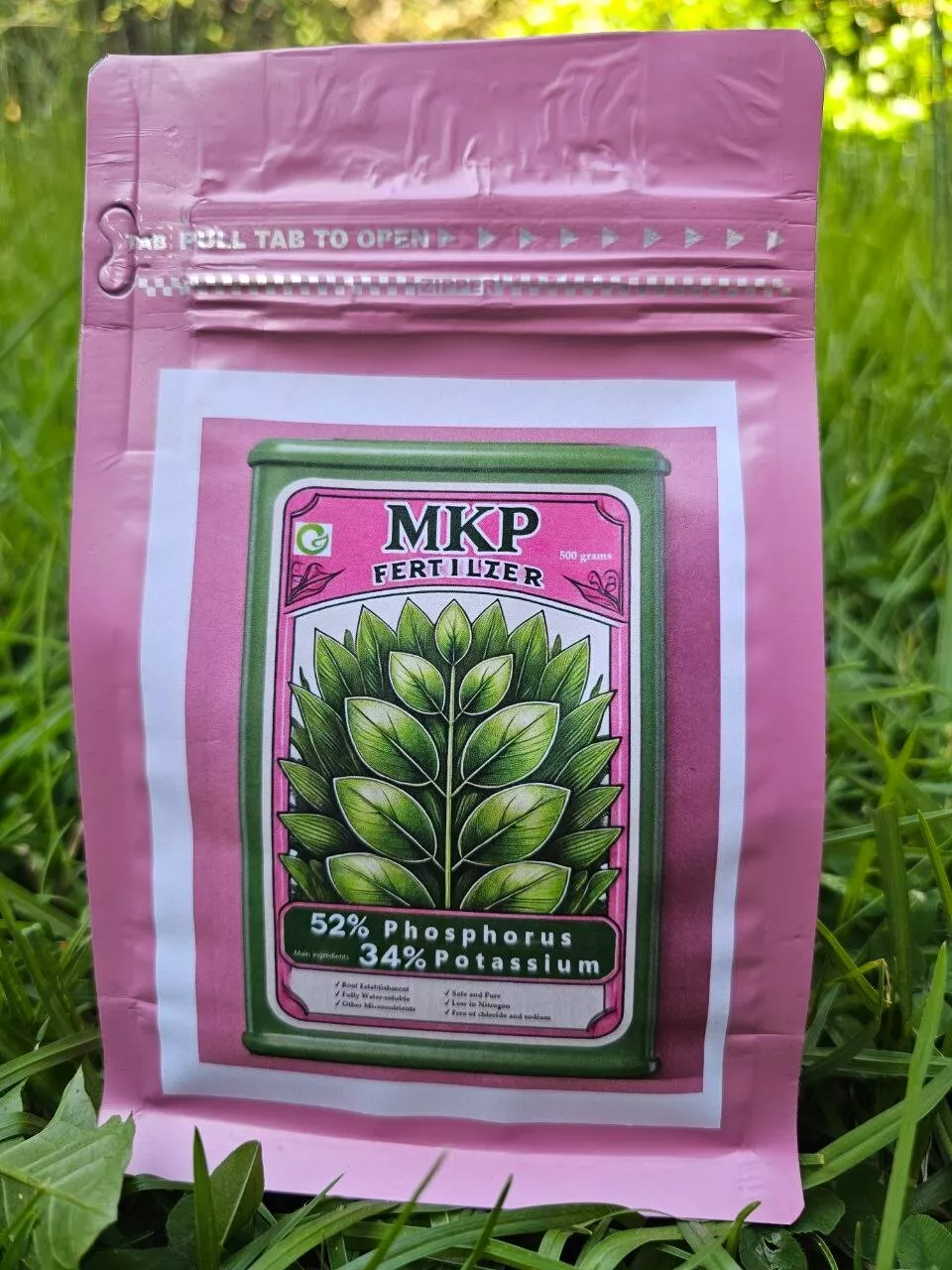

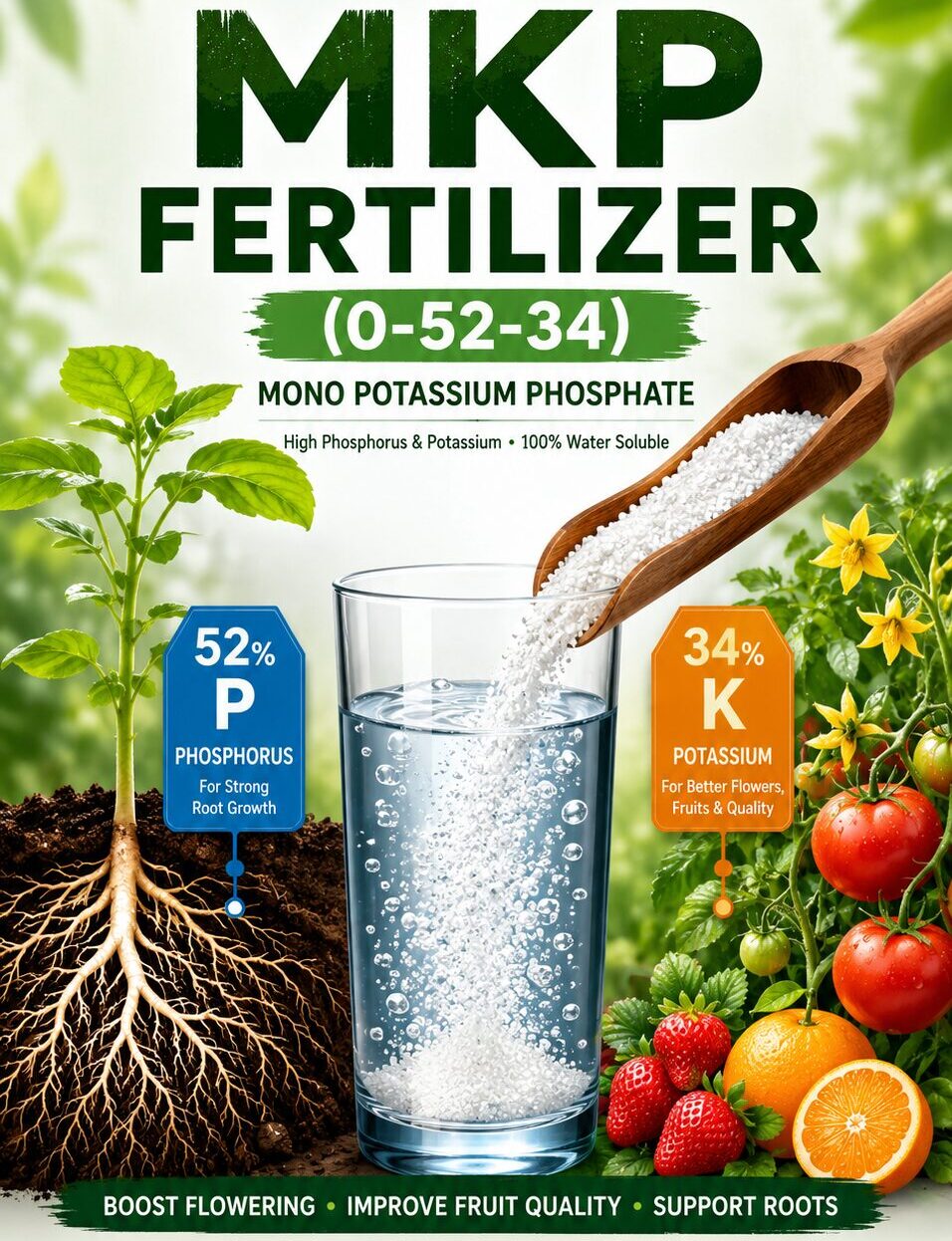
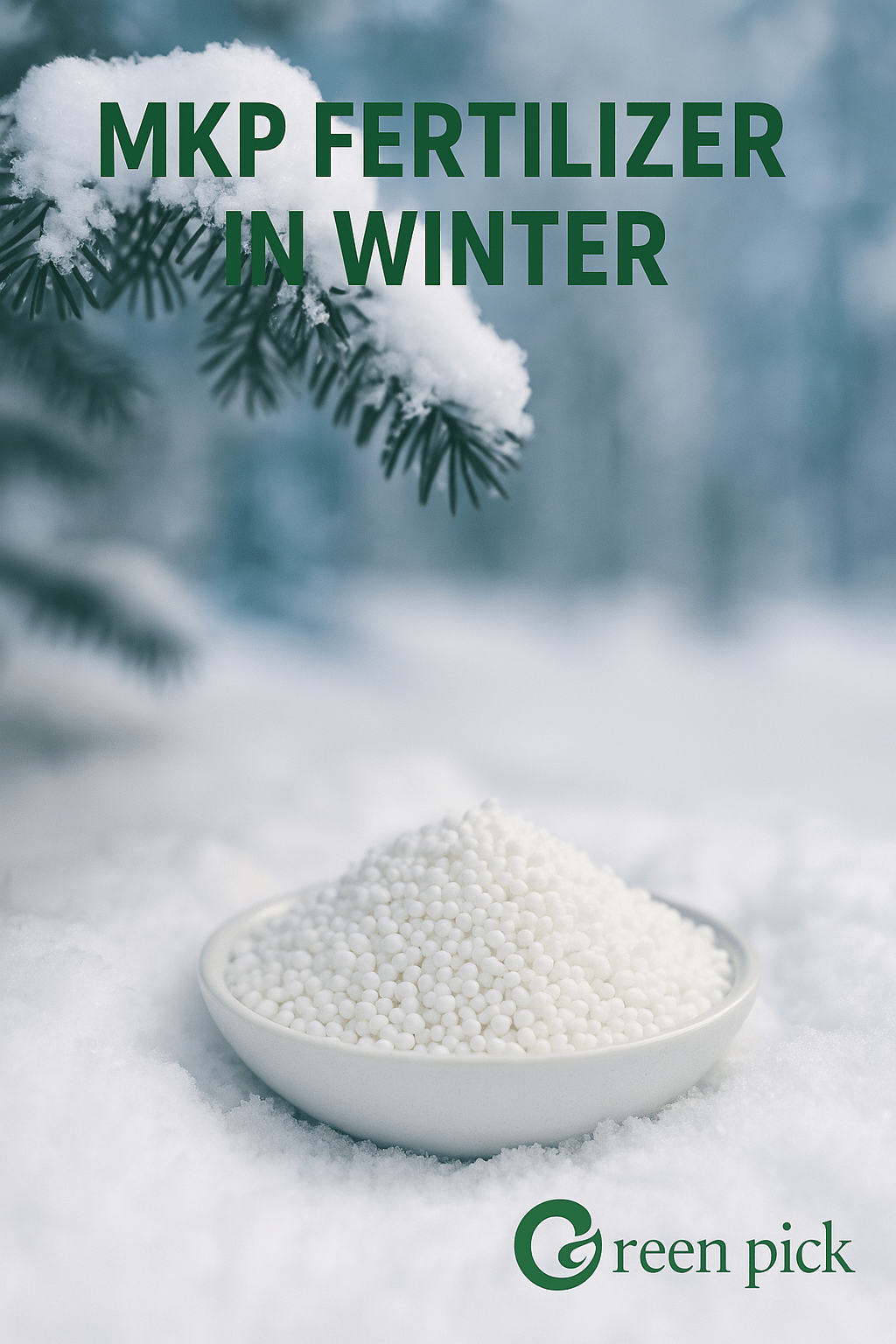
MKP (mono potassium phosphate) is a fully water-soluble fertiliser with an analysis of 0-52-34: no nitrogen, 52% phosphate and 34% potash. Growers use it at flowering and fruiting, when plants need phosphorus and potassium but not more leafy growth.
52% Phosphate (P₂O₅)34% Potash (K₂O)Nitrogen-Free100% Water-Soluble
Our MKP fertiliser comes as fine white crystals that dissolve completely, so plants can start using it from the first watering. It suits a pot of chillies on the balcony just as well as an orchard on drip irrigation. This guide covers what the numbers on the bag mean, how much to use and when, and which fertiliser it should never share a mixing tank with.
Shop Now See the Dosage Guide ↓
What Is Mono Potassium Phosphate?
Mono potassium phosphate (also written monopotassium phosphate, or KH₂PO₄ if you remember high-school chemistry) is a simple salt made from potassium and phosphoric acid. Good grades are almost pure nutrient, with no chloride and no sodium, which is why it’s a staple in drip systems and hydroponics.
The numbers on the bag are its N-P-K analysis. 0-52-34 means 0% nitrogen, 52% phosphate (P₂O₅) and 34% potash (K₂O). Most countries label fertiliser this way, using oxides rather than the elements themselves, so the actual amounts of phosphorus and potassium are lower:
| Nutrient | On the bag (oxide form) | Actual element |
|---|---|---|
| Nitrogen (N) | 0% | 0% |
| Phosphorus (P) | 52% as P₂O₅ | 22.7% |
| Potassium (K) | 34% as K₂O | 28.2% |
That difference catches people out when they compare products. Australian labels usually show the elements, so a local MKP may be listed as P 22.7% and K 28.2%. It looks weaker than a bag marked 0-52-34, but it’s the same thing. Check which form a label uses before you compare prices per kilo.
The zero matters too. Nitrogen drives leaves and shoots. Once a tomato, lemon or rose starts setting flowers, extra nitrogen tends to push more leaf at the expense of flowers and fruit. MKP gives plants the phosphorus and potassium they need at that stage without the push.
What MKP Does For Your Plants
🌱 Stronger Roots, Faster Establishment
Phosphorus drives early root growth. A feed after transplanting helps new roots spread into the soil, so seedlings and young trees settle in sooner.
🌸 Bigger Blooms, Better Fruit
Potassium moves sugars into flowers and fruit. That’s why growers use MKP from fruit set onwards for better size, colour and sweetness in tomatoes, citrus, strawberries and grapes.
💧 Nutrients Ready From the First Watering
MKP dissolves completely at garden rates, even in cold tap water. There’s nothing sitting on the soil waiting for rain to break it down.
🛡️ More Resilient Through Heat and Stress
Potassium controls the tiny pores that let water out of leaves. Plants with enough of it control water loss more tightly and handle heat and dry spells better, which counts for a lot in an Australian summer. If you’re expecting a hot one, here’s how to prepare your garden for El Niño.
How to Use MKP Fertiliser
There are two good times to use MKP. The first is right after transplanting, while new roots establish. The second runs from the first flower buds through to fruit fill. It’s the wrong choice for lawns and leafy greens, which mostly want nitrogen. It won’t fix yellow leaves with green veins either. That’s usually iron or magnesium, and our guide to yellow leaves with green veins shows how to tell which.
⚠️ Note: Apply these rates to moist soil and in the cool of the day. More fertiliser is NOT always better. Use half strength for seedlings, for salt-sensitive plants like strawberries and avocados, and during heatwaves.
| Use | Preparation | Application | Frequency |
|---|---|---|---|
| Pots & containers | Dissolve 5 grams in 1 litre of water | Water onto moist potting mix; use half strength for seedlings | Every 2 weeks |
| Vegetable gardens & flower beds | Dissolve 20 grams in a 9 litre watering can | Water evenly over about 4 m² of moist bed (5 g per m²) | Every 2–3 weeks |
| Farms & orchards: foliar spray | Dissolve 1 kg in 100 litres of water (1%); up to 2 kg for citrus, bananas and olives | Spray the leaves in the cool of early morning or evening | 2–4 sprays from fruit set to colouring |
| Farms & orchards: fertigation | Make a stock solution of 10–15 kg per 100 litres | 150–300 kg per hectare over the season for fruiting crops and citrus, through drip or sprinklers | Split across irrigations, from transplanting or flowering to fruit fill |
Farm rates are seasonal totals from Van Iperen’s MKP guide: 100–250 kg/ha for vegetables, 150–300 kg/ha for fruiting vegetables and mature citrus, 200–300 kg/ha for bananas and 50–200 kg/ha for vines. Spread over a 15-week program, 150–300 kg/ha works out to 10–20 kg/ha a week.
🧪 Keep MKP and calcium apart in the tank
Don’t dissolve MKP and calcium nitrate together in the same concentrate or spray tank. Calcium and phosphate react to form calcium phosphate, a chalky sediment that blocks drippers and nozzles and that plants can’t take up. Mix them in separate containers (growers call these the A and B tanks), or apply them on different days.
Not sure about another product? Do a jar test: mix both at their normal rates in a clear jar, let it stand for half an hour, and look for cloudiness or sediment.
🧮 Not sure about your exact plant or setup?
Our free Smart Fertigation Planner works out an MKP dose for your plant, soil type and growing conditions in seconds, so you’re not guessing.
Why MKP Works Well in Australian Conditions
Plenty of Australian growers deal with salty bore water, recycled water or soil that builds up salt over a dry summer. MKP suits those conditions better than most fertilisers, for a few reasons.
It has one of the lowest salt indexes of any common fertiliser: about 8, against about 120 for muriate of potash, on a scale where sodium nitrate is 100. It’s also chloride-free, so it adds nothing to the chloride that causes leaf-edge burn in salty conditions.
It’s mildly acidic, too. Sometime it measures a 1% solution at about pH 4.4, so it won’t raise the pH of hard, alkaline water.
There’s a catch in alkaline soil, though. Above about pH 7, phosphorus reacts with calcium in the soil and forms slowly soluble calcium phosphate. In chalky or alkaline soils, MKP works best little and often, through drippers or as a leaf spray, rather than as one big dose. Here’s why little and often gets more from every gram.
✓ Chloride-free✓ Very low salt index✓ Nitrogen-free precision feed
Frequently Asked Questions
What is MKP fertilizer?
What does 0-52-34 mean?
Is MKP the same as 10-52-10?
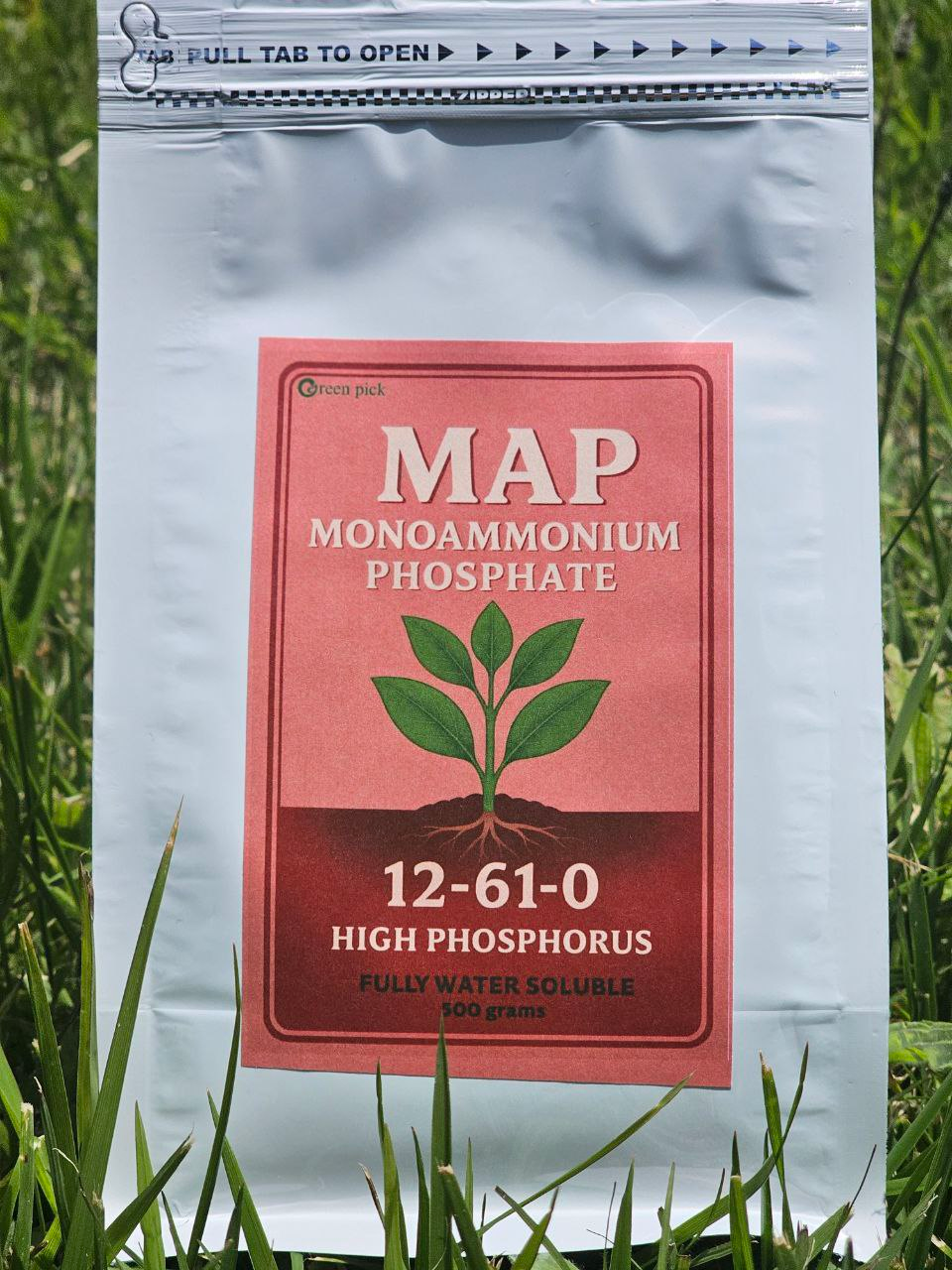
What is the difference between MKP and MAP?
How do I know if my plants need MKP?
When and how often should I apply MKP?
How much MKP per litre of water?
Can I mix MKP with calcium nitrate?
Is MKP good for tomatoes?
What sizes do you sell, and do you ship Australia-wide?
Buy Mono Potassium Phosphate (MKP) Fertiliser
If your plants are flowering, fruiting or freshly transplanted, MKP gives them phosphorus and potassium in a form they can use straight away.
🚚 Ships across Australia · 🔒 Secure checkout · 🌱 For home gardens and commercial growers


Hi, how I can order larger sizes of MKP? Thanks!
Hi, thanks for your message. Please email info@greenpick.au for the quote and more details.