


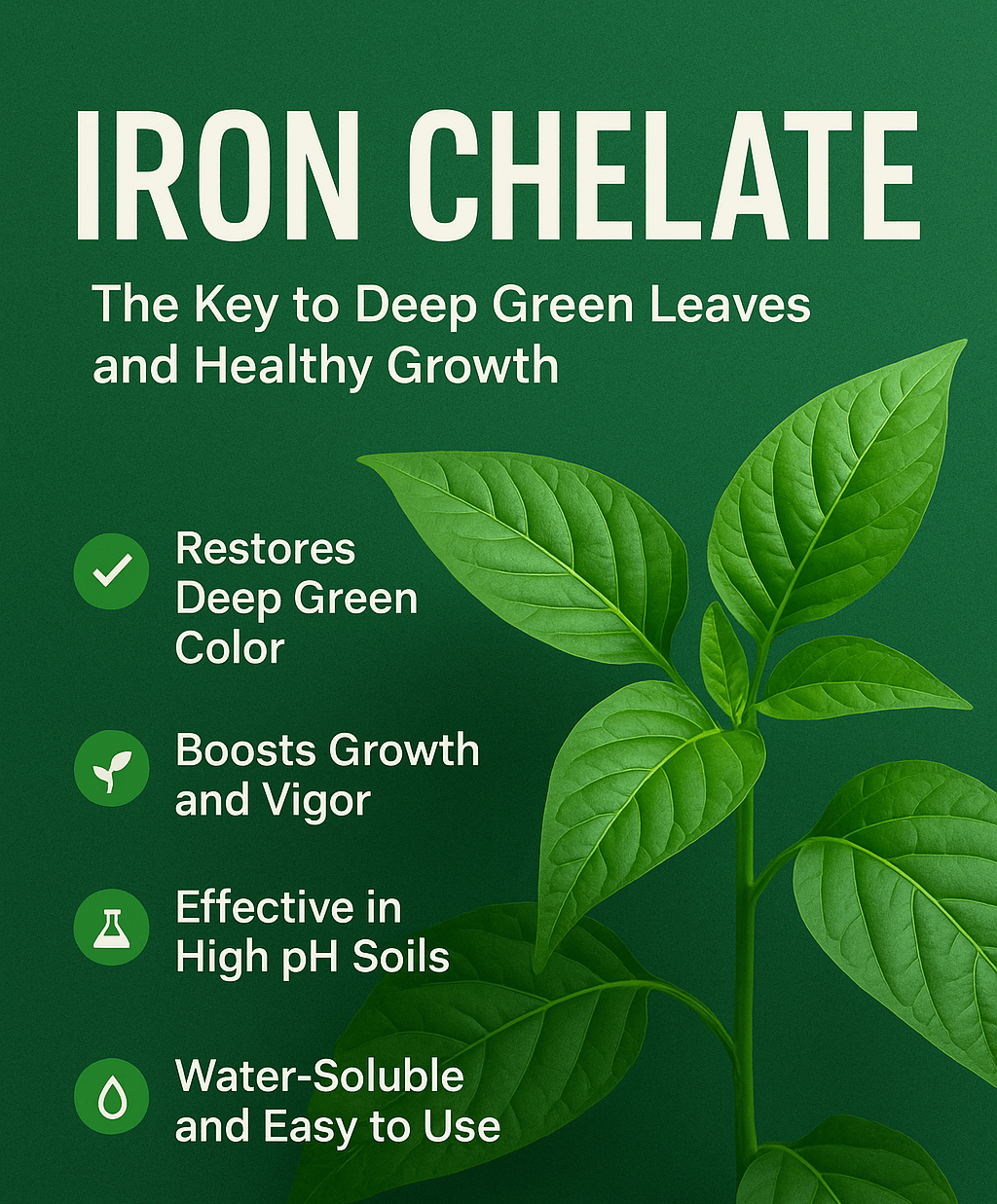
Iron chelate is iron wrapped in a protective molecule, so roots can still take it up in alkaline soil, where ordinary iron gets locked away. It’s the fix for yellow new leaves with green veins: dissolve it in water, pour it over the roots and water it in.
6% Iron (Fe)EDDHSA ChelateStable to pH 9Fully Water-Soluble
Our Iron Chelate is 6% iron held by EDDHSA, a chelate that keeps working in limey soil and hard water. This guide gives you the rates for pots, garden beds, lawns, citrus, hydroponics and farms, a calculator for your plants, and what to check when the leaves won’t green up.
Shop Iron Chelate See the Rates ↓
When Plants Need Iron
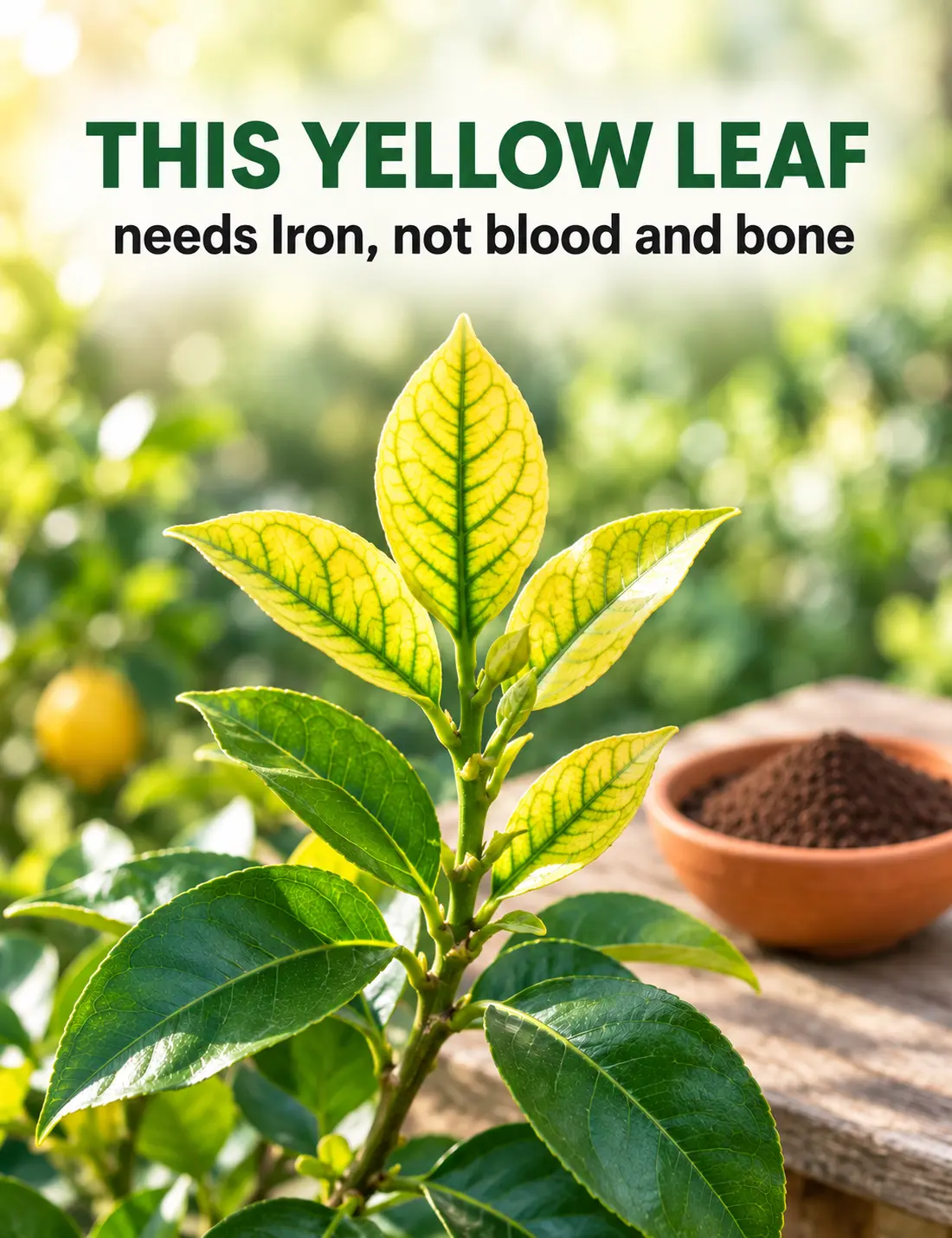
Plants need iron to make chlorophyll, the pigment that keeps leaves green. Iron doesn’t move from old leaves into new ones, so when a plant runs short, the newest growth comes through pale yellow with the veins standing out in sharp green, while the older leaves stay green.
In most gardens the soil isn’t short of iron. It’s locked up. Once the pH climbs above about 7, iron turns into forms roots can’t absorb. That’s why the same plants keep turning yellow: citrus, gardenias, azaleas, camellias, hydrangeas, roses, blueberries and many natives, especially in pots. A few things push them into it:
- Limey or alkaline soil. That includes sandy soil over limestone and beds given too much lime or dolomite.
- New concrete. Fresh paths, slabs and footings leach lime into the soil beside them.
- Alkaline bore water. Hard water keeps nudging the soil pH back up, so acidifying the soil rarely lasts.
- Wet, cold soil. Waterlogged roots struggle to take up iron, so yellowing often shows after a wet winter or in pots that stay soggy.
- Too much phosphorus. In natives, yellowing is often the first sign of a phosphorus overdose.
Check it’s iron before you buy anything. If the older leaves yellowed first, it’s more likely magnesium, and our guide to yellow leaves with green veins shows how to tell the two apart.
Why the Chelate Type Matters
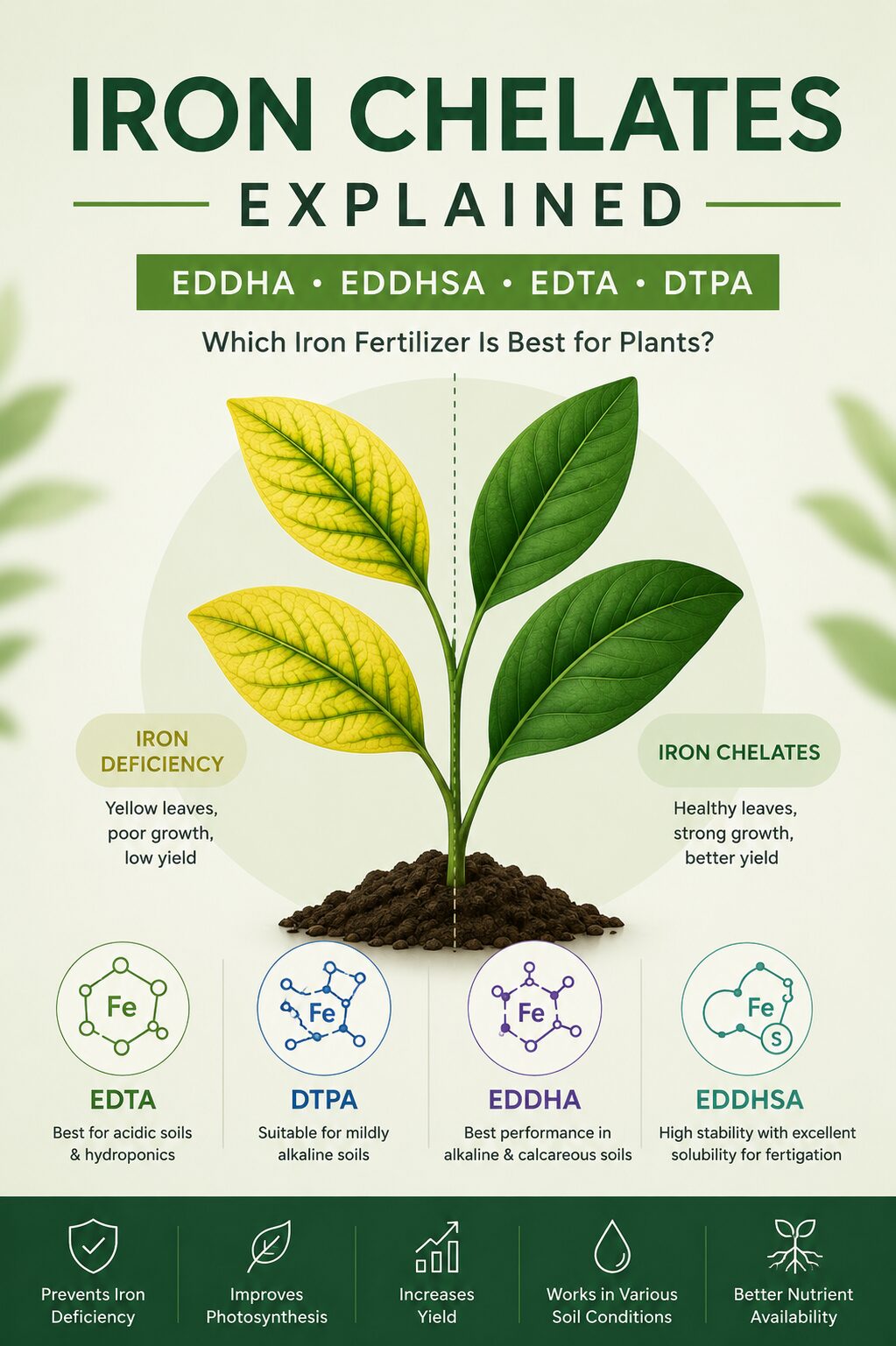
A chelate holds iron in a form roots can use and stops the soil from locking it up. Each chelate lets go at a different pH, so the type on the label decides whether an iron fertiliser will work in your soil.
| Chelate | Holds iron up to about | Best for |
|---|---|---|
| EDTA | pH 6.5 | Acid soils and potting mix. The cheapest and most common type |
| DTPA | pH 7 to 7.5 | Neutral soils. Common in hydroponic nutrients |
| EDDHA and EDDHSA | pH 9 | Alkaline and limey soil, hard water, citrus and fruit trees |
Ours is EDDHSA, a close relative of EDDHA. It holds iron from about pH 4 to 9 and dissolves around three times more readily than EDDHA, so it mixes easily in a watering can, a dripper line or a hydroponic tank. EDTA is the cheapest and most widely used chelate, but it only suits soils up to about pH 6 to 6.5, which is why some iron products barely work on limey ground. For the chemistry, see our article on EDDHA vs EDDHSA.
How Much Iron Chelate to Use
⚠️ Note: Treat these rates as a starting point, because the right dose depends on the plant, the soil and how yellow it is. More iron won’t green a plant faster. Treat only plants that show iron deficiency, and repeat only if the new growth is still pale.
| Use | Rate | How to apply | How often |
|---|---|---|---|
| Pots & containers | 2 g per litre of water (20 g in a 10 litre can) | Use it in place of a normal watering, enough to wet the whole pot. Half strength for seedlings and indoor plants | Once in spring. Repeat after 4 to 6 weeks if new leaves are still pale |
| Garden beds, roses & shrubs | 5 g per m² (10 g in a 9 litre can covers 2 m²) | Water onto moist soil over the root zone, then hose it in | Late winter or early spring. Repeat after 6 to 8 weeks if needed |
| Lawns | 1 g per m² (10 g in a 9 litre can covers 10 m²) | Sprinkle evenly with a can or sprayer. Keep it off paving | Spring and autumn, if new blades come through yellow |
| Citrus & fruit trees | Young trees 5 to 10 g. Mature trees 50 to 100 g, more for very large trees | Dissolve in 10 to 20 litres of water, pour into a shallow trench or ring of holes around the drip line, then water in | Late winter or early spring. Citrus can have a second dose in summer |
| Hydroponics & fertigation | 3 to 5 g per 100 litres of final solution (2 to 3 mg/L iron) | Pre-dissolve in a little warm water. In two-tank systems it usually goes in the A tank | Each fresh batch, if your base nutrient has no iron or the pH runs high |
| Farms & orchards | Vegetables 5 to 15 kg/ha a season. Orchards and citrus 10 to 30 kg/ha a season | Through drip or micro sprinklers, or banded into moist soil | In 2 or 3 doses, from the start of spring growth |
| Leaf spray | 1 g per litre (0.1%), up to 1.5 g on fruit trees | Spray young leaves late in the afternoon, below 29°C. Wet both sides and avoid ripening fruit | Every 2 to 3 weeks while new leaves are pale |
The leaf spray follows Utah State University, which suggests repeating it every 10 to 21 days, and New Mexico State University, which advises against spraying above about 29°C. For hydroponics, the University of Florida’s tomato recipe runs 2.8 mg/L of iron. A 500 g pack treats about 100 m² of garden bed, or five to ten mature citrus.
How much iron chelate do you need?
Pick what you’re treating, then slide to the size of your pot, bed, tree or tank.
A 30 cm pot: about 2.3 g in 1.1 L of water (2 g per litre), poured on in place of a normal watering.
Weigh a level teaspoon of the powder once on kitchen scales, and you’ll know how many spoons make your dose. Tree doses use canopy width, the spread of the branches. For lawns, use 1 g per m².
How to Apply Iron Chelate
- Water first. Apply it to moist soil, never to bone-dry soil or a wilting plant.
- Dissolve it fully. Stir the powder into the water until none is left at the bottom.
- Pour it where the feeder roots are. For trees and shrubs, that’s the drip line under the outer edge of the canopy, not the trunk. A shallow trench or a ring of holes helps it soak in.
- Water it in straight away. Sunlight breaks iron chelates down, so get it into the soil rather than leaving it sitting on top.
- Rinse off splashes. Hose any off the leaves, and off paving and concrete, which iron can mark.
- Mix only what you’ll use. Use the solution the same day. If you run a stock tank, cover it and keep it out of the light.
The best time is late winter to early spring, as new growth starts, because that’s when plants take up iron for their new leaves. Autumn is the next best time. In summer, a leaf spray is quicker.
Don’t expect old leaves to turn green overnight. Soil-applied iron shows first in the new growth. In early chelate trials, hydrangeas greened up within about ten days, while azaleas took six to eight weeks, so give slow growers time before you dose again.
Wear gloves and eye protection when you handle the powder, and keep the bag sealed, cool, dry and out of the sun.
Mixing Iron Chelate With Other Fertilisers
In a watering can, iron chelate mixes happily with most soluble fertilisers. Dissolve everything else first and add the iron last. Keep it out of strongly acidic mixes, too: We recommend keeping the tank above pH 4.
In two-tank hydroponic and fertigation systems, we recommend putting it in the A tank with calcium nitrate, held at pH 5 to 7. Our calcium nitrate guide shows what else goes in each tank.
Don’t pour it straight into pesticide concentrates or spray oils. If you want to add it to a spray, mix a small batch first and test it on a few leaves.
Iron Chelate Not Working? Check These
- It isn’t iron. If the older leaves yellowed first, it’s more likely magnesium, which responds to Magnesium Sulphate (Epsom salts) instead.
- It’s hungry, not short of iron. Plants that are evenly pale all over, older leaves included, are usually short of nitrogen. For lawns, our guide to greening up a pale, patchy lawn covers it.
- The roots are waterlogged or cold. Roots sitting in wet soil can’t take up iron, whatever you give them. Fix the drainage, let pots dry a little between waterings, and wait for the soil to warm up.
- The chelate is wrong for your soil. An EDTA product won’t hold iron in alkaline soil. Check the label for EDDHA or EDDHSA.
- The lime keeps coming back. Concrete, limestone and hard water keep pushing the pH up, so those plants may need a dose every spring.
- It was fed too much phosphorus. Natives given a high-phosphorus fertiliser often yellow. Switch to a low-phosphorus native fertiliser.
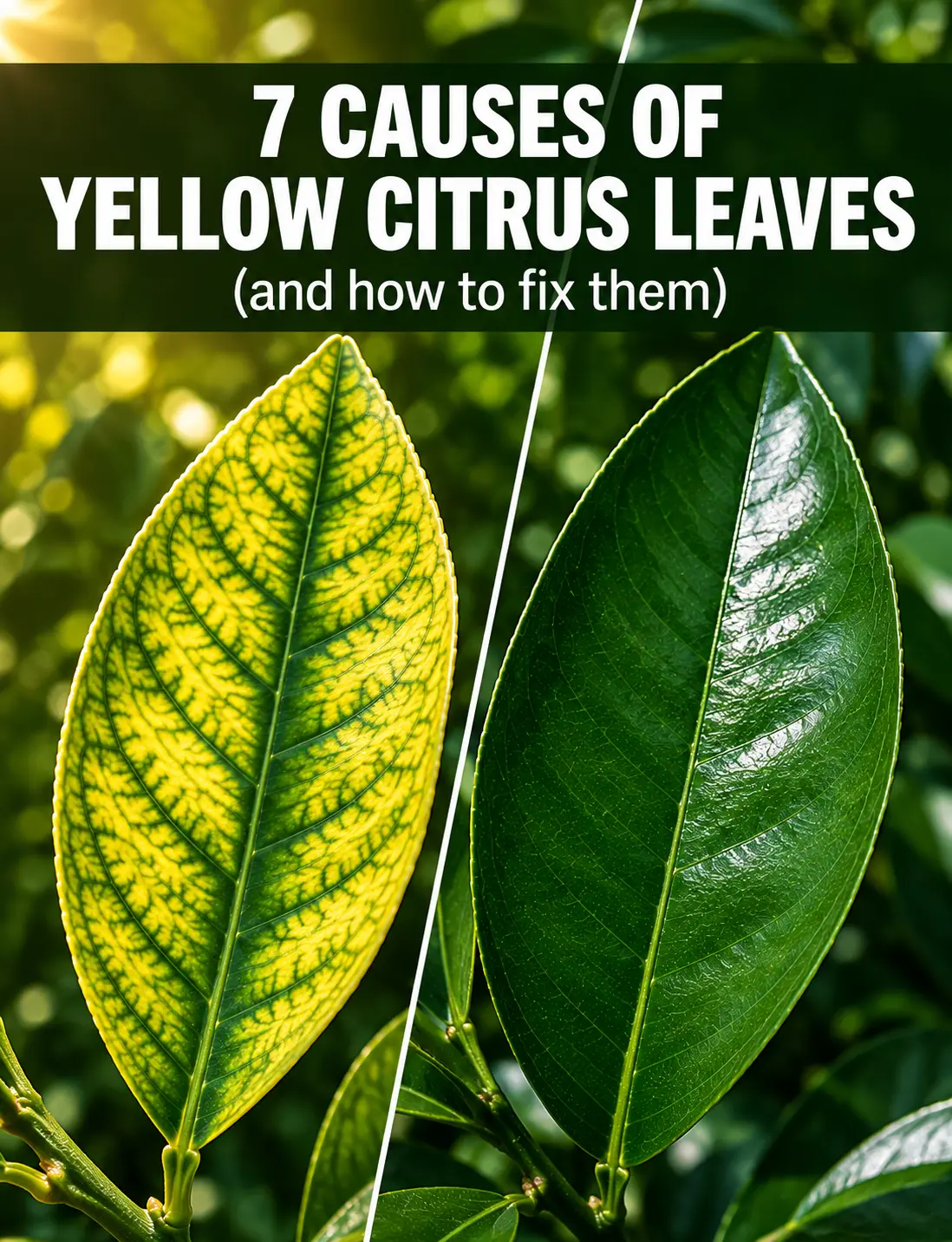
Citrus leaves yellow for other reasons too, and our guide to yellow citrus leaves walks through them.
Frequently Asked Questions
How do I know my plant needs iron?
How long does iron chelate take to work?
Can I spray iron chelate on leaves?
Can I mix iron chelate with other fertilisers?
Is iron chelate better than iron sulphate?
Can you use too much iron chelate?
What sizes do you sell?
Shop Iron Chelate
If new leaves are coming through yellow with green veins, especially on limey soil, citrus or acid-loving plants in pots, iron chelate puts back the iron your soil is locking away. Our EDDHSA powder comes in 500 g and 5 kg packs.
🚚 Free shipping Australia-wide · 🔒 Secure checkout · 🌱 For home gardens and commercial growers
Shop Iron Chelate Check Your Yellow Leaves
Sources and further reading
- Klem-Marciniak E. and others (2021). Chemical stability of the fertilizer chelates Fe-EDDHA and Fe-EDDHSA over time. Molecules 26(7), 1933.
- Winetitles (2023). ‘Chelates ain’t chelates’ when feeding plants iron.
- Cultifort. Ferrofort EDDHA iron chelate.
- Sprint 138. Chelated iron product label (PDF).
- University of Florida IFAS Extension (2024). Nutrient solution formulation for hydroponic tomatoes in Florida.
- Utah State University Extension. Iron chlorosis (deficiency) in fruit.
- New Mexico State University (2026). Iron chlorosis, Guide H-171 (PDF).
- University of Idaho Extension, in East Idaho News. Stop the yellow: when and how to apply iron for greener lawns, trees and gardens.
- Widmer R. E. (1953). Chelated iron tests. New York State Flower Growers Bulletin (PDF).
- Searles. Iron deficiency in plants.
- Washington State University HortSense. Azalea: lime-induced chlorosis.
- Ball Horticultural. Avoiding iron and manganese toxicity.

Iron