
Quick answer
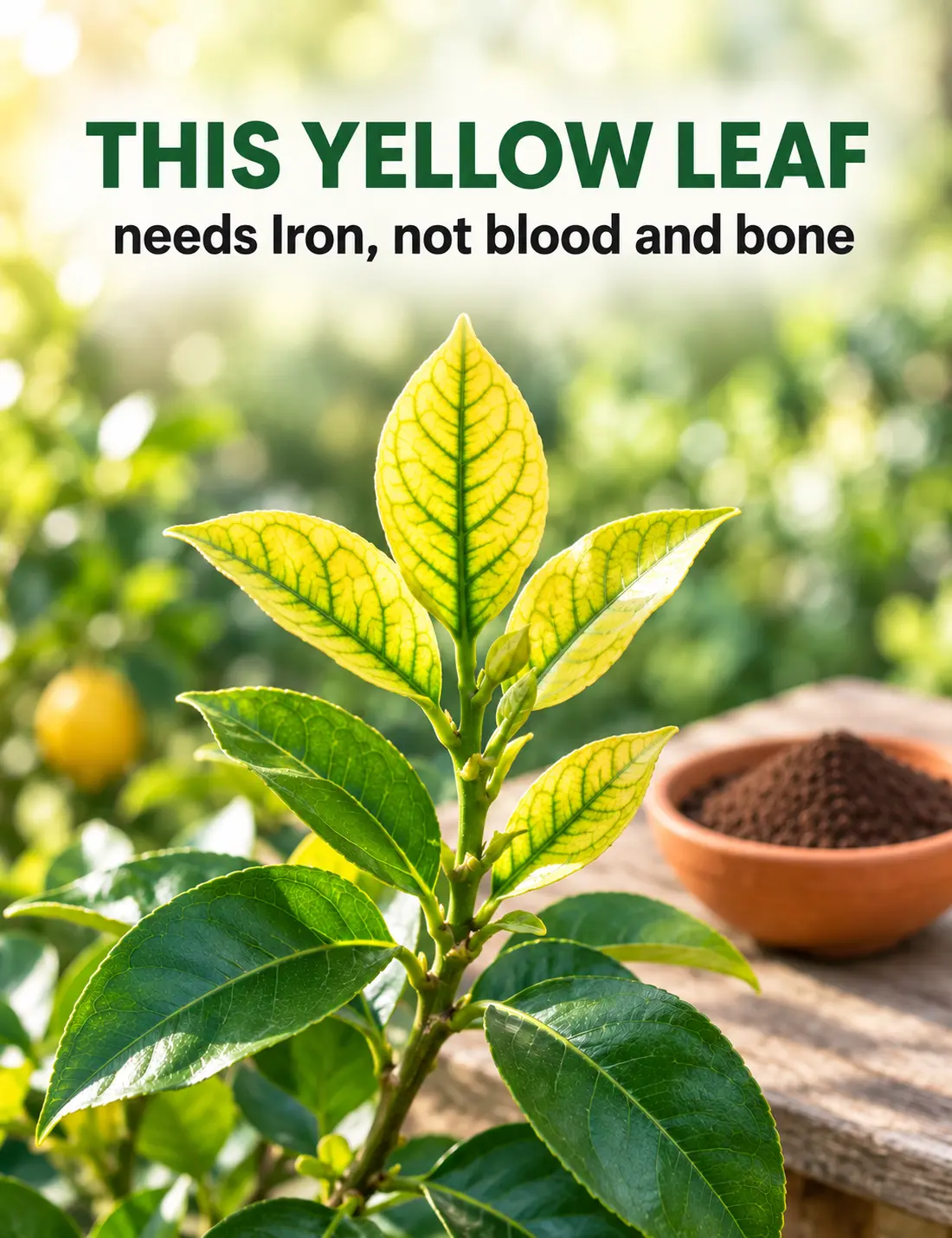
Check which leaves are yellow. If it’s the newest leaves at the tips, with the veins standing out in sharp green, the plant is usually short of iron, most often because alkaline soil has locked it up. If the yellowing started on older, lower leaves, think magnesium. Iron needs a chelate that suits your soil pH, and magnesium usually responds to Epsom salts. Blood and bone fixes neither.
Jump to the iron fix or the magnesium fix.
It’s practically an Australian reflex. The lemon tree turns yellow, so out comes the bag of blood and bone. But if you’re looking at yellow leaves with green veins, that bag isn’t going to help.
That pattern usually comes down to one of two nutrients, iron or magnesium. You could tip the whole bag of blood and bone around the tree and it still wouldn’t green up, because it won’t fix either.
The good news is that a yellow leaf is a surprisingly honest messenger. Learn to read it, and you’ll know in about ten seconds whether you need iron, magnesium or just a bit of patience.
What’s behind your yellow leaves?
Pick the pattern that best matches your plant. You’ll see the likely cause, and whether blood and bone will help.
Your answer will appear here.
Blood and bone: won’t fix it
Likely iron. The plant can’t get iron, usually because the soil is alkaline. Use a chelated iron that suits your soil pH, such as our Iron Chelate, and test your pH. Manganese shortage can look almost identical, so if iron doesn’t help within a few weeks, get a test.
Blood and bone: helps, slowly
Likely nitrogen. Blood and bone can fix this as soil microbes release its nitrogen, faster in warm soil. For a quicker green-up, a water-soluble feed like NPK 20-20-20 goes straight to work.
Blood and bone: won’t fix it
Could be potassium. Most blood and bone contains no potassium at all. Our article on banana peel water explains what actually works.
Blood and bone: won’t fix it
Likely magnesium. Magnesium shortage starts on older leaves and shows as yellow between the veins, often leaving a green V at the base of citrus leaves. Blood and bone won’t fix it, and heavy potassium feeding can make it worse. Epsom salts, such as our Magnesium Sulphate, is the usual fix, and here’s how to use it.
Blood and bone: not yet
Probably cold or wet roots. No fertiliser fixes this. Cold, soggy soil slows nutrient uptake, so leaves look hungry even when the soil is fine. Check drainage, wait for warmer weather and judge the new spring growth.
Symptoms overlap, so treat this as a starting point. For a second opinion, upload a photo to our Leaf Scan AI.
What yellow leaves with green veins are telling you
Plants handle nutrients in two different ways, and that’s the key to reading a yellow leaf. Some nutrients, like nitrogen, potassium and magnesium, can be moved around inside the plant. When they run short, the plant strips them out of older leaves to feed new growth, so the yellowing starts down low.
Iron is different. Once it’s in a leaf, it stays put. A plant that’s short of iron can’t raid its old leaves, so the problem shows up on the newest growth: pale yellow leaf tissue with a crisp network of green veins. It’s called iron chlorosis, and it’s a classic sign of iron deficiency on citrus, gardenias, azaleas and camellias. One caution: manganese shortage can look almost identical, and in citrus, zinc shortage causes similar yellow patches between green veins, usually with small, narrow new leaves. If iron doesn’t help within a few weeks, a soil or leaf test is the only way to be sure.
So the quick rule is this: yellow new leaves with green veins point to iron, and yellow older leaves point to magnesium. Here’s how the two compare side by side.
| Iron | Magnesium | |
|---|---|---|
| Which leaves go first | The newest leaves, at the tips | Older, lower leaves, often those nearest the fruit |
| What it looks like | Pale yellow leaf with a crisp network of green veins | Yellow blotches between the veins; on citrus, a green V is often left at the leaf base |
| Usual cause | Alkaline soil locking up the iron that’s already there | Acid, leached soil, heavy potassium feeding or a heavy crop |
| The fix | An EDDHA-type iron chelate, watered into the root zone | Epsom salts (magnesium sulphate), sprayed on or watered in |
| Will blood and bone help? | No | No |
Why blood and bone can’t fix it
Check the label on a bag of blood and bone. You’ll typically find nitrogen, phosphorus and a fair amount of calcium. Most list no potassium, and iron doesn’t rate a mention.
Here’s the bigger surprise, though: your soil probably isn’t short of iron at all. Most soils contain plenty of iron. The trouble is soil pH. In alkaline soil, iron reacts with oxygen and carbonates to form solids that roots can’t absorb. The pantry is full. The door is locked.
That’s why piling on more of almost anything can fail. Even plain iron, like iron sulphate, gets locked up quickly once soil pH climbs. And blood and bone won’t shift the pH of a limey soil, so it can’t free up the iron that’s already there.
Alkaline soil is more common than many gardeners realise. It’s typical over limestone, in sandy soils full of crushed shell, alongside concrete paths and foundations, and wherever hard bore water is used for irrigation. Wet, compacted or cold soil makes things worse, even when the pH isn’t extreme, because struggling roots take up less iron. The classic sufferers are acid-lovers like gardenias, azaleas, camellias and blueberries, plus almost every citrus tree.
Can your plants still get iron? Slide to your soil pH
Iron behaves very differently as soil pH rises. Drag the slider to see which forms of iron stay available to roots.
Alkaline soil: iron is locking up. Citrus, gardenias and azaleas often show yellow new leaves with green veins.
Approximate ranges based on published chelate studies. Real soils vary with lime content, moisture and the plant.
Not every iron chelate works in alkaline soil
The answer to locked-up iron is chelated iron. A chelate is a molecule that wraps around iron and stops the soil from grabbing it, so roots can still take it up.
Chelates aren’t equal, though. EDTA, the most common type, only protects iron reliably in slightly acidic soil, up to around pH 6.5. DTPA holds on to about pH 7.5. In properly alkaline soil, the EDDHA family is the one that keeps working where the others fail. Before you buy any iron fertilizer, check which chelate is on the label.
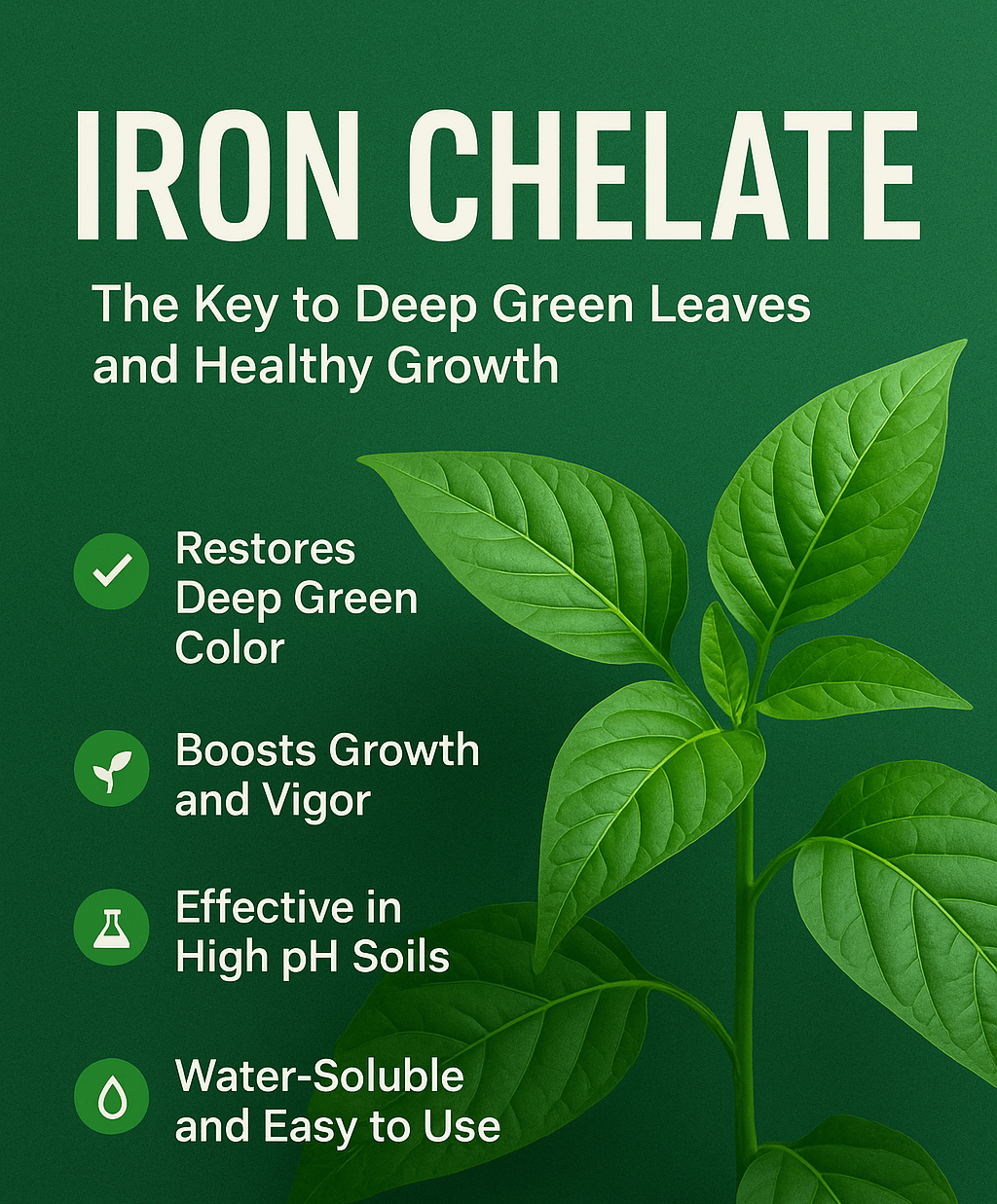
Our Iron Chelate uses EDDHSA, a member of the EDDHA family made for alkaline and problem soils. In both field and soil-free trials, researchers found EDDHSA as effective as EDDHA at greening up iron-starved plants. Our iron chelate guide covers rates for pots, garden beds and orchards.
A few habits help it work. Dissolve it and water it into the root zone rather than leaving it on the surface. Expect new growth to green up within one to three weeks, but don’t judge by the old leaves, because badly yellowed ones may stay pale. And since even the best chelates don’t last forever in alkaline soil, plan on repeat treatments through the growing season. One practical warning: EDDHA-type chelates are a deep red-brown and can stain paving, so rinse any spills off paths straight away.
| Blood and bone | Iron chelate (EDDHA type) | |
|---|---|---|
| What it supplies | Nitrogen, phosphorus and calcium | Iron, held in a protective chelate |
| Fixes yellow leaves with green veins? | No | Yes, when iron is the problem |
| Works in alkaline soil? | Its nitrogen does, but it can’t free up iron | Yes, it keeps iron available even in strongly alkaline soil |
| Speed | Weeks, depending on soil warmth | New growth often greens in one to three weeks |
| Best for | Nitrogen-hungry plants and building soil | Citrus, gardenias, azaleas and plants on alkaline soil |
| Watch out for | High phosphorus for sensitive natives | Badly yellowed old leaves may stay pale |
If it’s magnesium: older leaves go first
Magnesium sits at the heart of chlorophyll, the pigment that makes leaves green. Unlike iron, plants can move it around, so when supply runs short they pull it out of older leaves to feed new growth and ripening fruit. That’s why the yellowing starts low on the plant and on the leaves closest to the crop.
On citrus, NSW DPIRD describes yellow blotches that start near the centre of mature leaves and spread, often leaving an upside-down V of green at the base of the leaf. It tends to show up as fruit matures, especially on branches carrying a heavy crop, and bad cases end in heavy leaf drop. It’s most common in acid, leached soils near the coast, but it turns up in alkaline soils too.
Potassium is the other usual suspect. High potassium levels get in the way of magnesium uptake, so gardens fed lots of potash or high-potassium bloom fertilisers can tip into magnesium shortage.
The fix is cheap. Epsom salts is simply magnesium sulphate, like our Magnesium Sulphate. It dissolves easily and, unlike dolomite, it works in alkaline soil too. Burke’s Backyard suggests 2 teaspoons per litre of water, poured around the tree. For a faster result, spray the leaves. The NSW DPIRD recipe for citrus is 1 kg of Epsom salts and 1 kg of calcium nitrate in 100 litres of water with a wetting agent, which works out to 10 g of each per litre for a home sprayer. Spray when the spring flush is half to two-thirds grown, which in NSW means October to November.
For a long-term fix in acid soil, dolomite adds magnesium as it slowly raises the pH. Lime materials don’t work in neutral or alkaline soil, though, and pushing the pH up around citrus that’s already short of iron will only make the iron problem worse. Stick with Epsom salts there.
Neither fix crosses over. Epsom salts won’t help an iron-starved plant, and an iron chelate won’t help a magnesium-starved one, so read the leaf before you buy.
When blood and bone is the right call
None of this makes blood and bone a bad product. If older leaves are evenly pale or yellow, without green veins or scorched edges, the plant is probably short of nitrogen rather than iron, and blood and bone can genuinely fix that.
It just works slowly. Its nitrogen has to be broken down by soil microbes first, which happens faster in warm soil, as we explained in our piece on organic vs synthetic fertiliser. For a quicker, measured green-up, a water-soluble feed like our NPK 20-20-20 goes straight to work, and our NPK 20-20-20 guide explains how to use it. One caution: blood and bone is rich in phosphorus, so go easy around sensitive natives like grevilleas and banksias.
Sometimes the fix is patience
If your citrus looked miserable all winter, hold off on a diagnosis for a few more weeks. Cold, wet soil slows root activity so much that trees can look hungry even when the soil is well stocked. University of California horticulturists note that adding nitrogen or iron in winter doesn’t fix these “winter yellows” at all, and trees usually recover as the soil warms and drains.
In southern Australia, that means watching the spring flush. If the fresh new leaves come out green, the problem has fixed itself. If they come out yellow with green veins, now you know what to reach for.
Make the fix last
Chelated iron treats the symptom. To get ahead of the cause, start with a cheap soil pH test from any garden centre.
If your soil is only mildly alkaline, you can bring it down gradually with elemental sulphur and plenty of organic matter, and our guide to adjusting soil pH explains the options. If you’re gardening on limestone, fighting the soil is a losing battle. Grow acid-lovers like azaleas and blueberries in pots of acidic potting mix, and give citrus a regular dose of an alkaline-proof chelate instead.
Go easy on garden lime and dolomite around citrus and acid-lovers, too. They often get added out of habit, and overdoing them is a quick way to push pH up and set off iron chlorosis. A layer of organic mulch and careful watering help more than you might expect.
Read the leaf, then reach for the bag
Blood and bone fixes one kind of yellow leaf, and it’s not the one with green veins. Before you buy anything, check where the yellowing is: new leaves point to iron, older leaves to magnesium. It takes ten seconds, and it can save you a whole season of feeding the wrong thing.
Still not sure? Upload a photo to our Leaf Scan AI, read our comparison of online plant health checkers, or use Find My Fertiliser to match a product to your plant.
Sources and further reading
- Oklahoma State University Extension. Identifying and correcting iron deficiencies in ornamentals.
- Control of iron chlorosis in ornamental and crop plants. Extension fact sheet hosted by New Mexico State University.
- Fertigation with Fe-EDTA, Fe-DTPA, and Fe-EDDHA chelates to prevent iron chlorosis of sensitive species in high-pH soilless media.
- Álvarez-Fernández A, García-Marco S, Lucena JJ (2005). Evaluation of synthetic iron(III)-chelates (EDDHA/Fe3+, EDDHMA/Fe3+ and the novel EDDHSA/Fe3+) to correct iron chlorosis. European Journal of Agronomy.
- University of Arizona. Recognizing and treating iron deficiency in the home yard.
- Iowa State University Extension. Identifying plant nutrient deficiencies: potassium.
- University of California Master Gardeners. Yellowing leaves and leaf drop in citrus in winter.
- NSW Department of Primary Industries and Regional Development. Magnesium and manganese deficiencies in citrus.
- Burke’s Backyard. Magnesium deficient plants.
- BC Tree Fruit Production Guide. Magnesium (Mg).