
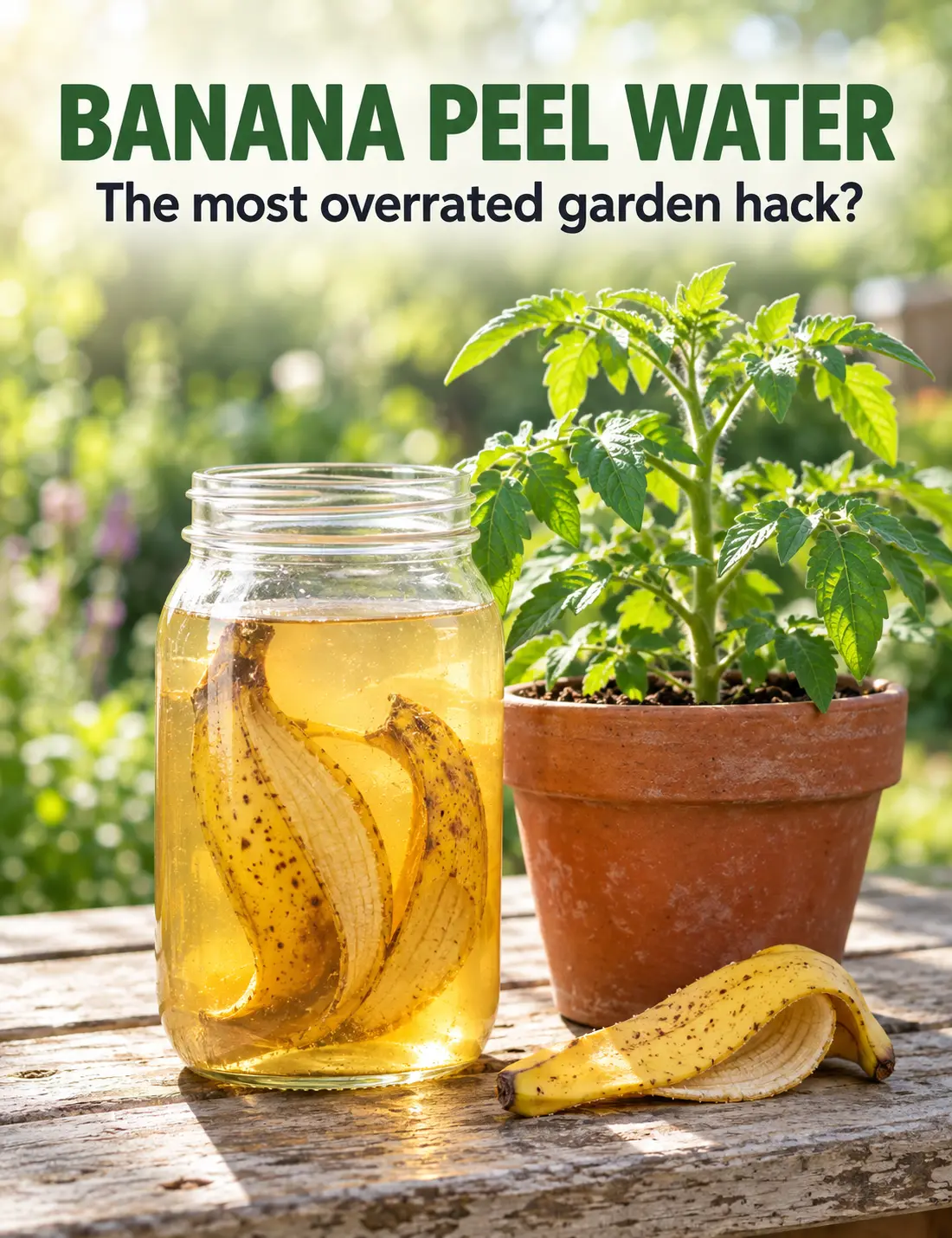

Banana peel water might be the most shared gardening hack of the decade. Drop a few peels in a jar of water, wait a couple of days, pour the cloudy result on your plants and watch them flourish. Or so the videos promise.
Here’s the awkward part. We went looking for a published measurement of what a typical home soak actually contains, and couldn’t find one. Not from a university, not from a government lab. For all its fame, the jar on the windowsill has never really been put to the test.
That doesn’t make it useless. Banana peels genuinely are rich in potassium, and some of it does end up in the water. The trouble is everything that happens between the peel and your plant, and that’s where this hack starts to fall apart.
Banana water claims: true or false?
Five things the videos say. Tap each claim to see the verdict.
True. Potassium is the main mineral in banana peel. A single peel holds roughly as much as the fruit inside it.
Partly true. Some of it, yes. Potassium sits in the peel as dissolved salts and washes out as the peel breaks down. How much reaches your jar is anyone’s guess.
False. It’s mostly potassium. There’s very little nitrogen, the nutrient plants use most.
False. Only if the plant is short of it. Extra potassium won’t push a well-fed plant into flowering, and too much can reduce how much calcium and magnesium it takes up.
True. Sugary liquid starts to ferment. It can grow mould and draw fungus gnats and vinegar flies, especially indoors.
What’s actually in a banana peel?
Potassium, mostly. Lab analyses consistently find it’s the most abundant mineral in banana peel (one widely cited analysis measured it far above everything else). That’s the whole basis of banana peel fertiliser’s reputation. Peels also contain sugars, fibre and smaller amounts of calcium and magnesium, but far less nitrogen than potassium, and nitrogen is the nutrient plants use in the largest amounts.
How much potassium are we talking about? The peel makes up roughly a third of a banana’s weight and is mostly water, around 85%. Put the published numbers together and a single peel holds very roughly half a gram of potassium. That’s about the same as the banana you just ate, which USDA data puts at around 420 mg for a medium fruit. Estimates swing a lot between studies and bananas, so treat that as a ballpark, not a label.
So the peel isn’t the problem. The jar is.
Does banana peel water actually work?
Partly, which is exactly why it’s so persuasive.
Potassium is unusual among plant nutrients. Nitrogen and phosphorus get built into proteins and other structures, but potassium mostly stays as dissolved salt inside cells. Once a peel’s cells start breaking down, it washes out easily. Australian soil scientists see the same thing in the paddock, where rain leaches potassium straight out of crop stubble. So your jar of banana water does contain some potassium, and probably more after a few days than after a few hours.
The problems start after that.
The dose is a guess. Ripeness, how finely you chop, how much water you use, the temperature and the soaking time all change what ends up in the jar. You might be pouring on a decent feed or almost nothing, and there’s no way to tell the difference.
It’s a one-nutrient drink. Even at its best, banana water for plants is mostly potassium with very little nitrogen. It can’t replace a fertiliser, and it won’t fix a plant that’s short of something else.
Most gardens aren’t short of potassium anyway. Deficiency is most common on sandy soils in high-rainfall areas, while heavier soils usually hold plenty. If your plants already have enough, the extra simply has nowhere useful to go. It won’t make a well-fed plant flower harder.
It can bring unwanted guests. Sugary liquid left to sit starts to ferment. Horticulturists warn that it can grow mould and attract fungus gnats and vinegar flies, which is a particular nuisance with indoor pots.
What about roses and staghorns?
Australians were tucking banana skins under roses and behind staghorn ferns long before anyone filmed it. There’s a kernel of sense in the tradition. Roses use potassium for flowering, and a staghorn mounted on a board has no soil to draw from, so anything that rots into its fronds is a feed of sorts.
It’s just the slowest, least predictable feed you could choose. A whole peel can take months to break down, and rotting fruit tucked into a fern is a magnet for vinegar flies and mould. A rose that’s already flowering well doesn’t need extra potassium, and one that’s struggling probably needs more than a banana skin can offer. If the ritual makes you happy, a skin now and then won’t hurt. Just don’t count it as feeding.
Even banana growers don’t rely on peels
Here’s an irony worth savouring. Banana plants are among the hungriest potassium feeders in agriculture. In commercial plantations, the crop can take up more potassium than all its other nutrients combined. Growers recycle leaf litter and plant waste back into the soil, and they still have to apply a lot of potassium fertiliser to keep up. If recycled banana waste could feed a banana plant, they wouldn’t need to.
How many peels would your harvest need?
Every tomato, strawberry and orange you pick carries potassium out of your garden. Here’s what it would take to put it back with peels.
How many banana peels would your harvest need?
Pick a crop and a harvest size to see what it would take to put the potassium in that fruit back into your soil.
Each banana shown is one peel, using the middle estimate. Based on USDA potassium figures for the fruit (citrus uses oranges) and an estimated 0.4 to 0.8 g of potassium per peel. Leaves, stems and roots take up more again, and a soak extracts only part of a peel’s potassium.
For a modest 5 kg tomato harvest, that’s somewhere between 15 and 30 peels, fully composted, just to replace what’s in the fruit. The leaves, stems and roots take up plenty more over a season. Soak those same peels for a couple of days instead and you would only capture part of their potassium.
How to tell if your plant actually needs potassium
Before reaching for any potassium, banana or bagged, make sure potassium is really the problem. Plants can move potassium around, so when supplies run short they rob older leaves to feed new growth. That’s why potassium deficiency shows up on the lower, older leaves first: yellowing that starts at the edges and tips, then scorches brown. Other shortages look different, as Iowa State University Extension explains, and this quick check will point you in the right direction.
Is it really potassium?
Pick the description closest to what you’re seeing on your plant.
Your result will appear here.
Could be potassium. Plants move potassium to new growth when supplies run short, so older leaves show it first: yellow edges that scorch brown. This is where a measured potassium feed helps.
More likely nitrogen. Even yellowing across older leaves, without scorched edges, usually points to nitrogen. Banana water won’t help here, because it carries very little.
Could be magnesium. Magnesium shortage also starts on older leaves, but shows as yellow between the veins rather than scorched edges. Piling on potassium can make it worse.
Often iron. Yellowing between the veins of new growth is a classic sign of iron shortage, usually because alkaline soil locks iron away. Potassium won’t fix it.
Check watering first. Waterlogged roots can’t take up nutrients properly, so a drowning plant can look like a hungry one. Let the soil dry out a little before feeding anything.
Symptoms overlap, so treat this as a starting point. For a second opinion, upload a photo to our Leaf Scan AI.
What to do with banana peels instead
Peels are worth keeping. They just work better slowly than they do in a jar.
Compost them. Chopped peels break down well in a compost heap or worm farm, and nearly all their potassium comes along for the ride, with organic matter as a bonus. Keep the heap covered, though. The same leachiness that gets potassium into your jar lets rain wash it out of an open compost pile.
Don’t bury whole peels under plants. They break down slowly in soil, and in Australian backyards they’re an open invitation to rats and possums.
If you love the ritual, keep it fresh. Use the water within a day or so, dilute it, and pour it on outdoor plants rather than indoor pots, where fermenting liquid causes the most trouble.
When your plants really do need potassium
Some plants genuinely need a potassium top-up: fruiting crops like tomatoes, capsicums and citrus, plants growing in sandy soil, and anything showing those scorched older leaves. That’s when a measured product earns its place. And a potassium ion from a bag is identical to one from a peel, for the same reasons we covered in our piece on organic vs synthetic fertiliser.
Our Potassium Sulphate (SOP), better known to many gardeners as sulphate of potash, is around 41 to 42% potassium, plus sulphur, which plants also need. It’s chloride-free, so it’s gentler on roots than muriate of potash (potassium chloride). A few grams holds as much potassium as a pile of peels, and you know exactly how much you’re applying.
If your plants are flowering or fruiting and you’d rather feed nitrogen and phosphorus at the same time, NPK 12-12-36 leans hard on potassium while covering the basics. Our guide on when plants actually need high-potassium fertiliser explains the timing. Whatever you use, stick to the label rate. Potassium isn’t harmless in excess, and too much can reduce how well plants take up calcium and magnesium.
Keep the peel. Lose the jar.
Banana peels are a genuine source of potassium. Banana peel water is a guess in a jar. Compost the peels, feed your plants something you can measure when they actually need it, and enjoy the banana.
Not sure what your plants are missing? Try our Leaf Scan AI, or use Find My Fertiliser to narrow down the right product.
Sources and further reading
- Anhwange BA et al. (2009). Chemical composition of Musa sapientum (banana) peels. Electronic Journal of Environmental, Agricultural and Food Chemistry.
- Nutritional content and bioactive compounds of banana peel and its potential utilization: a review (2023).
- Moisture content of banana stems and banana peels, from a study on converting agricultural wastes into sugar.
- US Department of Agriculture. FoodData Central.
- University of Maine Cooperative Extension. Bulletin 2251: Potassium, an essential element for potatoes.
- Soil Quality Knowledge Base. Potassium.
- Soil Quality Pty Ltd. Potassium fact sheet and Potassium, New South Wales.
- Iowa State University Extension. Identifying plant nutrient deficiencies: potassium.
- All For Gardening. Can you use banana water as plant fertilizer? An expert answers.
- Yara Australia. Nutritional summary for bananas.
- The Sulphur Institute. Fertilizers containing sulphate.
- Potash Development Association. Potassium for the soil and crop.
