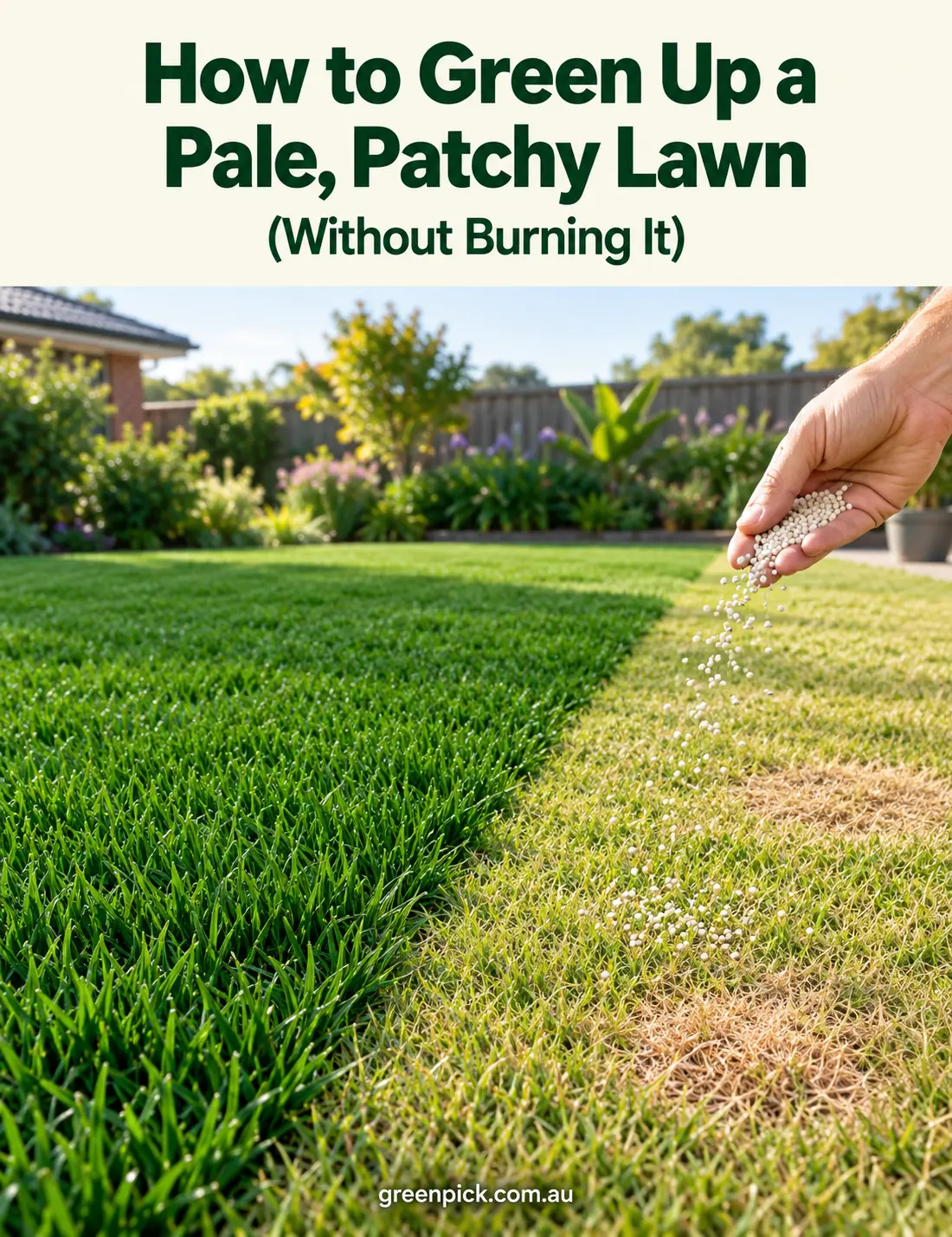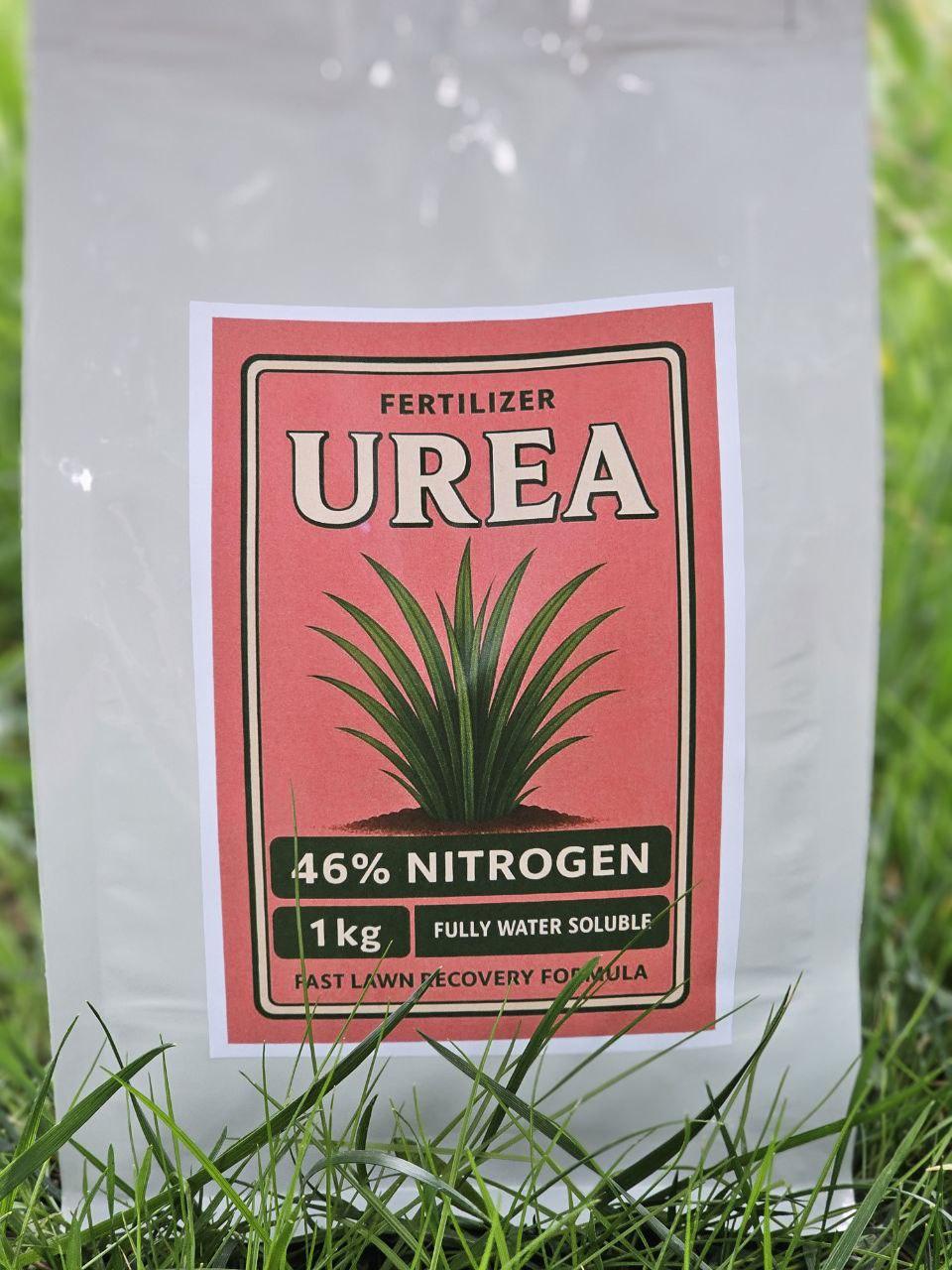

The Lawn Root & Shoot Repair Kit is 1 kg of urea granules (46% nitrogen) and 1 kg of sulphate of potash powder (51% K₂O, 18% sulphur). A main feed is 10 g of each per square metre. On lawns up to about 100 m², dissolve it in a watering can for the most even coverage. On bigger lawns, spread it dry. Either way, water it in straight away.
46% Nitrogen (N)51% Potash (K₂O)100 m² per Main FeedDry or DissolvedWater It In
Our Lawn Root & Shoot Repair Kit gives you urea and sulphate of potash in one box, so a single feed takes care of colour and toughness. This guide covers how much to use and when, whether to spread it dry or dissolve it, how much to mix for your lawn, and how to put it down without burning the grass.
The first main feed of the year goes on in mid to late spring, once you’ve mown a few times. If that’s where your lawn is now, you’re right on time.
Shop the Lawn Kit See the Rates ↓
What’s in the Kit
Two fertilisers, two jobs. Nitrogen buys colour. Potassium buys toughness.
- Urea, 1 kg of granules. At 46% nitrogen, it’s the most concentrated solid nitrogen fertiliser. Nitrogen drives leaf growth and keeps grass green, so urea is the quickest way to bring back colour and density. Our urea guide covers it in detail.
- Sulphate of potash, 1 kg of fine powder. Also called potassium sulphate or SOP, it’s 51% potash (K₂O) and 18% sulphur. Potassium regulates the pores on leaves that control water loss, so well-fed grass handles heat and dry spells better. It also strengthens cell walls, which helps plants stand up to stress, and the sulphur supports enzyme activity and protein formation. It’s very low in chloride, so there’s no risk of chloride build-up in your soil. Our SOP guide has more.
The two work well together, dry or dissolved, so one feed does both jobs. But one is a granule and the other a fine powder, and that matters when you spread them.
How Much Urea and Sulphate of Potash to Use
⚠️ Note: Always water lawns straight after, whether you spread it dry or dissolve it. Use the half rate for summer top-ups and newly laid turf.
| Feed | Rate per m² | When and why |
|---|---|---|
| Spring main feed | 10 g urea and 10 g sulphate of potash (20 g of mix) | Mid to late spring, once you’ve mown a few times. The grass is growing again, so it can use the nitrogen |
| Summer top-up | 5 g urea and 5 g sulphate of potash (10 g of mix) | Every 4 to 6 weeks if the colour fades, because quick-release nitrogen lasts about 4 to 6 weeks. Skip heatwaves and dry spells |
| Autumn main feed | 10 g urea and 10 g sulphate of potash (20 g of mix) | Early autumn. It helps the lawn repair summer damage before winter |
| Winter | None | Don’t feed while the lawn is dormant. It can’t use the nitrogen, so most of it goes to waste |
| New lawns | 5 g urea and 5 g sulphate of potash (10 g of mix) on newly laid turf | Keep it off newly sown seed, because small seeds are the most easily damaged |
Water every feed in straight away with about 12 mm, which is 12 litres per square metre.
Ryegrass and fescue lawns are different. They grow best in cooler weather, so give them their main feeds in autumn and spring, and go easy in summer heat.
Dry or Dissolved?
Both products dissolve in water, so it’s fair to ask whether pouring the kit on beats spreading it. We checked both ways against the research, along with the two sprayers people often reach for.
| Method | Good for | Watch out for | Verdict |
|---|---|---|---|
| Spread dry, then watered in | Any lawn. The quickest way on lawns over 100 m² | Hand spreading can leave stripes and scorched spots, and the potash powder settles out of the urea granules. Spread it in measured squares, in two passes | Best for lawns over 100 m² |
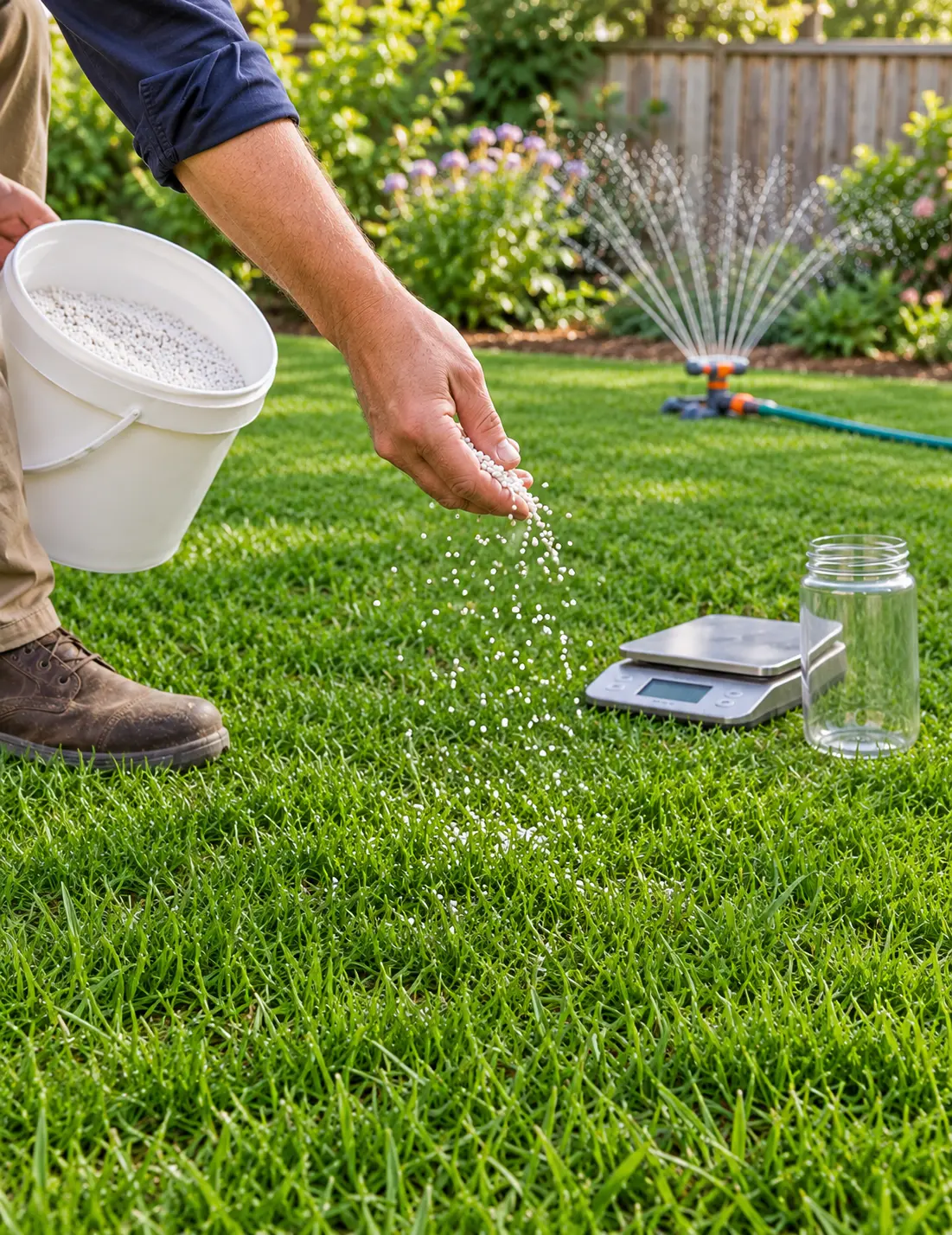
| Dissolved in a watering can, then watered in | Lawns up to about 100 m², and new turf | One 9 litre can per 10 m², so it takes longer. It still has to be watered in | Best for lawns up to 100 m² |
| Pump sprayer | Not a full feed | At a safe strength, a 5 litre tank covers only about 5 m². Mixed stronger, it can scorch the leaves and leave potash undissolved | Not suitable |
| Hose-end sprayer | Not a full feed | A 1 litre jar holds enough dissolved potash for 6 to 11 m², and the dose depends on how fast you walk | Not suitable |
Our recommendation: on lawns up to about 100 m², dissolve the kit in a watering can. It’s the most even way to put this mix down, with no stripes and nothing to separate. On bigger lawns, spread it dry in measured squares, because 20 or 30 cans is a lot of carrying for the same result. Whichever you choose, water it in with about 12 mm straight away, and don’t use a pump or hose-end sprayer for a full feed.
What the Research Says
Dissolving doesn’t green the lawn faster or better. In a University of Illinois trial, urea was applied at about a main feed’s rate, 49 kg of nitrogen per hectare or about 4.9 g per m². Sprayed urea never gave better colour than granular urea, and on 12 of the 36 rating dates, the granular plots scored higher.
The leaves can’t take up a full feed. Grass does absorb urea through its leaves, and fast. In University of Arkansas trials on golf greens, 24 to 67% of sprayed urea was taken in within an hour. But those were light sprays of 0.1 to 0.25 lb of nitrogen per 1,000 square feet, about 0.5 to 1.2 g per m², and the leaves took up a smaller share at the higher rate. A main feed from the kit is 4.6 g of nitrogen per m², four to nine times more, so most of it has to go through the soil. Once it’s watered in, both methods feed the roots the same way.
It doesn’t stop nitrogen loss. Dissolved urea still turns to ammonia gas if it’s left on the surface. In a Northern Ireland trial on ryegrass, liquid urea lost significantly more ammonia than solid urea on two of three occasions, and spraying it in more water, up to 640 ml per m², made no difference. At University of California, Davis, urea sprayed in more water ran down into the thatch, where it broke down faster: it lost 11.6% of its nitrogen in two days, against 5.3% for a lighter spray. What works for granules and liquid alike is watering in. In laboratory tests reported by the University of Florida, watering straight after application cut the losses from both to minor levels.
It does spread more evenly. This is where dissolving wins with this kit. Mississippi State University’s turf specialist warns that streaking or burning is quite common when fertiliser goes on by hand, and that blends with different particle sizes need extra care to spread evenly. Our urea is granular and our potash is a fine powder. Dissolved, the two can’t separate, and every square gets exactly the same dose of both.
But it takes longer, and it saves no water. One can covers 10 m², so a 300 m² lawn takes 30 cans. And a can only puts down 0.9 mm of water, so you still need the full 12 mm afterwards.
Will It Dissolve?
Urea dissolves easily: about 105 kg in 100 litres of water at 20 °C. Sulphate of potash is the limit, at about 11 kg per 100 litres at 20 °C and 9 kg at 10 °C, and we suggest working at no more than half the maximum. Urea also chills the water as it dissolves, and cold water holds less.
At watering-can strength, none of that matters. 100 g of potash in 9 litres is about 11 g per litre, well under the working limit even in cold water, so both dissolve completely with a stir. The two are compatible in solution too. Keep calcium fertilisers such as calcium nitrate out of the can, though, because with potash they form gypsum.
The trouble starts when you concentrate it. A 1 litre hose-end jar can hold at most about 110 g of dissolved potash, or about 60 g at the working limit. That’s enough for only 6 to 11 m² per fill, which is why sprayers don’t suit a full feed.
How Much to Mix for Your Lawn
Here’s a main feed at 10 g of urea and 10 g of sulphate of potash per m².
| Main feed | 50 m² | 100 m² | 200 m² | 300 m² |
|---|---|---|---|---|
| Urea | 500 g | 1 kg | 2 kg | 3 kg |
| Sulphate of potash | 500 g | 1 kg | 2 kg | 3 kg |
| Kits | Half a kit | 1 | 2 | 3 |
| Spread dry | 5 lots of 200 g | 10 lots of 200 g | 20 lots of 200 g | 30 lots of 200 g |
| Dissolved | 5 cans (45 L) | 10 cans (90 L) | 20 cans (180 L) | 30 cans (270 L) |
| Water in after | 600 L | 1,200 L | 2,400 L | 3,600 L |
Each 9 litre can holds 100 g of urea and 100 g of sulphate of potash, and covers 10 m². That’s about 1.1% of each, close to the 1% urea. For a summer top-up, halve the fertiliser but keep the water the same.
How much does your lawn need?
Pick a feed, then slide to your lawn size. Not sure of the size? Multiply the length by the width in metres.
Main feed: 10 g of urea and 10 g of sulphate of potash per m², so 1 kg of each for 100 m².
Dissolved: 10 cans of 9 litres, each with 100 g of urea and 100 g of potash. Dry: 10 lots of 200 g of mix, one per 10 m² square.
One kit covers 1 feed of this size. A full year, with two main feeds and two summer top-ups, takes 3 kits.
Weigh doses on kitchen scales, because a handful isn’t a unit. The summer top-up rate is also the rate for newly laid turf. The full-year figure assumes your lawn needs both summer top-ups.
How to Apply It
Dissolved, with a watering can (lawns up to about 100 m²)
- Mark out 10 m² squares. Pegs and string at 2 m by 5 m work well. Each square gets one can.
- Weigh one can’s worth. For a main feed, that’s 100 g of urea and 100 g of sulphate of potash, or 50 g of each for a top-up. Weigh each once, tip it into a cup and mark the level, then use the marks for the rest.
- Dissolve the potash first. Fill a 9 litre can almost to the top, stir in the potash until the water is clear, then add the urea and stir until the granules disappear.
- Pour in two passes. With the rose on and the can held low, walk half the can over the square one way and the rest at right angles. Then move on to the next square.
- Water it in straight away. Give it about 12 mm, which is 12 litres per square metre. On a warm day, water each section in as you finish it.
- Mix it fresh. Make up each can as you go, don’t store leftover mix, and rinse the can when you’re done.
Dry, by hand (lawns over 100 m²)
- Pick a dry, mild day. Spread on dry grass so the granules fall through to the soil. Damp leaves catch powder and granules, and that’s where burn starts. Skip hot afternoons, heatwaves and drought-stressed lawns.
- Mark out 10 m² squares. As above, so each square gets its own measured dose.
- Weigh 200 g of mix per square. That’s 100 g of urea and 100 g of sulphate of potash, or half that for a top-up. Shake the cup before every handful, because the fine powder settles below the granules.
- Spread it in two passes. Throw half the cup walking one way and the rest at right angles. Scoop up any spills, because a heavy patch scorches the grass.
- Water it in straight away. About 12 mm, which is 12 litres per square metre. Watering dissolves the granules and carries the feed down to the roots.
Either way, reseal both pouches as soon as you’ve weighed what you need, because urea soaks up moisture from the air and cakes if it’s left open.
Stop It Burning or Going to Waste
Water it in the same day, whichever method you use. Urea left on the surface turns into ammonia gas and drifts away. In Australian field trials, broadcast urea that wasn’t worked into the soil lost an average of 8 to 12% of its nitrogen this way, and up to 29% in poor conditions. Incitec Pivot says 5 to 10 mm of rain in one fall is usually enough to wash it in, but light, patchy rain makes the losses worse.
Don’t leave it on the leaves. Granules stuck to damp blades can burn them, which is why dry spreading starts on dry grass. A liquid feed dries onto the leaves instead. In the Illinois trial, urea sprayed at about a main feed’s rate scorched the grass when it went on during a 31 °C day. So water a liquid feed in as soon as it’s on, and never feed on a hot afternoon, during a heatwave or on a drought-stressed lawn.
Stick to the rate. Ten grams of urea per square metre is the most to put down in one go, because above that is where burning starts. Urea has a high salt index, so a heavy patch scorches the grass in stripes or spots.
Take care on alkaline soil. Nitrogen losses run higher on alkaline soil, so watering in matters even more there. For the same reason, never mix the kit with lime, dolomite or wood ash.
Keep the mix simple. Don’t add superphosphate or ammonium nitrate products to a dry mix, and remember that trace-element sulphates like zinc sulphate are only partly compatible with urea. In a can, keep calcium fertilisers away from the potash. Our urea guide and SOP guide go into more detail.
If you do scorch it, water the patch well to wash away the excess, then keep mowing as normal to encourage new growth, as Lawn Solutions Australia advises.
Still Pale or Patchy?
- Give it a week or so. In warm, moist soil, you’ll usually see greener growth within a week or so, whichever way you applied it. It’s slower in cold soil.
- Check the patches. Lawn grubs, dog wee, dry water-repellent soil and shade all leave patches that no fertiliser fixes on its own. Our guide to greening up a pale, patchy lawn helps you tell which one you’ve got.
- Check for iron. If the yellowing is worst on new growth and you’re on limey soil, the problem may be iron rather than nitrogen, and more nitrogen won’t fix it. Our iron chelate guide has the lawn rate.
Frequently Asked Questions
Should I dissolve the kit or spread it dry?
Do I still need to water it in after a liquid feed?
Can I use a hose-end or pump sprayer?
How much lawn does one kit cover?
Will it burn my lawn?
Is it a good fertilizer for buffalo lawns?
Can I use it on new turf or lawn seed?
Shop the Lawn Root & Shoot Repair Kit
One kit gives you a kilo each of urea and sulphate of potash in resealable pouches: a main feed for 100 m², or both main feeds for 50 m², spread dry or dissolved. It suits buffalo, couch, kikuyu, zoysia, ryegrass and fescue.
🚚 Free shipping Australia-wide · 🔒 Secure checkout · 🌱 For home and commercial lawns
Shop the Lawn Kit Urea Guide SOP Guide
Sources and further reading
- Green Pick. Urea fertiliser guide.
- Green Pick. Potassium sulphate (SOP) fertiliser guide.
- Green Pick. How to green up a pale, patchy lawn (without burning it).
- Spangenberg B. G., Fermanian T. W. and Wehner D. J., University of Illinois (1986). Evaluation of liquid-applied nitrogen fertilizers on Kentucky bluegrass turf. Agronomy Journal 78: 1002 to 1006.
- USGA (2015). Foliar nitrogen fertilization feeds the grass well (University of Arkansas research by Stiegler, Richardson and Karcher).
- Watson C. J., Stevens R. J., Laughlin R. J. and Poland P. (1992). Volatilization of ammonia from solid and liquid urea surface-applied to perennial ryegrass. Journal of Agricultural Science 119: 223 to 226.
- Bowman D. C. and Paul J. L., University of California, Davis (1990). Volatilization and rapid depletion of urea spray-applied to Kentucky bluegrass turf. Journal of Plant Nutrition.
- Augustus B. J. and Peacock C. H., University of Florida IFAS (1985). Gaseous loss of nitrogen from turf (PDF).
- Wells W., Mississippi State University Extension (2006). Use some precision in lawn fertilization.
- GRDC. Nitrogen loss pathways: how much N is lost when urea is not incorporated.
- Montana State University. Urea volatilization: what we learned.