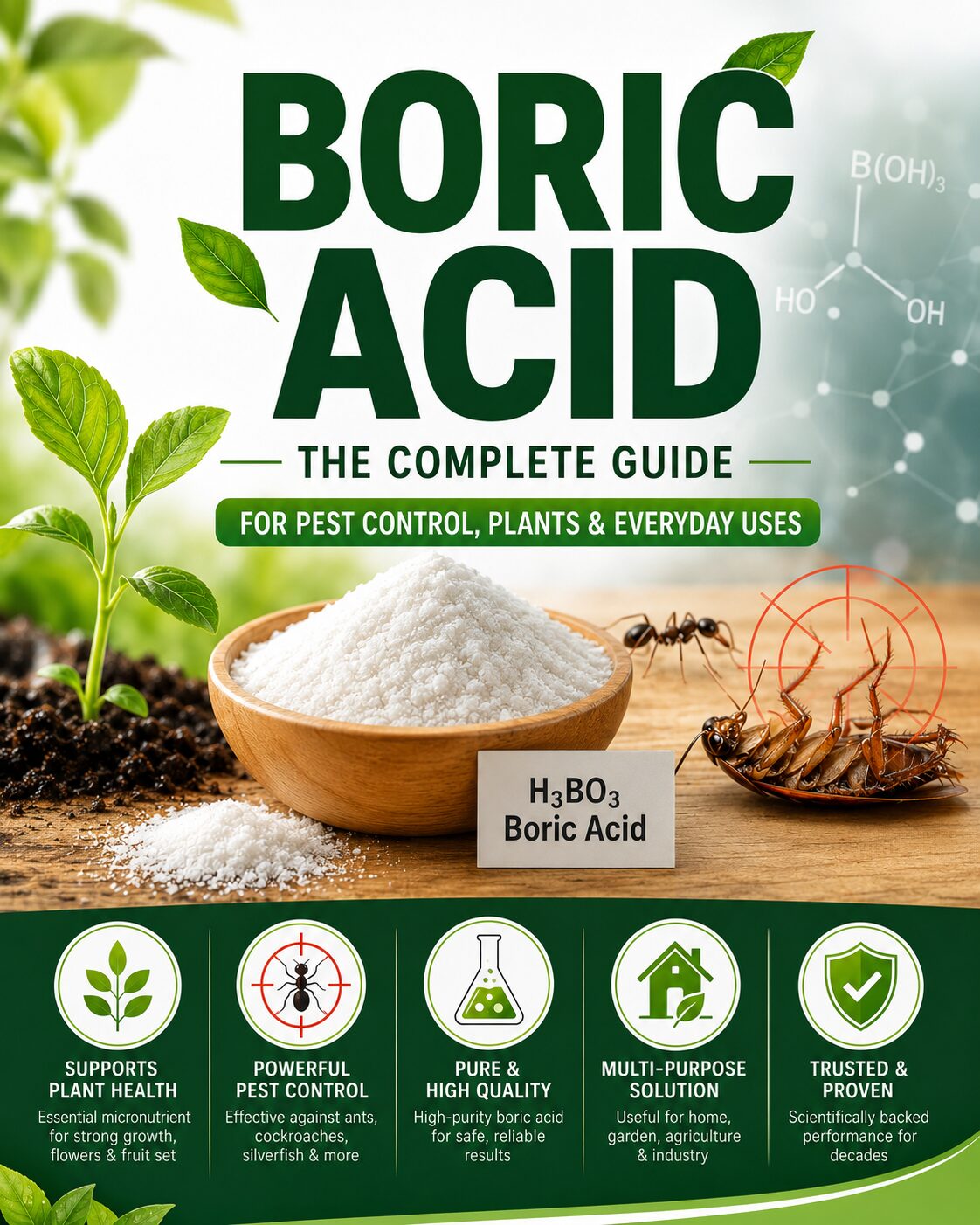
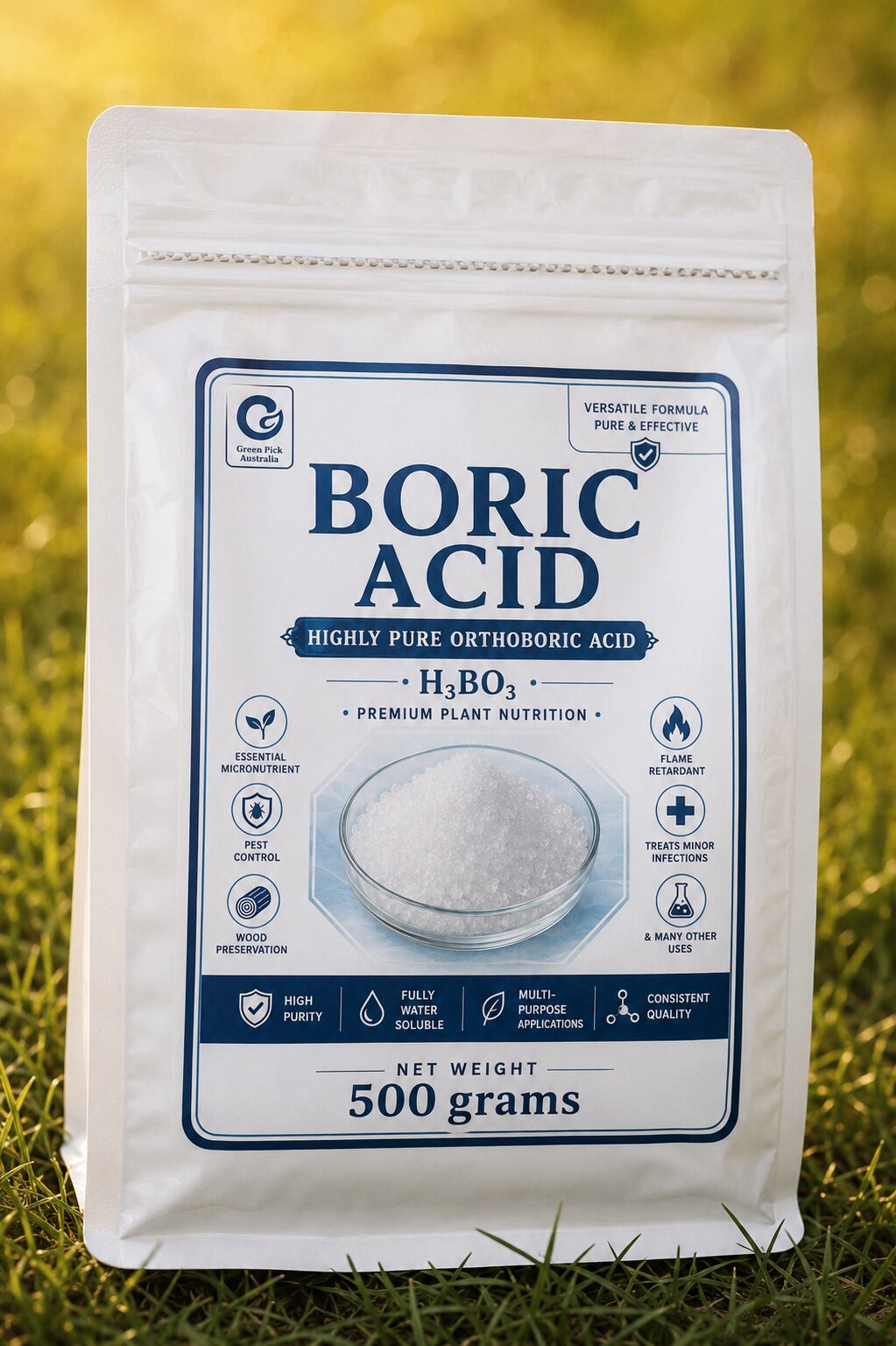

Welcome to your complete guide on Boric Acid (Orthoboric Acid – H₃BO₃) — a highly versatile compound widely used in agriculture, horticulture, household applications, and industrial processes.
In gardening and crop production, boric acid is valued as an essential source of boron, a critical micronutrient required for healthy plant growth, flowering, pollen development, fruit set, and nutrient transport; it facilitates sugar transport. Even though plants only require very small amounts, boron deficiency can quickly affect plant health and productivity.
Beyond agriculture, boric acid is also commonly used for household, cleaning, craft, laboratory, and technical applications due to its purity, stability, and water solubility.
Our premium-grade boric acid is fully water soluble, easy to apply, and suitable for a wide range of practical uses.
Why Use Boric Acid? (Agricultural Use)
Boron plays a vital role in plant cell development, reproductive growth, sugar transport, and nutrient movement inside the plant.
A lack of boron may lead to:
- Poor flowering and fruit set
- Brittle or distorted new growth
- Hollow stems or cracked fruit
- Reduced root development
- Lower crop quality and yield
When applied correctly, boric acid helps maintain balanced plant growth and improved crop performance.
Key Benefits
🌿 Supports Healthy Plant Growth
Essential for cell wall formation and healthy new growth.
🌸 Improves Flowering & Fruit Set
Helps support pollen development and reproductive growth.
🍅 Enhances Crop Quality
Supports stronger fruit development and improved plant vigor.
💧 Fully Water Soluble
Dissolves easily for convenient spraying and soil application.
⚡ Slow but Efficient Uptake
Plants will gradually but surely absorb nutrients when diluted correctly.
🧪 Multi-Purpose Formula
Suitable for agricultural, gardening, household, and technical applications.
When to Use Boric Acid
Boric acid is most effective when used during periods of active plant growth or when boron deficiency symptoms appear.
Recommended stages include:
- Early vegetative growth
- Pre-flowering stage
- Fruit development
- Root establishment periods
- Correcting visible boron deficiencies
For non-agricultural applications, use according to the intended purpose and always follow safe handling practices.
How to Apply Boric Acid
⚠️ Important: Boron is required only in very small amounts. Excess application may damage plants. Always measure carefully and avoid overuse.
⚠️ Dissolve completely in water before application. Apply during cooler parts of the day (morning or evening).
🌱 Small Plants, Pots & Indoor Plants
Dissolve 0.5–1 g per 1 L water
(≈ ⅛–¼ teaspoon)
Apply as a light foliar spray or soil drench every 4–6 weeks only when needed.
🥕 Vegetable Gardens & Flower Beds
Small Areas (1–2m²)
1–2 g dissolved in 2–4 L water
Medium Areas (5–10m²)
5–10 g dissolved in 10–20 L water
Large Areas (20–50m²)
20–40 g dissolved in 40–80 L water
Apply every 4–6 weeks if deficiency is suspected or during active growth.
🌳 Fruit Trees & Shrubs
Dissolve 2–5 g per 5 L water
(≈ ½–1 teaspoon)
Apply as a foliar spray before flowering and again after fruit set if required.
Do not overapply.
🌿 Lawns & Turf
Dissolve 5–10 g per 10 L water
Apply evenly over approximately 100 m² no more than every 6–8 weeks.
💧 Hydroponics & Fertigation
Use only in very small quantities as part of a balanced nutrient program.
Typical rates: 0.2–0.3 g per 10 L nutrient solution
Always monitor total boron levels carefully.
Using Boric Acid as a Pesticide
Boric acid is widely used as a low-toxicity insecticide for crawling insects such as ants, cockroaches, silverfish, and certain beetles. It works as a stomach poison and abrasive to the insect’s exoskeleton — insects pick it up on their bodies, ingest it while grooming or feeding, and it disrupts their digestive system. Because of its delayed action, it’s especially effective against ants and cockroaches, since affected insects carry it back to the nest/colony before dying, helping eliminate the source population rather than just visible individuals.
🐜 Ant & Cockroach Bait (Indoor Use)
Mixing ratio: 1 part boric acid to 3 parts sugar (or a 50/50 mix of sugar and cornmeal), dissolved in a small amount of warm water to form a paste or syrup.
- Ants: ~1 tsp boric acid mixed with 3 tsp sugar in 1 cup warm water. Soak cotton balls or place small dabs on bottle caps along known trails.
- Cockroaches: Mix boric acid powder directly with sugar and flour (equal parts) into a dry bait, or make a paste with water. Place in shallow lids near baseboards, under sinks, or behind appliances.
Application: Place bait stations in areas insects frequent but out of reach of children and pets — behind appliances, along baseboards, under sinks, near entry points. Avoid open application on countertops or food-prep surfaces.
Frequency: Replace bait every 1–2 weeks, or sooner if it dries out or gets contaminated with dust/debris, until activity stops.
🪳 Dry Powder Dusting (Cracks & Voids)
For deep cracks, wall voids, and entry points:
- Apply a very light, thin layer of dry boric acid powder using a bulb duster or small applicator — a visible dust layer is too much and may deter insects rather than attract them.
- Target cracks, crevices, behind switch plates, under appliances, and along pipe entry points.
- Do not apply to open, exposed surfaces where people, pets, or food may contact it.
🐌 Garden/Outdoor Crawling Insect Control
- Boric acid can be used around (not on) plant bases to deter ants and crawling pests, applied as a light dust in a barrier ring around the perimeter of garden beds or containers.
- Typical rate: a very thin dusting along ant trails or nest entrances outdoors — avoid direct application to edible plant parts or soil intended for root uptake, since this is a pest-control use, not a fertilization use, and rates differ from the boron nutrient applications described earlier in this guide.
- Reapply after rain or irrigation, as boric acid washes away easily outdoors.
🏚️ Wood-Boring Insect / Termite Prevention (Technical Use)
Boric acid solutions are also used in woodworking and construction to treat bare, untreated wood against termites, wood-boring beetles, and fungal decay:
- Typical solution: 1 part boric acid dissolved in 3–4 parts hot water, brushed or sprayed onto bare wood surfaces before painting, sealing, or installation.
- Not effective once wood is painted, sealed, varnished, or already installed with finished surfaces, since it needs to penetrate the wood fibers.
- Allow to fully dry before finishing.
⚠️ Pesticide-Specific Safety Notes
- Boric acid used for pest control is for crawling insects only — it is not effective against flying insects.
- Keep all baits and dusted areas strictly out of reach of children and pets; boric acid is toxic if ingested in quantity.
- Label and store pest-control mixtures separately from any boric acid used for plant nutrition to avoid confusing concentrations or accidental misuse.
- Do not apply dry powder or bait near food storage, food-prep areas, or dishware.
- Wear gloves when mixing baits or handling dry powder, and wash hands thoroughly afterward.
- Ventilate the area when dusting powder to avoid inhalation.
- Check local regulations, as some regions restrict or require registration for boric acid pest-control products.
Common Non-Agricultural Uses
⚠️ Always use responsibly and follow safe handling practices.
Boric acid may also be used for:
- General household applications
- Cleaning solutions
- Craft and slime making
- Laboratory and educational purposes
- Technical and industrial applications
- Woodworking and preservation-related uses
Users should determine suitability for their intended purpose.
Safe Handling & Storage
⚠️ Avoid inhalation and direct contact with eyes or skin.
⚠️ Keep away from children and pets.
⚠️ Store in a cool, dry place with the container sealed tightly.
⚠️ Do not exceed recommended application rates for plants.
Wear gloves and wash hands thoroughly after handling.
Why Gardeners & Growers Use Boric Acid
✔ Essential micronutrient source for healthy growth
✔ Supports flowering and fruit development
✔ Fully water-soluble and easy to apply
✔ Suitable for foliar spray, soil drench, and fertigation
✔ Effective as a low-toxicity pest control solution
✔ Useful across gardening, agricultural, and technical applications
✔ Premium high-purity formula for reliable results
Frequently Asked Questions
1. What does boric acid do for plants?
Boric acid supplies boron, an essential micronutrient involved in flowering, fruit set, root growth, and nutrient transport. It facilitates sugar transport.
2. Can I use too much boric acid?
No. Plants only require very small amounts of boron. Excessive application can damage plants, so always use carefully and follow recommended rates.
3. Can it be applied as a foliar spray?
Yes — foliar spraying is one of the most effective methods for correcting boron deficiency quickly.
4. Is boric acid fully water soluble?
Yes. It dissolves readily in warm water and mixes easily for spraying or soil application.
5. Can boric acid be used to control pests?
Yes. Boric acid is an effective, low-toxicity option for controlling crawling insects such as ants, cockroaches, and silverfish when used as a bait or light dust in targeted areas.
6. What pack sizes are available?
Available in convenient 500g/5kg packs — suitable for multiple applications across home gardens and general-purpose use.