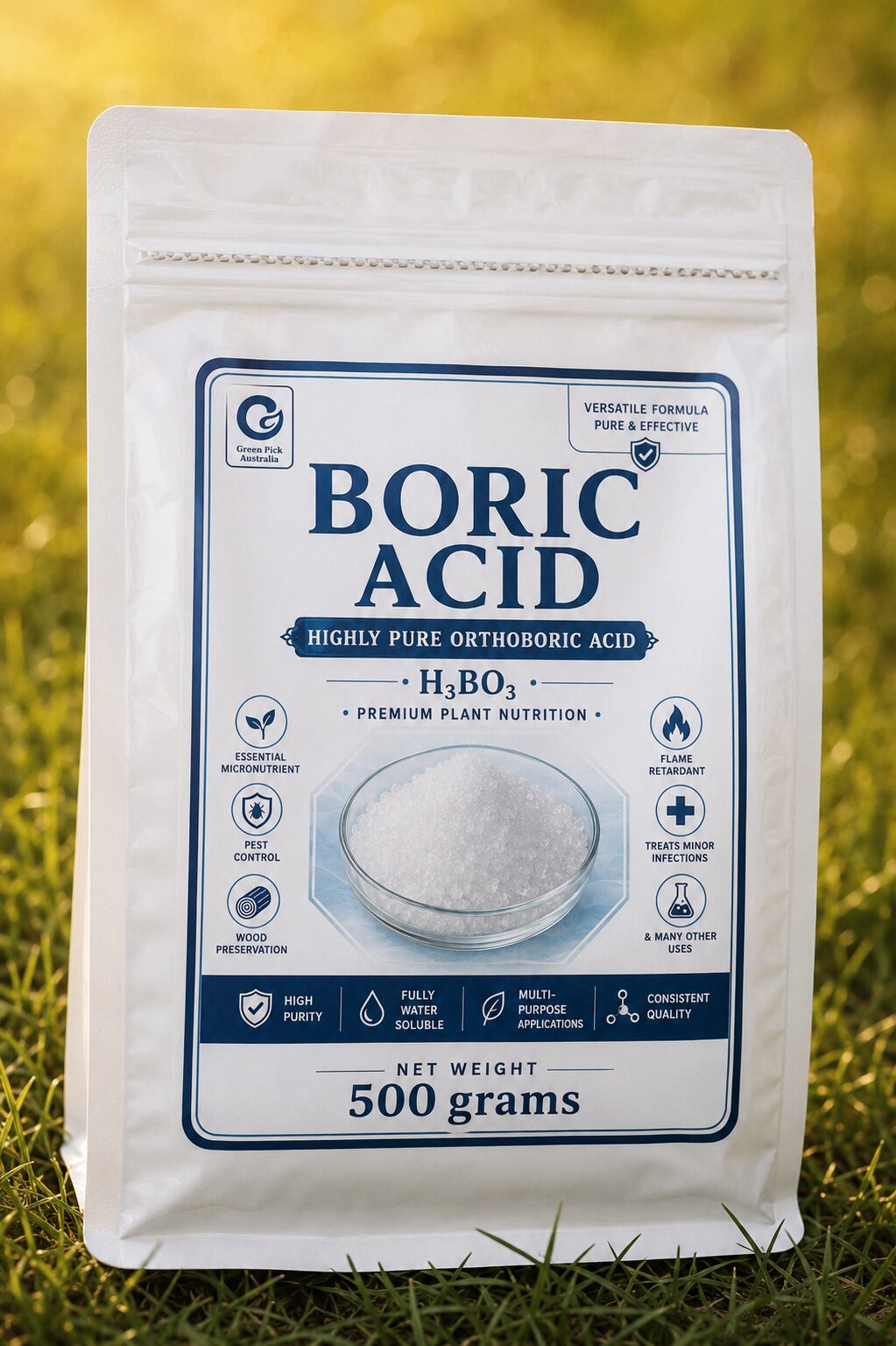
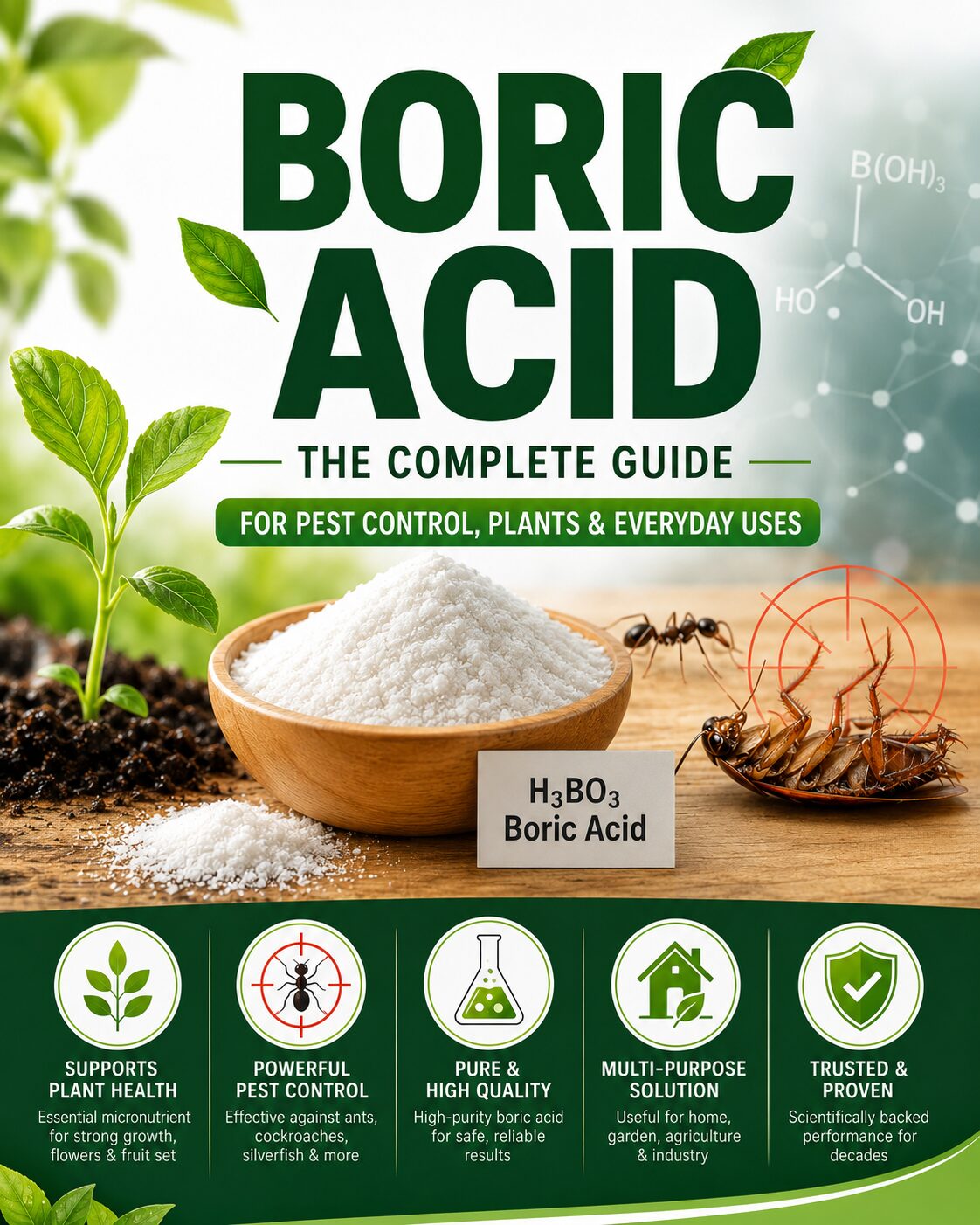

Boric acid is a versatile compound widely used in agriculture, horticulture, pest management, manufacturing, and various industrial applications. Known chemically as H₃BO₃, boric acid is a high-purity white crystalline powder that provides a reliable source of boron and has been valued for decades for its unique properties.
From supporting healthy plant growth to helping manage household pests such as ants, cockroaches, and silverfish, boric acid continues to be used by gardeners, growers, homeowners, and professional users worldwide.
This guide explains how boric acid works, its common applications, benefits, limitations, and important safety considerations for responsible use.
What Is Boric Acid?
Boric acid is a naturally occurring compound made from boron, oxygen, and hydrogen.
Its chemical formula is: H₃BO₃
It typically appears as a fine white powder or crystalline material and has several important characteristics:
- High purity and consistent composition
- Low odour
- Water solubility
- Long storage stability when kept dry
- Versatile applications
Boric acid is commonly used as:
- A boron fertiliser source
- A component in pest-control products
- An industrial chemical ingredient
- A laboratory material
- A manufacturing additive
Its popularity comes from its ability to perform effectively across different applications when used correctly.
The Chemistry of Boric Acid Explained
Boric acid is a weak Lewis acid containing the essential micronutrient boron.
Chemical Formula
H₃BO₃
Molecular Weight
61.83 g/mol
Appearance
White very fine crystalline powder
Solubility
Moderately soluble in water
Unlike strong mineral acids, boric acid behaves differently in chemical reactions. Its chemistry allows it to interact with biological systems and materials in ways that make it useful in agriculture, pest management, and industry. However, because boron is biologically active, correct dosage and responsible handling are important.
Why Is Boric Acid Used for Pest Control?
One of the most searched uses of boric acid is pest management.
For many years, boric acid has been used in pest-control formulations including baits and dust applications because it provides a slow-acting method of controlling certain crawling insects.
Its effectiveness comes from several mechanisms.
How Boric Acid Works Against Insects
1. Ingestion Effect
When insects consume boric acid, it interferes with normal digestive processes and metabolism.
The insect gradually becomes unable to function normally, eventually leading to death.
2. Exoskeleton Disruption
Boric acid particles can affect the protective outer layer of insects.
This may contribute to moisture loss and dehydration.
3. Slow-Acting Transfer
Unlike some fast-acting insecticides, boric acid generally works gradually. This slower action can be useful because ants and cockroaches may return to their hiding areas or colonies before the effects occur, which ultimately allows exposure to spread through insect populations.
Boric Acid for Ant Control
Boric acid is widely used in ant-control bait systems.
Worker ants collect food and carry it back to the colony, where it may be shared with other ants.
When correctly formulated in bait, boric acid can help target hidden colonies rather than only visible ants.
Why Boric Acid Works Against Ants
Benefits include:
- Slow action suitable for bait systems
- Ability to reach hidden nests
- Long-lasting effectiveness when kept dry
- Compatibility with integrated pest management approaches
Best Practices
For better results:
- Use small controlled amounts
- Place bait near ant activity
- Avoid excessive concentrations
- Allow ants time to carry material back to the colony
Using too much boric acid may reduce attractiveness and cause ants to avoid the bait.
For pest-control applications, selecting a high-quality boric acid product helps ensure predictable performance.
Boric Acid for Cockroach Control
Cockroaches are persistent pests that can survive in difficult environments.
Boric acid has been used as part of cockroach management programs because of its residual activity and ability to reach hidden areas.
How It Works on Cockroaches
Cockroaches may pick up boric acid particles while walking through treated areas.
During grooming, they can ingest the particles, which affects their digestive system and contributes to control.
Common Application Areas
Typical locations include:
- Behind appliances
- Under sinks
- Around plumbing entry points
- Inside cracks and crevices
- Along wall edges
- Hidden dry areas
A light application is generally preferred over heavy piles because insects are more likely to cross a barely visible layer.
Boric Acid for Silverfish
Silverfish prefer humid environments and commonly feed on materials containing starches, paper products, and adhesives.
Boric acid can help manage silverfish by:
- Affecting their outer body layer
- Causing dehydration
- Acting through ingestion
Common areas of concern include:
- Storage spaces
- Cupboards
- Wall gaps
- Skirting areas
- Low-moisture hidden spaces
Boric Acid for Other Crawling Insects
Boric acid may be used in various pest-management applications involving insects such as:
- Ants
- Cockroaches
- Silverfish
- Earwigs
- Beetles
- Carpet beetles
Effectiveness depends on the insect species, application method, environmental conditions, and formulation.
Why Professionals Use Boric Acid
Despite the availability of newer pest-control products, boric acid remains widely used because of several advantages.
Long History of Use
Boric acid has been studied and used in pest management for many years.
Long Residual Activity
When kept dry and properly applied, it can remain effective for extended periods.
Cost Efficiency
Small quantities can provide useful results.
Versatility
It can be incorporated into:
- Baits
- Dust applications
- Integrated pest management programs
Boric Acid for Plants and Agriculture
This material is also important in agriculture because it provides boron, an essential micronutrient required for normal plant development.
Although plants require only small amounts of boron, it plays a major role in growth and reproduction.
Why Plants Need Boron
Boron contributes to:
- Cell wall formation
- Root development
- Flower formation
- Pollination
- Fruit and seed development
- Nutrient transport
A shortage of boron can negatively affect crop quality and yield.
Signs of Boron Deficiency in Plants
Common symptoms include:
- Abnormal new growth
- Weak stems
- Poor flowering
- Reduced fruit set
- Cracked or damaged produce
- Root development issues
Crops that may require careful boron management include:
- Brassicas
- Canola
- Sunflowers
- Apples
- Pears
- Grapes
- Beet crops
Using Boric Acid as a Boron Source for Plants
Boric acid is commonly used as a boron fertiliser ingredient because it provides a readily available form of boron.
Benefits include:
- Consistent nutrient content
- Easy mixing and application
- Reliable boron availability
- Compatibility with many fertiliser programs
However, boron is a micronutrient required in very small quantities. The difference between sufficient boron and excessive boron can be relatively narrow, so application should always be based on crop requirements and appropriate recommendations.
Over-application of boron may cause plant stress or toxicity.
Signs of Excess Boron in Plants
Too much boron may result in:
- Leaf tip burn
- Yellowing or browning leaf edges
- Reduced plant growth
- Leaf damage
- Lower crop performance
For this reason, boric acid should not be applied at random or in excessive amounts.
Correct application rates depend on factors such as:
- Crop type
- Soil conditions
- Existing boron levels
- Application method
- Local growing conditions
Choosing High-Quality Boric Acid
Boric acid products can vary in purity, particle size, and suitability depending on their intended use.
When selecting boric acid, consider:
Purity
High-purity material provides more consistent results, especially for agricultural, horticultural, and formulation purposes.
Product Consistency
A reliable product should have:
- Consistent appearance
- Clear product specifications
- Proper labelling
- Safety information
Suitable Grade
Different applications may require different specifications. Agricultural and industrial users should select a product appropriate for their intended purpose.
High-quality boric acid helps provide predictable performance and easier handling.
Other Common Uses of Boric Acid
Beyond pest control and agriculture, boric acid is used in many industries.
Common applications include:
- Glass manufacturing
- Ceramics production
- Metal treatment
- Chemical manufacturing
- Laboratory applications
- Industrial formulations
- Cleaning products
- Fire-resistant materials
Its combination of chemical stability and useful boron properties makes it an important industrial compound.
Safety Precautions When Using Boric Acid
Boric acid is a useful chemical compound, but it should always be handled responsibly.
It is important to understand that boric acid is not a food product, medicine, or general-purpose household powder. It should only be used for appropriate applications and stored correctly.
Keep Away From Children and Pets
Store boric acid:
- In its original labelled container
- In a dry location
- Away from children
- Away from pets
- Away from food and animal feed
Pets, especially smaller animals, may be more vulnerable to accidental exposure.
Do not leave boric acid powder or treated bait products where animals can access them.
Avoid Excessive Plant Application
⚠️ Although boron is essential for plants, excessive amounts may cause toxicity.
Avoid applying concentrated boric acid solutions unless you understand the required rate for your specific crop.
More product does not mean better results. Correct dosage is essential.
First Aid and Exposure Information
If boric acid contacts eyes:
- Rinse carefully with clean water
- Seek medical advice if irritation continues
If it contacts skin:
- Wash thoroughly with water
If swallowed or accidental exposure occurs:
- Seek appropriate medical advice
- Provide the product label or safety information where possible
Frequently Asked Questions About Boric Acid
Is boric acid effective against ants?
Yes. Boric acid is commonly used in ant bait systems because its slower action can allow ants to carry material back to their colony.
Does boric acid kill cockroaches?
Yes. Cockroaches may ingest boric acid particles while grooming after contact with treated areas. It is commonly used as part of cockroach management strategies.
How long does boric acid take to work?
The timeframe depends on:
- Insect species
- Amount used
- Environmental conditions
- Application method
Because boric acid often works gradually, visible results may take several days or longer.
Can boric acid be used on plants?
Yes. Boric acid can be used as a boron source for plants when applied correctly.
However, plants require only small amounts of boron, and excessive application may damage plants.
Is boric acid safe around pets?
⚠️ Boric acid should be stored and applied carefully. Pets should not have access to boric acid powder, treated areas, or pest-control bait products.
Can boric acid be mixed with water?
Yes, boric acid can be dissolved in water for certain applications. However, the correct concentration depends on the intended use.
Always follow appropriate application guidance.
Final Thoughts
Boric acid remains one of the most versatile boron compounds available today, which means that in agriculture, it provides a valuable source of boron, supporting important plant processes such as flowering, reproduction, and healthy growth. In pest management, it has been widely used because of its slow-acting properties, residual effectiveness, and ability to target certain crawling insects. Whether used by gardeners, growers, homeowners, or professional users, high-quality boric acid can provide reliable performance when handled and applied responsibly.
For best results, always choose a suitable grade, follow recommended application practices, and store the product safely.
Explore our premium Boric Acid range today for a high-purity product suitable for agricultural, horticultural, and general-purpose applications.
References & Further Reading
The information in this article is based on established chemical, agricultural, and pest-management resources, including:
- Australian Pesticides and Veterinary Medicines Authority (APVMA)
https://www.apvma.gov.au/ - United States Environmental Protection Agency (EPA) chemical safety resources
https://www.epa.gov/ - University agricultural extension publications on boron nutrition and crop management
- Integrated Pest Management (IPM) guidance from agricultural extension services