
Aluminium Sulphate vs Potassium Bicarbonate: Which One Does Your Soil Actually Need?
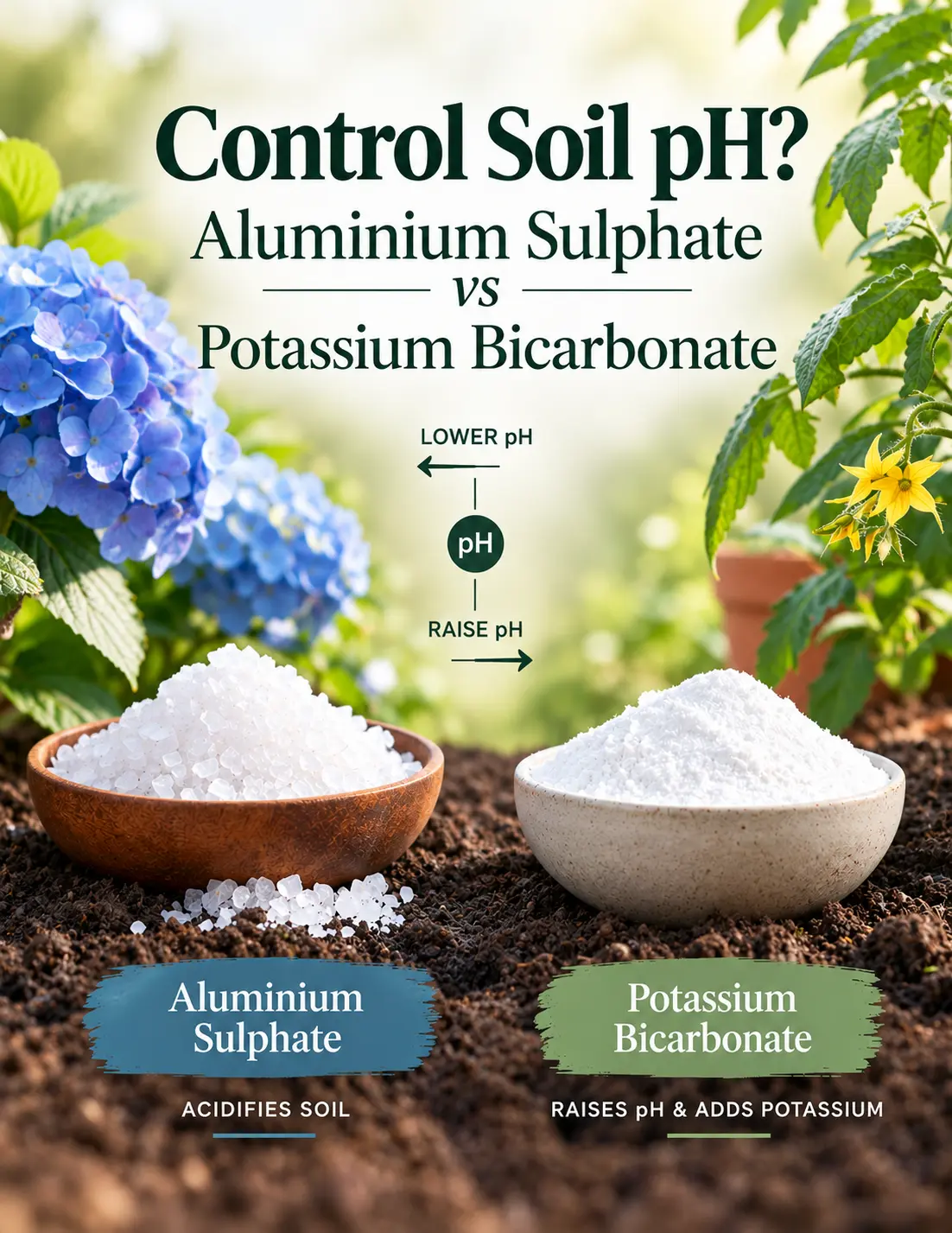
Ask five gardeners how to change soil pH and you’ll get five different answers — lime, sulphur, coffee grounds, vinegar. Two of the most reliable, fastest-acting options rarely get compared side by side: aluminium sulphate and potassium bicarbonate. They sit at opposite ends of the pH scale, solve opposite problems, and despite turning up in the same “soil amendment” search results, they aren’t really competing for the same job. This guide walks through the real chemistry behind each one, exact rates from pots to garden beds, safety handling, and — most importantly — which one your soil is actually asking for.
Why soil pH matters before you reach for either one
Soil pH measures hydrogen ion concentration on a 0–14 scale: 7 is neutral, below is acidic, above is alkaline. It matters less for its own sake and more for what it controls — pH decides which nutrients are chemically available for roots to take up, regardless of how much fertiliser is sitting in the ground. Most garden plants access nutrients best in slightly acidic to neutral soil, roughly pH 6.0 to 7.0, which is exactly the window most soil amendments are trying to nudge things toward.
Push outside that range and specific nutrients get locked up even when they’re physically present in the soil:
| Soil condition | What’s happening chemically | What you’ll see |
|---|---|---|
| Below pH 6.0 (acidic) | Aluminium and manganese become more soluble, sometimes to toxic levels; calcium and magnesium harder to access | Stunted roots, poor growth in lime-loving plants |
| Above pH 7.5 (alkaline) | Iron, manganese and zinc form insoluble compounds roots can’t use | Interveinal chlorosis — yellow leaf tissue, green veins, worst on new growth |
| 6.0–7.0 (near neutral) | Most macro and micronutrients sit at or near peak availability | Steady, unstressed growth for most garden plants |
A cheap pH test kit — or a $15 digital probe — is the only way to know which direction, if any, your soil actually needs to move. Guessing is how most home acidifying and liming mistakes happen.
Aluminium sulphate vs potassium bicarbonate, at a glance
Before the deep dive, here’s how the two stack up on the numbers that actually decide which one belongs in your shed.
| Feature | Aluminium Sulphate Al₂(SO₄)₃ |
Potassium Bicarbonate KHCO₃ |
|---|---|---|
| Effect on soil pH | Lowers it (acidifier) | Raises it (mild alkalizer) |
| How it acts | Hydrolyses on contact, releasing H⁺ ions within days | Neutralises acid on contact, but is used up as it reacts |
| Key nutrient supplied | ~9% aluminium (not a plant nutrient) | ~39% potassium (essential macronutrient) |
| Purity (GreenPick) | 98% min | 99% min |
| Solubility @ 20°C | 364 g/L | 224 g/L |
| Sodium / chloride | None | 0% — safe for chloride-sensitive plants |
| Best for | Acid-loving beds, hydrangea blueing, pond/water clarifying | Pots, hydroponics, soft water, foliar feeding |
| Not ideal for | Soil that’s already below pH 6 | Correcting a whole bed cheaply — use lime instead |
| Typical starting rate | 100–150 g/m² (garden bed) | 2–3 g/L (foliar spray) |
| GreenPick price | $19.99–$129.90 | $19.99–$129.90 |
| Shop | View product → | View product → |
🔴 Aluminium sulphate: the acidifier
Aluminium sulphate (Al₂(SO₄)₃) is a water-soluble salt of a strong acid and a weak base, so when it dissolves it hydrolyses — the aluminium ion reacts with water to form aluminium hydroxide and free hydrogen ions:
Those extra H⁺ ions are what push soil pH down, and because it’s a straightforward chemical reaction rather than a biological one, it works within days to weeks of watering in. Elemental sulphur, the other common acidifier, has to be oxidised by soil bacteria first — a slower process needing warm, moist soil that can take months, though the result lasts longer. The trade-off: aluminium sulphate typically needs six to eight times more product by weight than sulphur for the same pH drop — you’re buying speed, not efficiency.
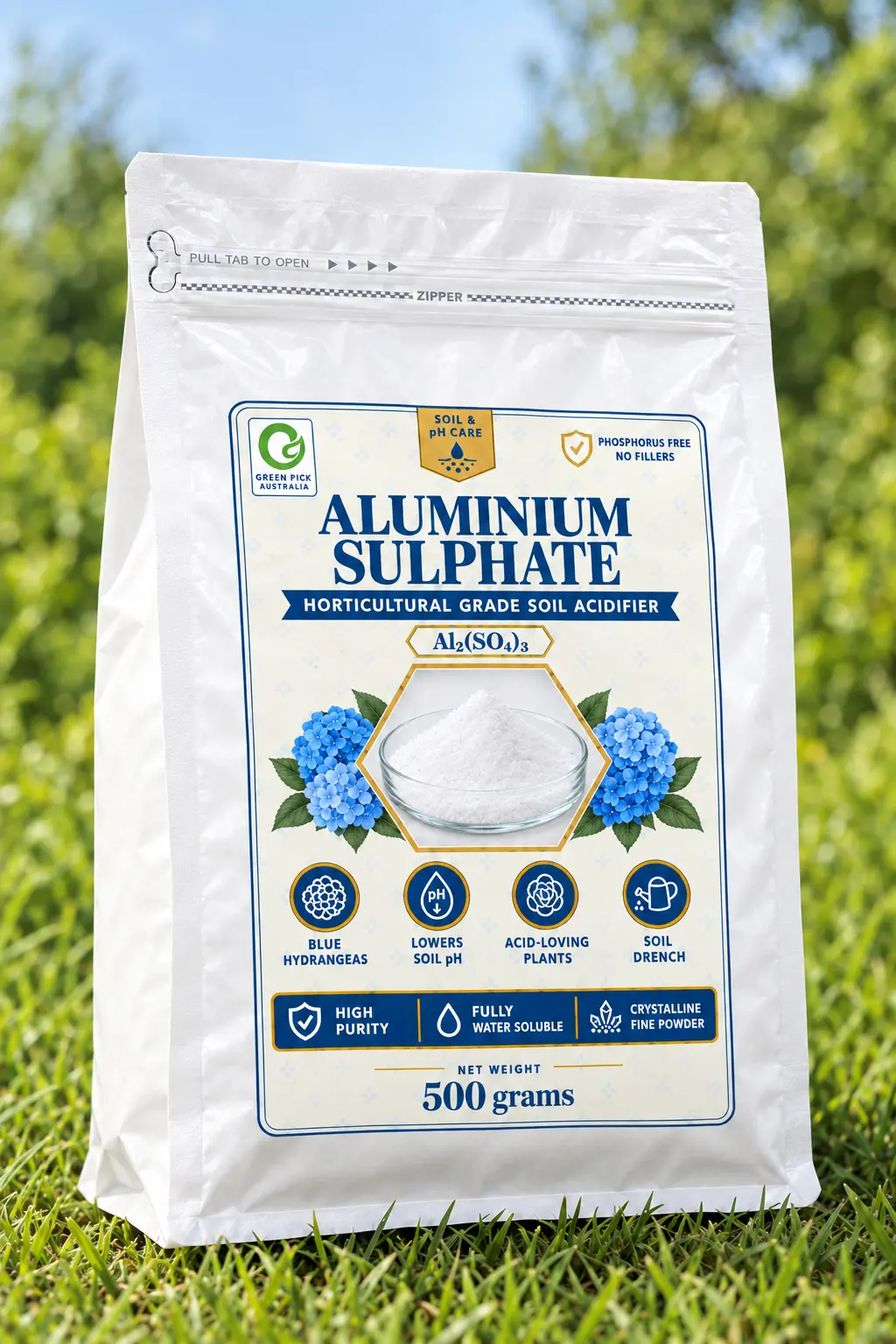
GreenPick’s grade is low-iron (non-ferric) at 98% minimum purity, supplying around 9% elemental aluminium and 43% sulphate, fully soluble to 364 g/L at 20°C.
How much to use
| Situation | Rate | Notes |
|---|---|---|
| Light correction, sandy soil | 50–75 g/m² | Retest pH after 4–6 weeks |
| Standard bed prep (azaleas, camellias, rhododendrons) | 100–150 g/m² | Water in well; delay planting bare soil ~1 month at higher rates |
| Heavy clay or strongly alkaline soil | 150–250 g/m² | Split into 2 doses, 4 weeks apart |
| Potted acid-lovers (blueberries, camellias) | 5–20 g per pot | Scale to container size; water thoroughly |
Always confirm against a soil test rather than guessing — treating soil that’s already acidic can push pH low enough to cause aluminium toxicity and lock out calcium and magnesium.
Turning hydrangeas blue
The one job aluminium sulphate does that nothing else really does well: hydrangea colour. Mophead and lacecap hydrangeas (Hydrangea macrophylla and H. serrata) carry the same flower pigment whether they bloom pink or blue — the difference is whether free aluminium is available at the roots. Below about pH 5.5, aluminium becomes soluble enough for the plant to take up and shift the pigment toward blue; above that, the same plant blooms pink.
Full, saturated blue is usually a second-season result, especially starting from alkaline soil — aluminium reaches the roots quickly, but pigment builds up over a full growing cycle. Skip high-phosphate fertilisers on hydrangeas you’re trying to blue; phosphorus binds aluminium into a form roots can’t use.
Handle it safely
The dry powder and its solutions are skin and eye irritants — gloves and eye protection are worth it every time, not just for a big batch. Never mix it with lime, dolomite, wood ash or any bicarbonate/carbonate product: the reaction neutralises both and can precipitate insoluble aluminium hydroxide, wasting the lot. Store it sealed and dry — it’s hygroscopic and will cake in humid air, though clumping doesn’t reduce its strength.
🔵 Potassium bicarbonate: the alkalizer and feeder
Potassium bicarbonate (KHCO₃) is a mildly alkaline salt — a 0.1 molar solution sits around pH 8.2. Unlike aluminium sulphate, it isn’t primarily sold as a soil-pH tool; it’s better known for feeding potassium without the sodium or chloride baggage of muriate of potash, and as the compound behind commercial foliar fungicides. Raising pH is a genuine side effect here, not the headline act.
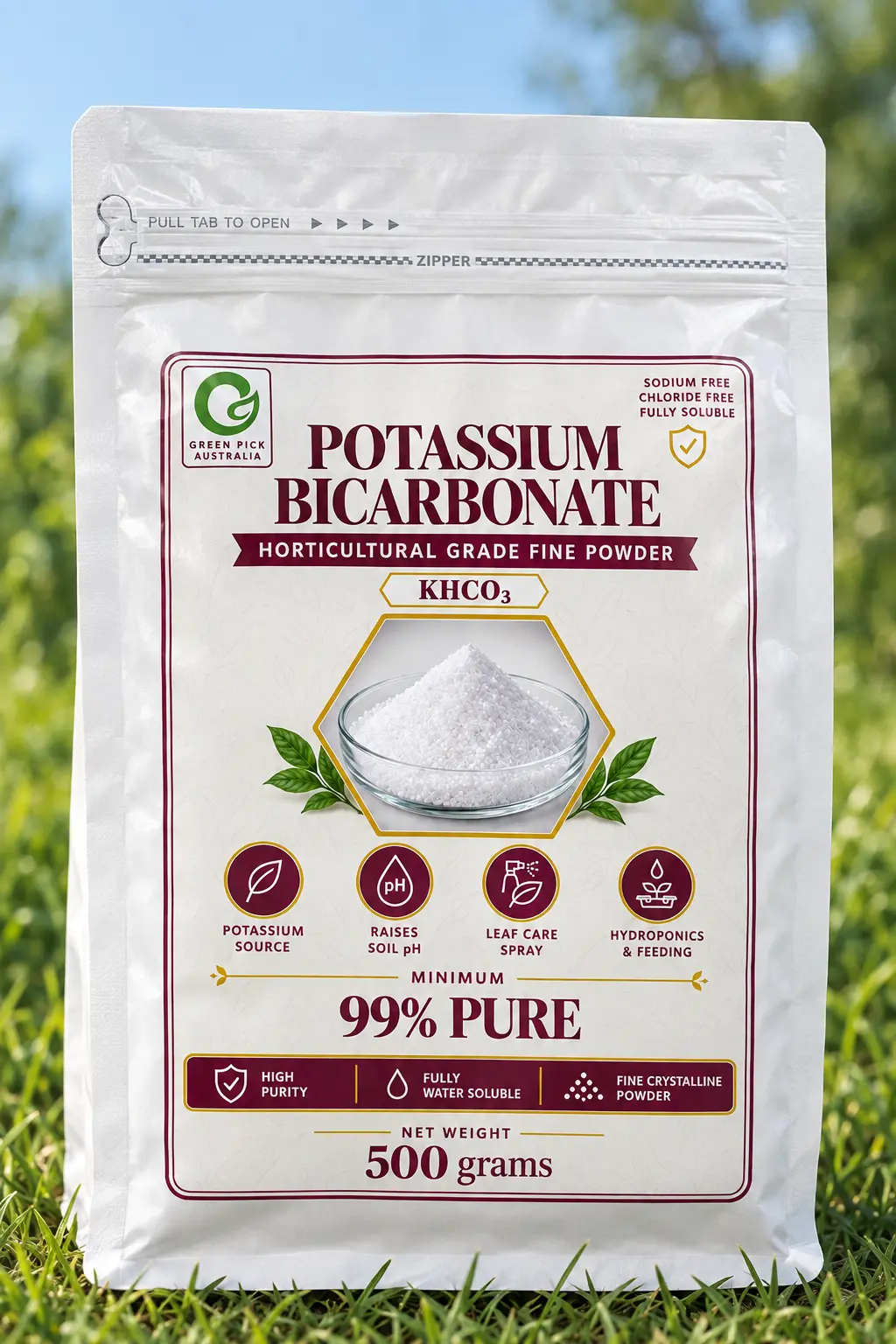
GreenPick’s grade is 99% minimum purity, supplying around 39% elemental potassium (47% K₂O equivalent), fully soluble to 224 g/L, with zero sodium and zero chloride — which matters most in pots, recirculating hydroponic systems and on chloride-sensitive plants where salt build-up is a real risk over time.
Feeding potassium
| Plant type | Rate | Frequency |
|---|---|---|
| Seedlings & sensitive foliage | 1–2 g/L | Every 3–4 weeks |
| Vegetables & annuals | 2–3 g/L | Every 2–3 weeks in active growth |
| Roses & ornamentals | 2–4 g/L | Every 2–3 weeks |
| Fruit trees, vines & shrubs | 3–5 g/L | Every 2–4 weeks |
Spray to the point just before runoff on both leaf surfaces, in early morning or late afternoon — never above 28°C or in full sun. Don’t exceed 5 g/L; bicarbonate sprays can mark sensitive leaves at higher concentrations, so spot-test a couple of leaves first on any plant you haven’t sprayed before.
Raising pH — and why it’s not a lime replacement
Potassium bicarbonate neutralises acid at roughly half the strength of agricultural lime, weight for weight, and the effect isn’t permanent — it’s consumed as it reacts, so it needs repeating. That makes it a poor economic choice for a whole garden bed, where lime or dolomite does the job for a fraction of the cost. It earns its place in smaller, controlled volumes instead: potting mix (3–5 g/L as a drench), soft or acidic rainwater and RO water (0.3–0.5 g per 10 L), and hydroponic reservoirs, where 0.25–1 g per 10 L nudges pH up while adding a small dose of potassium and buffering alkalinity.
The foliar-spray story
Potassium bicarbonate has a long history as a leaf-surface treatment for rose, grape, cucurbit and fruit-tree growers, and it’s the same compound behind commercial fungicide products like MilStop and Kaligreen. On contact, it raises the pH at the leaf surface and draws water out of fungal spores, disrupting cell-wall formation — a mechanism well documented against powdery mildew specifically.
Away from the garden, the same compound turns up as a food additive (E501, a low-sodium baking-powder ingredient), a wine deacidifier, a mild antacid, and the active ingredient in some dry-chemical fire extinguishers — more on that in the “other uses” section below.
Handle it safely
It’s the milder of the two products, but still not something to breathe or handle carelessly — gloves and eye protection for the dry powder remain good practice. Keep it away from acids, pH-down products and concentrated calcium or magnesium fertiliser stocks; mixed together they fizz, waste the product, and can precipitate a sludge that blocks drippers and nozzles. Store it sealed, cool and dry — heat and humidity slowly convert it to potassium carbonate.
🤔 Which one do you actually need?
If you’re still not sure, match your situation to the list below rather than the product name.
- Growing azaleas, camellias, rhododendrons or blueberries in neutral-to-alkaline soil → Aluminium sulphate
- Trying to turn a mophead or lacecap hydrangea blue → Aluminium sulphate
- Watering pots or a hydroponic reservoir with soft, naturally acidic rainwater or RO water → Potassium bicarbonate
- Feeding potassium to flowering or fruiting plants without adding sodium or chloride → Potassium bicarbonate
- Managing powdery mildew or a similar foliar disease → a registered, labelled fungicide product — not either raw input in this guide
- Correcting pH across a whole garden bed or lawn as cheaply as possible → neither — use elemental sulphur (to lower) or agricultural lime/dolomite (to raise), then return to these two for the specific jobs above
The two products rarely substitute for each other, and that’s the point — pick based on which direction your soil (or your hydrangea) actually needs to move, not on whichever bag is already in the shed.
🧴 Other uses beyond the garden
Aluminium sulphate
Long before it was a garden bag, alum was a water-treatment chemical, and it still is at municipal scale. In water it acts as a coagulant: dissolved aluminium reacts with natural alkalinity to form a fine floc that drags clay, silt and colour-causing particles out of suspension as it settles — the same floc binds dissolved phosphorus, the nutrient that fuels algae blooms. It’s chemistry, not a biocide, so it clarifies without disinfecting. Home-scale uses include clearing muddy dam water (5–20 g per 1000 L), managing phosphorus in fish ponds (check alkalinity is at least 50 mg/L as CaCO₃ first), and a one-off pool clarifying dose after an algae bloom (40–50 g per 1000 L). It’s also a traditional mordant for dyeing wool and cotton, and a historic ingredient in leather tanning and paper sizing.
Potassium bicarbonate
As KHCO₃, this compound shows up across food, wine and fire safety long before it shows up in a garden catalogue. It’s registered in the EU as food additive E501, used as a low-sodium alternative to baking soda in bread and cakes, and as an acidity regulator in soda water. Winemakers use it to deacidify wines that have tipped too sharp. It’s a mild, short-term antacid and potassium supplement in over-the-counter products. And it’s the active ingredient in some dry-chemical fire extinguishers rated for flammable-liquid and electrical fires, valued because it breaks down cleanly into potassium carbonate, water and CO₂ with no toxic residue.
⚠️ Safety & storage quick reference
| Aluminium sulphate | Potassium bicarbonate | |
|---|---|---|
| Handling | Gloves + eye protection; skin/eye irritant | Gloves + eye protection recommended; milder |
| If in eyes | Rinse with running water for 15 minutes | |
| If swallowed | Rinse mouth, drink water, then seek medical advice | |
| Storage | Sealed, cool, dry; away from lime & alkaline products | Sealed, cool, dry; away from acids & direct sun |
| Pets, kids, edible crops | Keep pack away from both; wash produce before eating, as with any garden input | |
| Poisons info (Australia) | 13 11 26 | |
Neither product is registered as an agricultural chemical or sold for pest, weed or disease control — both are horticultural-grade raw materials and soil/plant nutrient inputs. Where you need a registered product for a specific claim, check the label for an APVMA approval number.
❓ Frequently asked questions
Can I use aluminium sulphate and potassium bicarbonate in the same garden?
Yes, but not on the same bed for the same purpose — one lowers pH, one raises it. A common combination is aluminium sulphate on an azalea or camellia bed in one corner, and potassium bicarbonate as a potassium-rich foliar feed on vegetables elsewhere. Never mix the two together in the same bucket; the bicarbonate reacts with the acidic sulphate salt and fizzes uselessly.
Which one is better for a vegetable garden?
Neither is really a vegetable-garden pH fix. Most vegetables want 6.0–6.8, close to neutral, so a strong acidifier or alkalizer usually isn’t needed — test first. Potassium bicarbonate’s foliar-feed role suits pots and raised beds with soft water; aluminium sulphate is a specialist for acid-loving ornamentals, not general veggie beds.
Is either one organic-certified?
Potassium bicarbonate is accepted under many organic standards, though certification applies to specific labelled products, not the raw chemical. Aluminium sulphate is a mineral input but isn’t typically listed as an organic-approved soil acidifier — elemental sulphur is the usual organic choice for that job.
Will potassium bicarbonate fix powdery mildew on my plants?
Potassium bicarbonate is the active ingredient behind several registered commercial fungicide products used against powdery mildew, working by disrupting fungal cell walls and raising leaf-surface pH. Raw, unregistered potassium bicarbonate isn’t sold or labelled for disease control — for a disease claim, choose a product carrying the relevant registration and follow its label.
How long does the pH change last?
Both are temporary next to lime or elemental sulphur. Aluminium sulphate’s effect fades as sulphate leaches and soil buffering reasserts itself, often needing a repeat dose every few months on strongly buffered soils. Potassium bicarbonate’s alkalinity is used up as it neutralises acid, sometimes within weeks in a small pot or reservoir.
Can I use these on lawns?
Rarely a good idea for either. Most lawn grasses prefer close-to-neutral soil already, and neither product is a moss killer — that’s a common myth for aluminium sulphate specifically. If a soil test shows a genuinely alkaline lawn, a light rate can help, but treat it as the exception, not the default.
Which is safer to have around pets and kids?
Both are low-toxicity mineral inputs, not registered poisons, but neither is edible. Potassium bicarbonate is the milder of the two — food-grade versions exist for baking — while aluminium sulphate solutions are more irritating to skin and eyes and need more careful handling. Store both sealed, out of reach, and away from each other.
The bottom line
Aluminium sulphate and potassium bicarbonate aren’t rivals — they’re tools for opposite ends of the same scale. If your soil, or your hydrangea, needs to go more acidic, aluminium sulphate is the fast, well-understood way to get there. If you need a gentle pH lift in a pot, a hydroponic reservoir or soft irrigation water — with a side of potassium — reach for the bicarbonate instead. Test before you treat, respect the rates above, and keep the two well apart in storage.
📚 References & further reading
- GreenPick — Full Aluminium Sulphate usage guide
- GreenPick — Full Potassium Bicarbonate usage guide
- Oklahoma State University Extension — Acidifying Lawns and Garden Soils
- West Virginia University Extension — Lowering Soil pH
- Purdue Extension — Soil pH (HO-240-W)
- Encyclopedia.com — Potassium Bicarbonate