
How to use aluminium sulphate in the garden
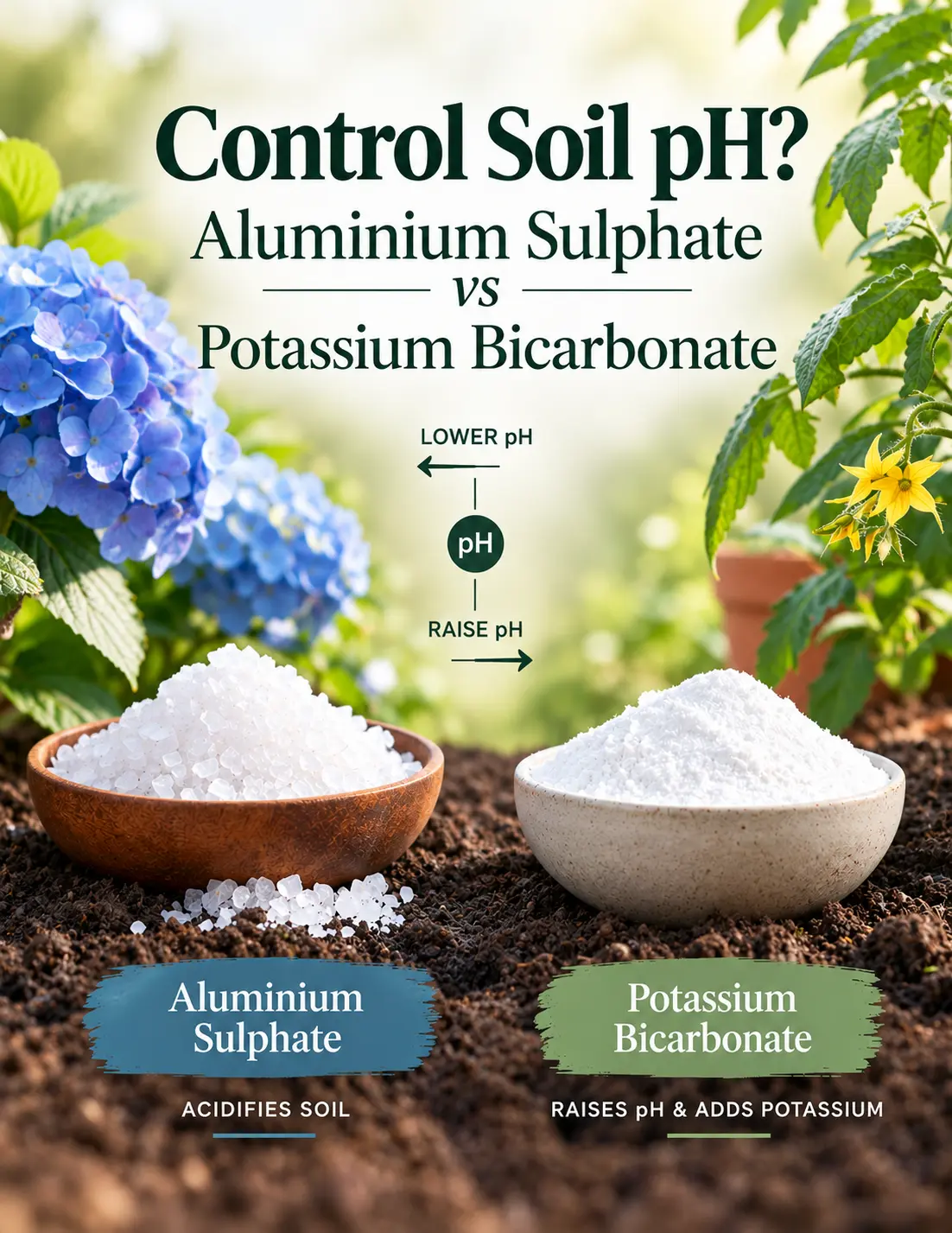
One acidic, water-soluble powder that does two garden jobs: it lowers soil pH for azaleas, camellias, rhododendrons and blueberries, and it’s the one input that reliably turns hydrangeas blue. This guide covers rates for both, plus how to use it safely in dams, ponds and pools.
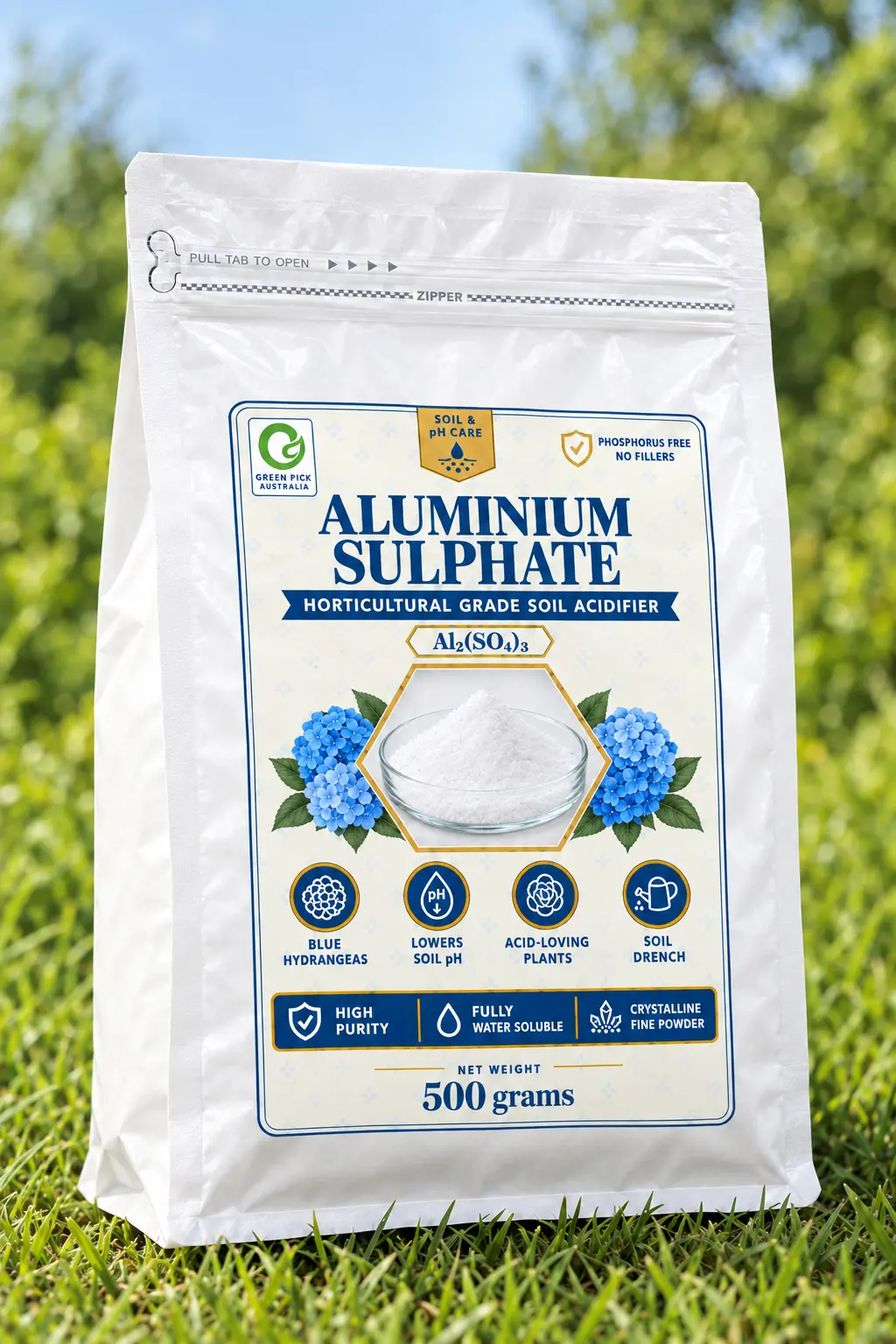
Aluminium sulphate is fully water-soluble and strongly acidic in solution. Unlike elemental sulphur, which needs weeks of microbial activity to shift pH, it acts as soon as it dissolves — and it supplies free aluminium ions directly, which is exactly what blue-flowering hydrangeas need. This is a low-iron (non-ferric) grade, which matters if you want to avoid the faint rust-brown staining that iron-contaminated alum can leave on pale blooms and fabric.
Which job are you doing?
Acidifying soil
Lower pH for azaleas, camellias, rhododendrons and blueberries, or correct an alkaline garden bed. Rates from 50–250 g/m².
Blueing hydrangeas
Supply the free aluminium ions blue-flowered varieties need, on top of acidifying the root zone. 3–4 g/L drench.
Water & pond treatment
Clear muddy dams and tanks, bind phosphorus in ponds, and clarify pools after an algae bloom.
Skip to this section →
Measuring without scales
One level metric teaspoon (5 mL) holds roughly 4–5 g. One level Australian tablespoon (20 mL) holds roughly 16–20 g. Kitchen scales are better — granule size varies between batches, and a heaped spoon can be well over the level amount.
Each kilogram of powder makes around 250 litres of hydrangea drench at 4 g/L, or treats about 8 m² of garden bed at the standard 125 g/m² acidifying rate. Scale this to your pack size — a 2.5 kg bag, for example, covers roughly 20 m² or makes 625 L of drench.
Acidifying garden soil
Test your soil pH first
Aluminium sulphate is mainly worth using if your soil is neutral to alkaline and you’re growing acid-loving plants. On soil that’s already acidic (below pH 6), adding more can push pH low enough to cause aluminium toxicity and lock out calcium and magnesium. A cheap pH test kit pays for itself on the first bag.
Garden beds & borders
Worked into the top 10–15 cm before planting acid-loving beds
| Situation | Rate | Notes |
|---|---|---|
| Light correction, sandy soil | 50–75 g/m² | Retest pH after 4–6 weeks |
| Standard bed prep (azaleas, camellias) | 100–150 g/m² | Water in well after applying |
| Heavier clay or strongly alkaline soil | 150–250 g/m² | Split into 2 doses, 4 weeks apart |
Delay planting for about a month after treating bare soil at the higher rates, to give the acidifier time to work before roots are in contact with it. On established beds, work the powder lightly into the surface and water it in rather than digging deep and disturbing roots.
Shrubs & trees
Topdressed in a ring around the drip line, not against the stem
| Plant size | Rate | Frequency |
|---|---|---|
| Small shrub (under 1 m) | 150 g | Monthly, to a seasonal total of 450 g |
| Medium shrub (1–2 m) | 300–450 g | Monthly through active growth |
| Large shrub / small tree (2–3 m) | 450–500 g | Monthly, never exceed 500 g per dose |
| Trees (by trunk diameter) | ~180 g per cm diameter | Split into 2–3 doses across the season |
Pots & containers
Scaled to container size, every 6–8 weeks in the growing season
Use around 5–10 g for a pot up to 10 L, 10–20 g for 10–25 L, and 25–40 g for a large tub or half-barrel. Potting mix has far less buffering capacity than garden soil, so use the lower end of the range to start, water it in thoroughly, and check for leaf-tip browning before repeating.
Lawns & turf
Most Australian lawn grasses are happy in slightly acidic to neutral soil already, so acidifying turf is rarely necessary and is not a moss treatment (see the FAQ below). If a soil test shows your lawn is genuinely alkaline, a light rate of 20–30 g/m² is enough to nudge pH — test again before repeating, and get advice for anything larger than a home lawn.
Turning hydrangeas blue
Hydrangea colour comes down to one element: aluminium. Pink and blue flowers on the same plant contain the same pigment — it’s whether free aluminium is available to the roots that decides which colour shows. Aluminium sulphate does both halves of the job at once, acidifying the soil and supplying the ion directly. Only mophead and lacecap varieties (Hydrangea macrophylla and H. serrata) respond, and even among these, some cultivars take up aluminium more readily than others; white varieties won’t turn blue regardless.
Soil drench around the drip line — roughly 2–3 L for a young plant, up to 10 L for a large, established shrub
Working method
Two things that stop it working
Soil pH above 5.5 locks aluminium away from the roots — acidify first. And phosphorus-rich fertilisers bind aluminium into a form roots can’t use, so skip the high-phosphate blends on hydrangeas you’re trying to blue.
Colour change takes time
Aluminium reaches the roots quickly, but pigment builds up over a full growing season. Expect lavender or mixed tones the first year and the deepest blue in the second, especially starting from alkaline soil.
What not to mix it with
| Avoid | What happens |
|---|---|
| Lime, dolomite & wood ash | Neutralises both products and precipitates as insoluble aluminium hydroxide. Keep applications weeks apart and never in the same hole. |
| Bicarbonate or carbonate products | Fizzes vigorously, releasing CO₂ and destroying the product before it reaches the plant or water. |
| Concentrated calcium fertiliser stocks | Forms insoluble calcium sulphate (gypsum), clouding the solution and blocking drippers and nozzles. |
| High-phosphate fertilisers | Forms insoluble aluminium phosphate, locking up both nutrients and undoing the hydrangea-blueing effect. |
If you’re unsure about a tank mix, run a jar test: combine both products at final dilution in a clear jar, stand it for 30 minutes and look for fizzing, cloudiness or sludge before mixing a full batch.
Mixing & applying
Storage
Keep the pack tightly sealed in a cool, dry place, away from lime, wood ash and other alkaline products. Aluminium sulphate is hygroscopic — it draws in moisture and will cake or clump if left open or somewhere humid. Avoid storing or mixing it in bare metal containers, since any damp contact will corrode them over time.
Safety
- Keep out of reach of children and pets.
- Not for human or animal consumption.
- Wear gloves and eye protection when handling the dry powder or mixing solutions; avoid breathing dust.
- If in eyes, rinse with running water for 15 minutes. If swallowed, rinse the mouth and drink water, then seek medical advice.
- Rinse off skin promptly, and hose down any solution splashed on concrete, pavers or painted surfaces — it’s acidic and can etch or discolour some finishes.
- Wash hands after handling and clean equipment after use.
- Australian Poisons Information Centre: 13 11 26.
Other uses: water & pond treatment
↑ Back to the soil & garden guide
In water, aluminium sulphate works as a coagulant. Dissolved in water, it reacts with natural alkalinity to form a fine aluminium hydroxide floc that drags clay, silt and colour-causing particles out of suspension as it settles. The same floc binds dissolved phosphorus — the nutrient algae need to bloom. This is chemistry, not a biocide: it doesn’t disinfect water or kill algae directly, so it isn’t a substitute for a registered algicide or proper filtration where safe drinking water is required.
Clearing muddy dam, tank or trough water
Roughly 15 g/1000 L for mildly cloudy water, up to 35 g/1000 L for heavily turbid water — jar-test to confirm
Dissolve the dose in a bucket of water first, then stir it through the tank, or add it at the inlet so it disperses through a dam. Turn off pumps and let the water stand for several hours to overnight so the floc can settle, then draw off the clear water above the sediment rather than disturbing it.
Jar-test before treating the whole tank
Every water source is different. Try the dose in a 1 L jar first and watch for clumping and clearing within a few hours, then scale up. Increase gradually rather than guessing high.
Ponds & water features with fish
Same working range as dams above for turbidity; phosphorus-binding treatments can need more — get a bucket test done for a valuable stocked pond
Check alkalinity before treating a fish pond
Aluminium sulphate consumes a water body’s natural alkalinity as it works and lowers pH. As a general guide, don’t dose a pond with fish in it unless total alkalinity is at least 50–75 mg/L (as CaCO₃) and pH sits between about 6.5 and 8 — stay toward the higher end of that alkalinity range for extra safety in valuable stocked ponds. If alkalinity is lower, buffer with agricultural lime first, treat a large pond in sections, and apply in the cool of the morning with aeration running — never on a hot, still afternoon when oxygen is already low. For valuable stocked ponds, get advice from a pond-management professional before a first treatment.
Working method
Pools & spas
One-off clarifying dose after an algae bloom or heavy bather load — not a routine weekly treatment
Balance and sanitise the pool as normal first. Dissolve the dose, add it with the pump on recirculate, and brush the pool to help fine particles clump. Turn the pump off for 12–24 hours so the floc can settle, then vacuum to waste rather than through the filter. Retest and rebalance pH afterwards, since the treatment will have made the water more acidic.
Other traditional uses
Aluminium sulphate has a long history outside the garden too — as a mordant that helps natural dyes bind to wool and cotton, and as a traditional agent in leather tanning and paper sizing. These aren’t the focus of this product, but they explain why it turns up on hobby-dyeing and craft-supply lists as well as at garden centres.
Common questions
What does aluminium sulphate do for plants?
It works mainly as a soil acidifier — it lowers pH quickly on contact rather than waiting on soil microbes, and it supplies free aluminium ions at around 9% Al by weight. Most plants never need extra aluminium, but a handful of acid-loving species use the lower pH to access iron and other nutrients, and blue-flowered hydrangeas use the aluminium itself to produce their colour.
How is it different from elemental sulphur or iron sulphate?
Elemental sulphur lowers pH too, but slowly — soil bacteria have to oxidise it first, which can take weeks to months. Aluminium sulphate is already a soluble salt, so it acts as soon as it’s watered in — but weight for weight it’s the weaker acidifier, needing roughly six to seven times as much product as elemental sulphur to achieve the same pH drop. Iron sulphate (sulphate of iron) is a different tool again: it’s the usual choice for greening lawns and treating moss, where aluminium sulphate has no registered role.
What rate should I use on a garden bed?
Start at 100–150 g per m² worked into the top 10–15 cm before planting acid-loving beds, or 50–75 g per m² for a lighter correction on sandy soil. Heavier, more alkaline soils may need 150–250 g per m² split across two applications a few weeks apart. Always base the total on a soil test rather than guessing.
How much do I need for hydrangeas, and when do I apply it?
Dissolve 3–4 g per litre and drench around the drip line, using roughly 2–3 L of solution for a young plant, up to around 10 L for a large, established shrub. Apply from early spring, every 3–4 weeks, until flower buds are fully formed. Full, saturated blue usually takes a second season, especially if you’re starting from alkaline soil.
Can I use it on all my plants?
No. It’s suited to a specific group — azaleas, camellias, rhododendrons, blueberries and blue-flowered hydrangeas — that genuinely prefer acidic soil. Using it on plants that like neutral to alkaline conditions, or applying it too often, can push pH low enough to cause aluminium toxicity and interfere with calcium, magnesium and phosphorus uptake.
Will it get rid of moss in my lawn?
No — and it can work against you. Moss tends to favour acidic, compacted, poorly drained turf, so acidifying a lawn further doesn’t control it and may even encourage it. If moss is the problem, iron sulphate (sulphate of iron) is the standard lawn treatment in Australia, not aluminium sulphate.
Can I use it in ponds or dams that have fish?
Yes, and it’s a common water-clarifying and phosphorus-binding treatment — but check pH and total alkalinity first. Aluminium sulphate consumes alkalinity and lowers pH as it works, which can stress or harm fish in poorly buffered water. Buffer with agricultural lime if alkalinity is low, treat large ponds in sections, and apply in the cool of the morning with aeration running.
Is treated water safe to drink?
Aluminium sulphate is used at large scale in municipal water treatment, but treating your own tank or dam only clears suspended particles — it doesn’t disinfect the water or remove chemical or microbial contamination. Treated tank water should still be tested, and you should check with your local health authority before relying on tank water for drinking.
Is it safe around pets, bees and edible crops?
It’s a low-toxicity mineral input used the way any acidic fertiliser should be: keep the pack away from children and pets, avoid spraying it directly onto foraging bees, and wash produce before eating as you would with any garden input.
How should I store it, and does it go off?
Keep it tightly sealed, cool and dry, away from lime, wood ash and other alkaline products. It’s hygroscopic, so any exposure to humid air will make it cake and clump, though it doesn’t lose its acidifying strength — just break up any lumps before weighing a dose. Stored well, it keeps for years.