
How to use potassium bicarbonate in the garden
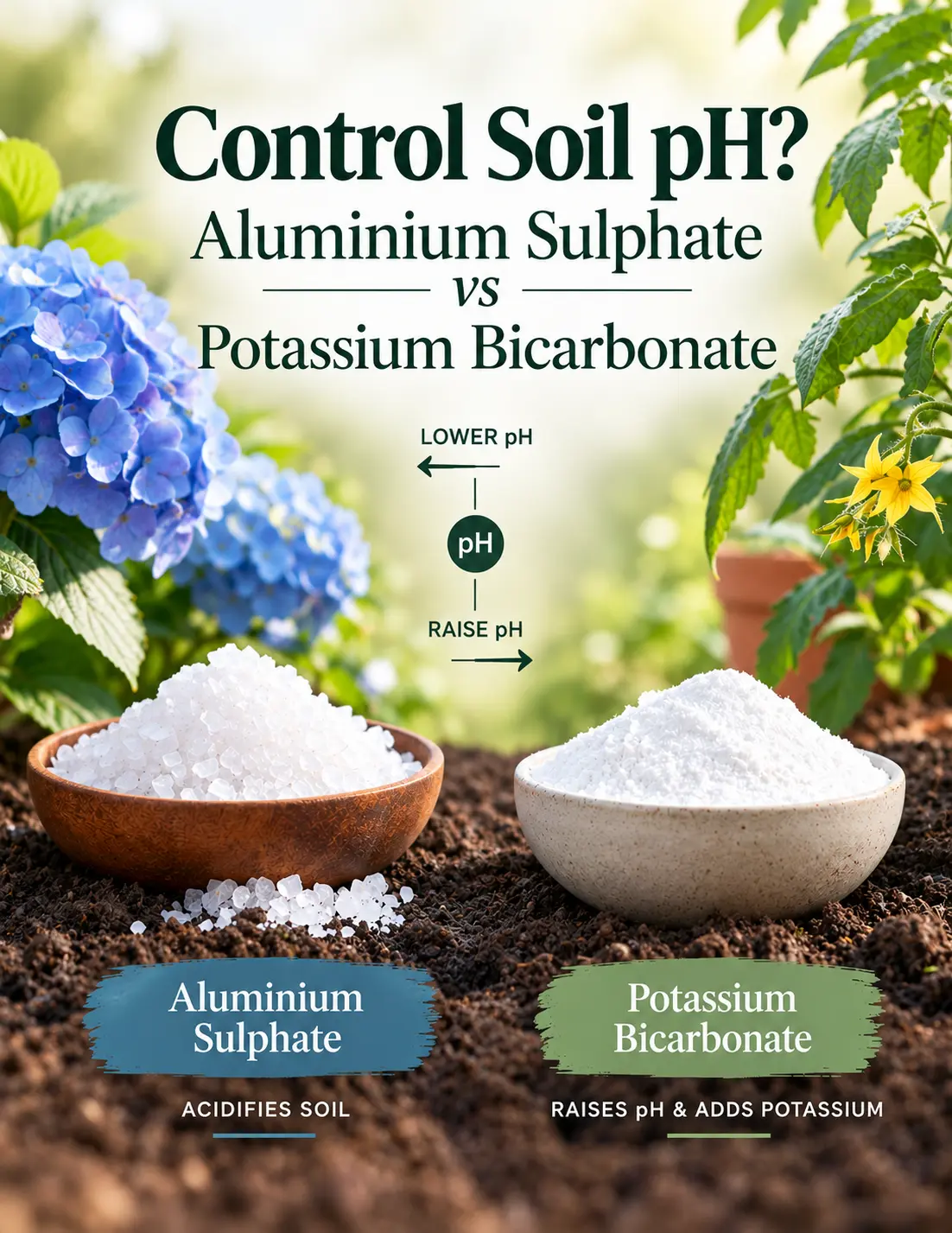
One soluble powder doing three jobs: it feeds potassium, it lifts pH in acidic soils and water, and it dissolves clean enough for foliar spraying. This guide covers rates for each, plus the two mixes to avoid.
Potassium bicarbonate is fully water-soluble and mildly alkaline. Because it carries no sodium and no chloride, it feeds potassium without the salt build-up that comes from repeated use of muriate of potash or sodium-based products — which matters most in pots, recirculating systems and heavier soils.
Which job are you doing?
Feeding potassium
Foliar spray or soil drench for flowering, fruiting, root strength and water regulation. Rates from 1–5 g/L.
Raising pH
Acidic soils, soft rainwater and hydroponic reservoirs. Adds alkalinity as well as potassium.
Foliar conditioning
Raises leaf-surface pH and dries to a fine potassium residue rather than a sodium one.
Measuring without scales
One level metric teaspoon (5 mL) holds roughly 4–5 g. One level Australian tablespoon (20 mL) holds roughly 17–19 g. Kitchen scales are better — powder settles, and a packed spoon can be 30% heavier than a level one.
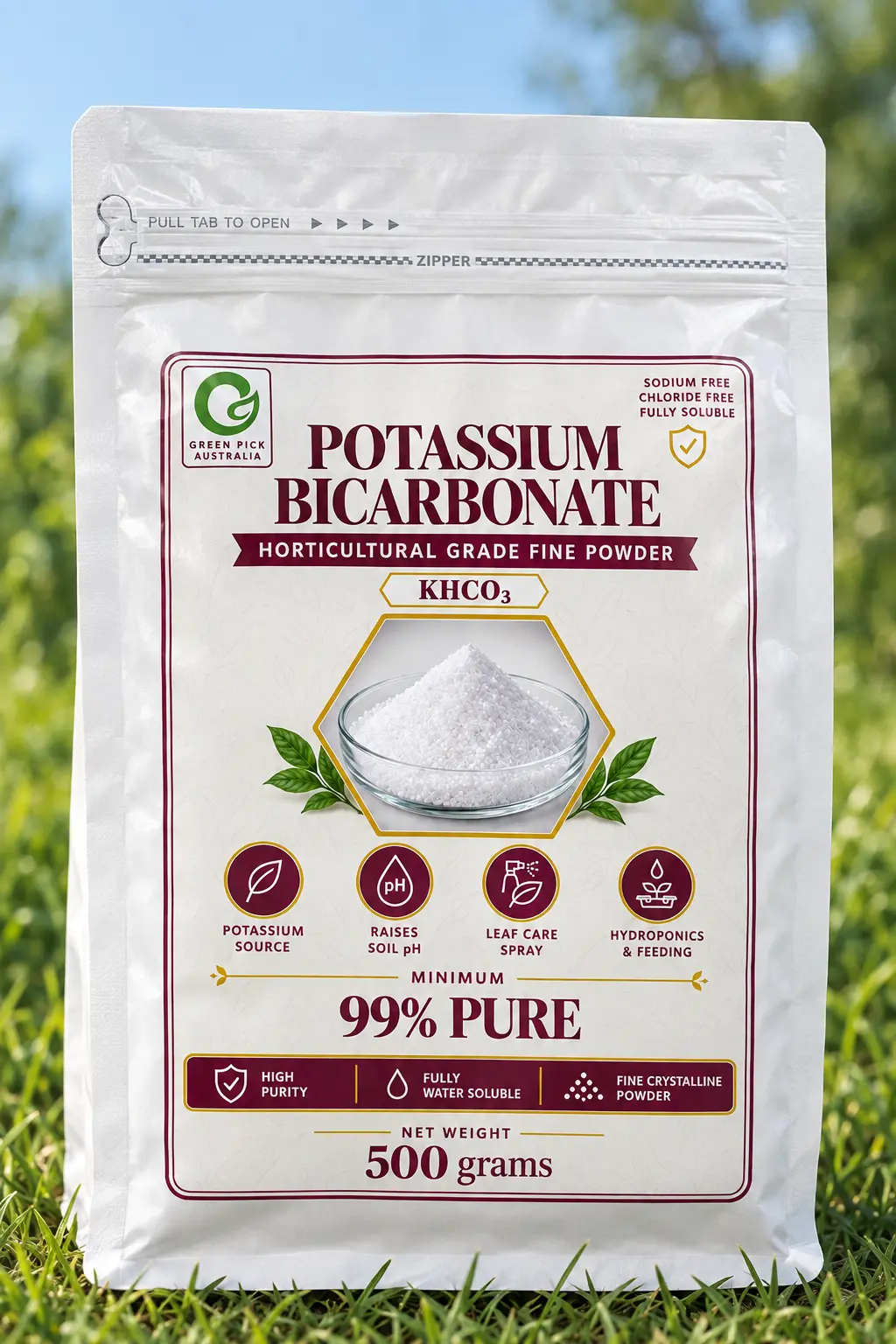
A 500 g pack makes around 165 litres of spray at 3 g/L.
Feeding potassium
Foliar spray
General rate for vegetables, ornamentals and soft-leaved plants
| Plant type | Rate | Frequency |
|---|---|---|
| Seedlings & sensitive foliage | 1–2 g/L | Every 3–4 weeks |
| Vegetables & annuals | 2–3 g/L | Every 2–3 weeks in active growth |
| Roses & ornamentals | 2–4 g/L | Every 2–3 weeks |
| Fruit trees, vines & shrubs | 3–5 g/L | Every 2–4 weeks |
Spray to even coverage on both leaf surfaces, stopping just before runoff. Apply in early morning or late afternoon — never in full sun, above 28°C, or when plants are wilting from dry soil.
Test before you spray the lot
Do not exceed 5 g/L on foliage. Bicarbonate sprays can mark sensitive leaves at higher concentrations. On any new plant variety, spray two or three leaves and wait 48 hours before treating the whole plant.
Soil drench
Apply 1–2 L of solution per square metre, around the root zone
| Area | Product | Water |
|---|---|---|
| 1–2 m² bed | 5–10 g | 2–4 L |
| 5–10 m² | 25–50 g | 10–20 L |
| 20–50 m² | 100–250 g | 40–100 L |
Water the bed first if the soil is dry, then apply the solution evenly around plants rather than against the stems. Repeat every 3–4 weeks through the growing season, adjusting for whatever else you are feeding.
Pots & indoor plants
Enough solution to moisten the mix through, every 3–4 weeks
Potting mixes are usually already slightly acidic and low in buffering, so they respond quickly. Use the lower rate and watch for leaf-tip changes before increasing.
Lawns & turf
Dissolved in 5–10 L of water, applied evenly and watered in
That delivers roughly 7–12 g of K₂O equivalent per 10 m² per application — a maintenance dose, not a corrective one. Apply monthly through the growing season at most. Potassium demand varies widely between couch, buffalo, kikuyu and cool-season turf, so a soil test is worth more than any general rate.
Raising pH and alkalinity
Potassium bicarbonate neutralises acid at roughly 50% of the strength of agricultural lime, weight for weight. That makes it excellent for pots, reservoirs and irrigation water, and uneconomical for correcting the pH of a large garden bed — use lime or dolomite for that and keep this for the jobs below.
Soft or acidic irrigation water
For rainwater or RO water with near-zero alkalinity
Tank and rainwater typically has almost no buffering, so pH swings the moment anything is added to it. This rate adds roughly 15–25 mg/L of alkalinity (as CaCO₃), which is usually enough to hold pH steady without pushing it high.
Potting mix and small beds
Applied as a drench — about 2 L of solution per m² or per 20 L of mix
The effect is real but modest and not permanent — bicarbonate is consumed as it neutralises acid. Re-test with a pH meter or test kit two weeks after application before repeating.
Hydroponics & fertigation
In a recirculating or injected system, potassium bicarbonate does three things at once: it adds potassium, it raises pH, and it adds alkalinity that resists future pH drop. All three need to be accounted for. The table below gives exactly what each rate contributes.
| Rate | In solution | Potassium | Alkalinity (as CaCO₃) |
EC added |
|---|---|---|---|---|
| 0.25 g / 10 L | 25 mg/L | 10 ppm K | ~12 mg/L | ~0.03 mS/cm |
| 0.5 g / 10 L | 50 mg/L | 20 ppm K | ~25 mg/L | ~0.06 mS/cm |
| 1 g / 10 L | 100 mg/L | 39 ppm K | ~50 mg/L | ~0.11 mS/cm |
| 2 g / 10 L | 200 mg/L | 78 ppm K | ~100 mg/L | ~0.22 mS/cm |
Start at 0.25–0.5 g per 10 L. Most nutrient solutions already supply 150–300 ppm potassium, so this is a top-up and a pH tool rather than a primary potassium source. Above about 1 g per 10 L you are adding enough alkalinity to make the reservoir stubborn to bring back down with pH-down acid.
Working method
Never add to a concentrated stock solution
Do not add potassium bicarbonate to Part A or any calcium-containing concentrate. Bicarbonate reacts with concentrated calcium and magnesium to form insoluble carbonates — you will get a white sludge, block your drippers, and lose the calcium from your feed. It goes into the diluted, circulating reservoir only.
Foliar and leaf-surface applications
Potassium bicarbonate is widely used as a foliar spray by rose, grape, cucurbit and fruit-tree growers, and it is the same high-purity KHCO₃ used in commercial horticultural formulations.
Two properties explain why growers choose it over sodium bicarbonate for leaf work. It raises the pH at the leaf surface, and as the spray dries it leaves behind potassium — a plant nutrient — rather than sodium, which is not a nutrient and accumulates in leaf tissue and soil with repeated spraying.
Typical foliar rate, applied to thorough coverage of both leaf surfaces
Coverage matters more than concentration — the material only acts where it lands, and it has no residual carry-over, so even application beats a stronger mix. Repeat applications at 7–14 day intervals are normal in humid conditions. Adding a wetting agent or horticultural oil at label rate improves how the spray spreads and sticks.
Product status
This product is supplied as a horticultural-grade raw material and plant nutrient. It is not registered with the APVMA as an agricultural chemical product, and is not sold for the control of any plant pest or disease. Where you need a registered crop-protection product, choose one carrying an APVMA approval number and follow its label.
What not to mix it with
| Avoid | What happens |
|---|---|
| Acids & pH-down | Fizzes vigorously, releases CO₂ and destroys the product before it reaches the plant. Includes phosphoric, citric and nitric acid. |
| Concentrated calcium or magnesium stocks | Forms an insoluble white carbonate precipitate that blocks nozzles and drippers. |
| Acidic liquid fertilisers | Same reaction as above, usually with visible foaming in the tank. |
| Iron chelates & some micronutrients | Raised pH can drop chelated iron out of solution, showing up later as leaf yellowing. |
If you are unsure about a tank mix, run a jar test: combine both products at final dilution in a clear jar, stand it for 30 minutes and look for fizzing, cloudiness, sludge or separation before mixing a full batch.
Mixing
Storage
Keep the pack tightly sealed in a cool, dry place, away from acids and out of direct sun. Potassium bicarbonate slowly converts to potassium carbonate if it is left damp or hot, so reseal properly and don’t leave it in a shed roof space over summer.
Safety
- Keep out of reach of children and pets.
- Not for human or animal consumption.
- Wear gloves and eye protection when handling the dry powder; avoid breathing dust.
- If in eyes, rinse with running water for 15 minutes. If swallowed, rinse the mouth and drink water, then seek medical advice.
- Wash hands after handling and clean equipment after use.
- Australian Poisons Information Centre: 13 11 26.
Common questions
What does potassium bicarbonate do for plants?
It supplies potassium, one of the three major plant nutrients, at around 39% K by weight. Potassium drives water regulation, enzyme activity, sugar transport, stem strength and fruit development. Because it is also mildly alkaline, it doubles as a way to lift pH in acidic soils and water.
How is it different from sulphate of potash or muriate of potash?
All three supply potassium, but the companion ion differs. Muriate of potash brings chloride, sulphate of potash brings sulphur, and potassium bicarbonate brings bicarbonate — which breaks down to carbon dioxide and water and leaves nothing behind in the soil. It is the only one of the three that raises pH, and the only one with no sodium or chloride at all, which makes it the safer choice for pots, recirculating hydroponics and chloride-sensitive plants.
What rate should I use for a foliar spray?
Start at 2–3 g per litre for vegetables and ornamentals, and 3–5 g per litre for fruit trees, vines and established shrubs. Do not exceed 5 g per litre. Always spot-test a few leaves and wait 48 hours before spraying a whole plant for the first time.
How often can I apply it?
Every 2–4 weeks during active growth for nutrition, adjusted for whatever else you are feeding. For foliar applications in humid weather, 7–14 day intervals are normal. Potassium is needed in large amounts but it is still possible to overdo it — excess potassium competes with calcium and magnesium uptake and can cause deficiency symptoms of those nutrients.
Will it raise my soil pH?
Yes, but modestly. It neutralises acid at roughly half the strength of agricultural lime by weight, and the effect is temporary because the bicarbonate is consumed as it works. It is a good fit for pots, seedling mixes, small beds and water treatment. For correcting the pH of a whole garden bed or lawn, lime or dolomite is far more economical.
Can I use it in hydroponics?
Yes, and it is popular for exactly that — but treat it as a pH and alkalinity tool that happens to add potassium, not as your main potassium source. Start at 0.25–0.5 g per 10 L of made-up solution, add it to the circulating reservoir rather than a concentrate, and re-check pH and EC after 20–30 minutes. Never add it to a calcium-containing stock concentrate, as it will precipitate.
Why does it fizz when I mix it with my other fertiliser?
You have combined it with something acidic. Bicarbonate reacts with acid to release carbon dioxide, which destroys the product before it reaches your plants. Keep it away from pH-down solutions, phosphoric and citric acid, and acidic liquid fertilisers. Apply it as a separate application instead, or jar-test any mix first.
Is it safe around pets, bees and edible crops?
It is a low-toxicity material and is not classified as a dangerous good for transport. Standard sense still applies: keep the pack away from children and pets, don’t spray directly onto foraging bees, and wash produce before eating as you would with any garden input.
Can I use it in a certified organic garden?
Potassium bicarbonate is accepted under many organic standards, but certification applies to specific products rather than to the raw chemical. If you are running a certified operation, check the input against your certifier’s approved list before using it. For home gardening with no certification involved, it is a straightforward mineral input.
How much spray will a 500 g pack make?
About 165 litres at 3 g per litre, or 250 litres at 2 g per litre. For a typical home garden applying a few litres a fortnight, one pack covers a full season comfortably.
How should I store it?
Tightly sealed, cool and dry, away from acids and out of direct sunlight. Moisture and heat slowly convert it to potassium carbonate, so reseal the pack properly and avoid storing it somewhere that gets very hot in summer. Stored well, it keeps for years.