
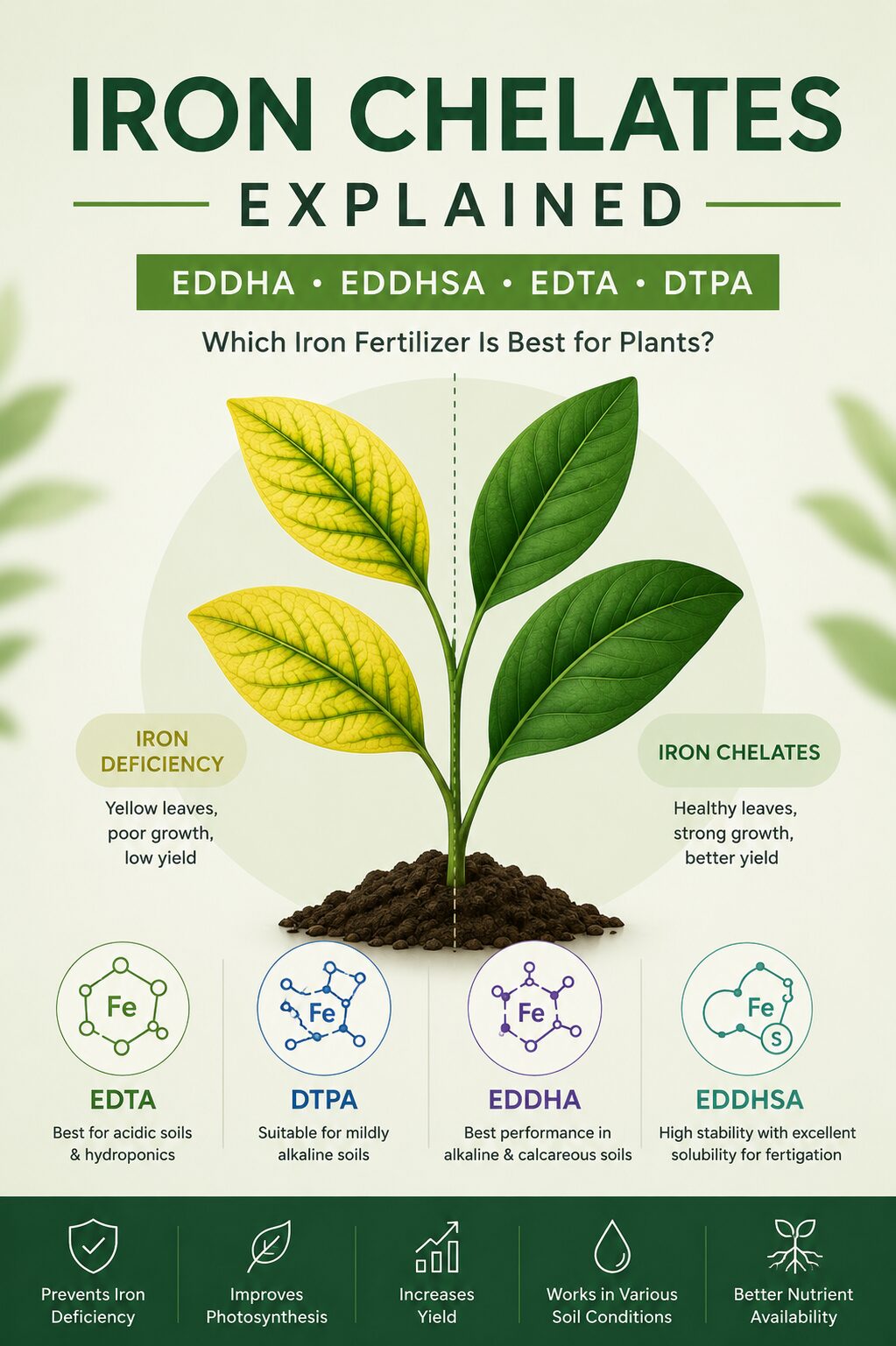

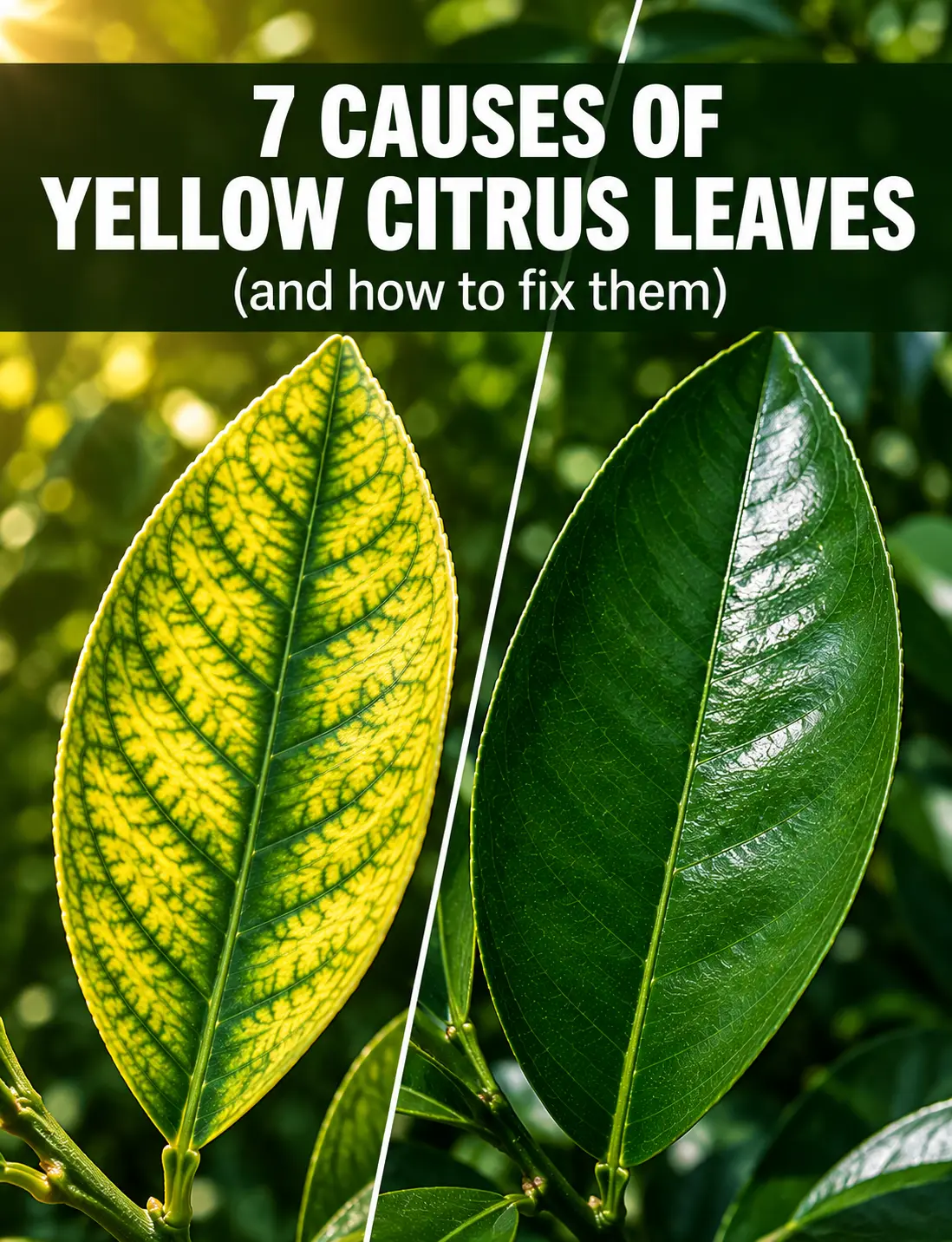
Iron chelates are essential tools for correcting iron deficiency in crops and maintaining healthy plant growth. Iron plays a critical role in chlorophyll production, photosynthesis, and enzyme activity. When iron becomes unavailable, plants develop iron chlorosis, characterized by yellowing young leaves while veins remain green.
Because iron readily reacts with compounds in the soil, especially under alkaline conditions, ordinary iron fertilizers often become unavailable to plants. Iron chelates solve this problem by binding iron and keeping it in a form that plants can absorb.
🧪 What Are Iron Chelates?
A chelate is an organic molecule, that surrounds and protects a metal ion such as iron. This protection prevents iron from reacting with carbonates and hydroxides in the soil, allowing it to remain available for root uptake.
The effectiveness of an iron chelate depends mainly on:
- Stability – how strongly it holds iron.
- Solubility – how easily it dissolves in water and irrigation systems.
- Soil pH tolerance – how well it performs under acidic or alkaline conditions.
Different chelating agents provide different levels of performance, which is why selecting the right product is important.
🌾 The Main Types of Iron Chelates
1️⃣ Fe-EDTA
EDTA is one of the most commonly used iron chelates and is widely found in hydroponic nutrients and greenhouse fertilizers.
Advantages
✅ Affordable
✅ Highly soluble in water
✅ Suitable for hydroponics
✅ Effective in acidic soils
Limitations
❌ Loses effectiveness in alkaline soils
❌ Iron can become unavailable as pH rises
Best suited for: Hydroponics, greenhouse production, and soils with pH below 6.5.
2️⃣ Fe-DTPA
DTPA provides stronger iron binding than EDTA and remains effective across a wider pH range.
Advantages
✅ Better stability than EDTA
✅ Good performance in fertigation systems
✅ Suitable for mildly alkaline soils
Limitations
❌ Less effective in highly calcareous soils
❌ Not ideal for severe iron chlorosis problems
Best suited for: Soils with pH up to about 7.5 and general agricultural applications.
3️⃣ Fe-EDDHA
EDDHA is widely regarded as the benchmark iron chelate for alkaline soils and severe iron deficiency problems.
Growers have relied on EDDHA for decades because it remains stable where other iron fertilizers fail.
Advantages
✅ Exceptional stability
✅ Highly effective in calcareous soils
✅ Excellent correction of iron chlorosis
✅ Extensive research and field history
Limitations
❌ More expensive than EDTA and DTPA
❌ Can dissolve more slowly than some newer chelates
Best suited for: Orchards, vineyards, citrus, and crops grown in alkaline soils.
4️⃣ Fe-EDDHSA
EDDHSA is a newer chelating technology designed to combine high iron stability with excellent water solubility. Read a scientific article HERE.
Like EDDHA, it performs well in alkaline soils, but its molecular structure includes sulfonic acid groups that improve interaction with water.
Advantages
✅ Very high iron stability
✅ Excellent solubility
✅ Fast dissolution in fertigation systems
✅ Good compatibility with liquid fertilizers
✅ Suitable for precision agriculture
Considerations
⚠ Long-term field data is still more limited than for EDDHA
⚠ Product quality can vary between manufacturers
Best suited for: Fertigation systems, liquid fertilizer programs, specialty crops, and modern irrigation systems.
🔬 Why Stability Matters
The primary purpose of a chelate is to protect iron from becoming unavailable.
In alkaline soils, iron quickly reacts with calcium and carbonates, forming compounds that plants cannot absorb. This is why many growers apply iron fertilizers but still observe chlorosis symptoms.
The stronger the bond between iron and the chelating agent, the longer the nutrient remains available.
In general:
- EDTA offers moderate protection.
- DTPA offers higher protection.
- EDDHA and EDDHSA provide the highest levels of protection.
For growers dealing with persistent iron deficiency in alkaline soils, this difference can significantly affect crop performance.
⚠️ Not All EDDHA Products Are Equal
When evaluating EDDHA products, growers should look beyond total iron percentage.
One of the most important indicators of quality is the ortho-ortho (o-o) isomer content.
Research and field experience have shown that the ortho-ortho isomer forms the most stable iron complex. Higher concentrations generally provide:
✅ Better iron stability
✅ Longer persistence in soil
✅ Improved chlorosis correction
✅ More consistent field performance
Professional growers often compare:
- Total iron content
- Water-soluble iron
- Chelated iron percentage
- Ortho-ortho isomer percentage
- Product solubility
- Compatibility with irrigation systems
A high-quality chelate can often outperform a lower-quality product even when the total iron percentage appears similar.
📊 Iron Chelate Comparison
| Property | Fe-EDTA | Fe-DTPA | Fe-EDDHA | Fe-EDDHSA |
|---|---|---|---|---|
| Acidic Soils | Excellent | Excellent | Excellent | Excellent |
| Alkaline Soils | Poor | Moderate | Excellent | Excellent |
| Iron Stability | Moderate | High | Very High | Very High |
| Water Solubility | Excellent | Good | Very Good | Excellent |
| Fertigation Compatibility | Good | Good | Very Good | Excellent |
| Chlorosis Correction | Good | Good | Excellent | Excellent |
| Research History | Extensive | Extensive | Extensive | Growing |
🌿 Common Agricultural Uses
Iron chelates are widely used across many cropping systems, including:
🍇 Vineyards
🍎 Fruit orchards
🍋 Citrus
🥬 Vegetables
🌱 Hydroponics
🌾 Broadacre crops
🌳 Tree crops
🌺 Ornamentals
🏡 Turf and landscaping
🚜 Fertigation systems
The choice of chelate depends largely on soil pH, irrigation practices, and the severity of iron deficiency.
🚜 EDDHA vs EDDHSA: Which Is Better?
This is a common question among growers.
EDDHA remains the most established and researched iron chelate for alkaline soils. Its long history of successful field performance makes it a trusted option worldwide.
EDDHSA, however, has gained attention because of its excellent solubility and ease of handling. For growers using liquid fertilizer programs, stock tanks, and fertigation systems, these characteristics can offer practical advantages.
Rather than viewing one as a replacement for the other, many growers see them as solutions designed for slightly different priorities:
- EDDHA: Maximum proven performance in alkaline soils.
- EDDHSA: High performance with enhanced solubility and handling characteristics.
The best choice often depends on the production system and application method.
⭐ Final Thoughts
Iron deficiency can significantly reduce crop health, yield, and quality, particularly in alkaline and calcareous soils. Iron chelates help prevent these problems by keeping iron available for plant uptake.
EDTA and DTPA remain useful options for acidic and mildly alkaline conditions, which means that for challenging soils and persistent chlorosis, EDDHA continues to be the industry standard. Meanwhile, EDDHSA is emerging as an attractive alternative for growers who value both strong iron protection and excellent water solubility.
Understanding the differences between these chelates allows growers to select the most suitable product for their soil conditions, irrigation systems, and crop requirements, ultimately supporting healthier plants and better yields.
One thought on “Iron Chelates Explained: EDDHA vs EDDHSA, EDTA & DTPA”